
នៅថ្នាក់ទី \(10\) យើងបានសិក្សារួចមកហើយពីអនុគមន៍ពហុធា ដូចជា \(y = au\), \(y = au^2\), \(y = au^3 \ldots\) ដែលអនុវត្តក្នុងចលនាស្មើឬទន្លាក់សេរី ។ នៅថ្នាក់ទី \(11\) នេះ យើងនឹងសិក្សាពីចលនាមួយទៀត ដូចចលនារំយោលនៃប៉ោលនាឡិកាមួយជាចលនាខួប ។ ចលនានេះគេសិក្សានៅក្នុងអនុគមន៍ត្រីកោណមាត្រជាអនុគមន៍ខួប ដូចជា អនុគមន៍ស៊ីនុស អនុគមន៍កូស៊ីនុស និងអនុគមន៍តង់សង់ ។
បំប្លែងមុំពីដឺក្រេទៅរ៉ាដ្យង់និងពីរ៉ាដ្យង់ទៅដឺក្រេ
ប្រើលក្ខណៈមុំផ្តុំក្នុងការគណនាអនុគមន៍ត្រីកោណមាត្រ
សង់ក្រាបនៃអនុគមន៍ត្រីកោណមាត្រ ។
រង្វាស់មុំ
ការកំណត់មុំមានទិសដៅ
ក្នុងរង្វង់ត្រីកោណមាត្រ គេប្រើវ៉ិចទ័រ \(\overrightarrow{OP_0}\) និង \(\overrightarrow{OP}\) មកកំណត់មុំ ។
\(\overrightarrow{OP_0}\) ជាវ៉ិចទ័រនឹងឋិតនៅផ្នែកវិជ្ជមាននៃអ័ក្ស \(\overrightarrow{Ox}\) ហៅថា វ៉ិចទ័រគល់ ។ \(\overrightarrow{OP}\) ជាវ៉ិចទ័រចល័តជុំវិញគល់ \(O\) ហៅថា វ៉ិចទ័រចុង ។
វ៉ិចទ័រ \(\overrightarrow{OP_0}\) និង \(\overrightarrow{OP}\) បង្កើតបានមុំតាមករណីដូចខាងក្រោម ៖
ក្នុងករណីវ៉ិចទ័រ \(\overrightarrow{OP}\) វិលច្រាសនឹងទិសដៅនៃទ្រនិចនាឡិកា មុំដែលបង្កើតបានជាមុំវិជ្ជមាន ។ មុំ \((\overrightarrow{OP_0}, \overrightarrow{OP}) = 30^\circ\) (រូប ក) ។
ក្នុងករណីវ៉ិចទ័រ \(\overrightarrow{OP}\) វិលស្របនឹងទិសដៅនៃទ្រនិចនាឡិកា មុំដែលបង្កើតបានជាមុំអវិជ្ជមាន ។ មុំ \((\overrightarrow{OP_0}, \overrightarrow{OP}) = -30^\circ\) (រូប ខ) ។
%22 stroke-opacity=%221%22 stroke-miterlimit=%2210%22 d=%22M -40.81 -0.00 L 41.37 -0.00 %22 transform=%22matrix(0.99, 0, 0, -0.99, 43.94, 59.42)%22/%3E%3Cpath fill-rule=%22nonzero%22 fill=%22rgb(0%25, 0%25, 0%25)%22 fill-opacity=%221%22 d=%22M 87.25 59.42 L 84.07 57.83 L 85.26 59.42 L 84.07 61.01 %22/%3E%3Cg fill=%22rgb(0%25, 0%25, 0%25)%22 fill-opacity=%221%22%3E%3Cuse xlink:href=%22%23glyph-0-0%22 x=%2290.77%22 y=%2261.56%22/%3E%3C/g%3E%3Cpath fill=%22none%22 stroke-width=%220.39%22 stroke-linecap=%22butt%22 stroke-linejoin=%22miter%22 stroke=%22rgb(0%25, 0%25, 0%25)%22 stroke-opacity=%221%22 stroke-miterlimit=%2210%22 d=%22M -0.00 -40.81 L -0.00 41.37 %22 transform=%22matrix(0.99, 0, 0, -0.99, 43.94, 59.42)%22/%3E%3Cpath fill-rule=%22nonzero%22 fill=%22rgb(0%25, 0%25, 0%25)%22 fill-opacity=%221%22 d=%22M 43.94 16.11 L 42.35 19.29 L 43.94 18.10 L 45.53 19.29 %22/%3E%3Cg fill=%22rgb(0%25, 0%25, 0%25)%22 fill-opacity=%221%22%3E%3Cuse xlink:href=%22%23glyph-0-1%22 x=%2241.32%22 y=%2210.66%22/%3E%3C/g%3E%3Cpath fill=%22none%22 stroke-width=%220.79%22 stroke-linecap=%22butt%22 stroke-linejoin=%22miter%22 stroke=%22rgb(0%25, 0%25, 69.99%25)%22 stroke-opacity=%221%22 stroke-miterlimit=%2210%22 d=%22M 30.61 -0.00 C 30.61 16.90 16.90 30.61 -0.00 30.61 C -16.90 30.61 -30.61 16.90 -30.61 -0.00 C -30.61 -16.90 -16.90 -30.61 -0.00 -30.61 C 16.90 -30.61 30.61 -16.90 30.61 -0.00 Z M 30.61 -0.00 %22 transform=%22matrix(0.99, 0, 0, -0.99, 43.94, 59.42)%22/%3E%3Cpath fill=%22none%22 stroke-width=%220.79%22 stroke-linecap=%22butt%22 stroke-linejoin=%22miter%22 stroke=%22rgb(0%25, 0%25, 0%25)%22 stroke-opacity=%221%22 stroke-miterlimit=%2210%22 d=%22M -0.00 -0.00 L 24.27 14.01 %22 transform=%22matrix(0.99, 0, 0, -0.99, 43.94, 59.42)%22/%3E%3Cpath fill-rule=%22nonzero%22 fill=%22rgb(0%25, 0%25, 0%25)%22 fill-opacity=%221%22 d=%22M 70.42 44.14 L 65.80 44.41 L 68.18 45.43 L 67.87 48 %22/%3E%3Cg fill=%22rgb(0%25, 0%25, 0%25)%22 fill-opacity=%221%22%3E%3Cuse xlink:href=%22%23glyph-0-2%22 x=%2274.13%22 y=%2240.42%22/%3E%3C/g%3E%3Cg fill=%22rgb(0%25, 0%25, 0%25)%22 fill-opacity=%221%22%3E%3Cuse xlink:href=%22%23glyph-0-2%22 x=%2278.03%22 y=%2269.73%22/%3E%3C/g%3E%3Cg fill=%22rgb(0%25, 0%25, 0%25)%22 fill-opacity=%221%22%3E%3Cuse xlink:href=%22%23glyph-1-0%22 x=%2284.42%22 y=%2271.23%22/%3E%3C/g%3E%3Cg fill=%22rgb(0%25, 0%25, 0%25)%22 fill-opacity=%221%22%3E%3Cuse xlink:href=%22%23glyph-2-0%22 x=%2235.45%22 y=%2269.35%22/%3E%3C/g%3E%3Cpath fill=%22none%22 stroke-width=%220.39%22 stroke-linecap=%22butt%22 stroke-linejoin=%22miter%22 stroke=%22rgb(0%25, 0%25, 0%25)%22 stroke-opacity=%221%22 stroke-miterlimit=%2210%22 d=%22M 15.30 -0.00 C 15.30 2.68 14.60 5.32 14.25 5.92 %22 transform=%22matrix(0.99, 0, 0, -0.99, 43.94, 59.42)%22/%3E%3Cpath fill-rule=%22nonzero%22 fill=%22rgb(0%25, 0%25, 0%25)%22 fill-opacity=%221%22 d=%22M 57.18 51.78 L 57.39 55.33 L 58.17 53.50 L 60.15 53.74 %22/%3E%3Cg fill=%22rgb(0%25, 0%25, 0%25)%22 fill-opacity=%221%22%3E%3Cuse xlink:href=%22%23glyph-2-1%22 x=%2262.22%22 y=%2258.89%22/%3E%3Cuse xlink:href=%22%23glyph-2-0%22 x=%2267.20%22 y=%2258.89%22/%3E%3C/g%3E%3Cg fill=%22rgb(0%25, 0%25, 0%25)%22 fill-opacity=%221%22%3E%3Cuse xlink:href=%22%23glyph-3-0%22 x=%2272.17%22 y=%2255.28%22/%3E%3C/g%3E%3Cg fill=%22rgb(0%25, 0%25, 0%25)%22 fill-opacity=%221%22%3E%3Cuse xlink:href=%22%23glyph-4-0%22 x=%2234.10%22 y=%22112.44%22/%3E%3Cuse xlink:href=%22%23glyph-4-1%22 x=%2237.26%22 y=%22112.44%22/%3E%3Cuse xlink:href=%22%23glyph-4-2%22 x=%2237.26%22 y=%22112.44%22/%3E%3C/g%3E%3Cg fill=%22rgb(0%25, 0%25, 0%25)%22 fill-opacity=%221%22%3E%3Cuse xlink:href=%22%23glyph-4-3%22 x=%2246.97%22 y=%22112.44%22/%3E%3C/g%3E%3Cpath fill=%22none%22 stroke-width=%220.39%22 stroke-linecap=%22butt%22 stroke-linejoin=%22miter%22 stroke=%22rgb(0%25, 0%25, 0%25)%22 stroke-opacity=%221%22 stroke-miterlimit=%2210%22 d=%22M 73.98 -0.00 L 156.18 -0.00 %22 transform=%22matrix(0.99, 0, 0, -0.99, 43.94, 59.42)%22/%3E%3Cpath fill-rule=%22nonzero%22 fill=%22rgb(0%25, 0%25, 0%25)%22 fill-opacity=%221%22 d=%22M 201.90 59.42 L 198.71 57.83 L 199.91 59.42 L 198.71 61.01 %22/%3E%3Cg fill=%22rgb(0%25, 0%25, 0%25)%22 fill-opacity=%221%22%3E%3Cuse xlink:href=%22%23glyph-0-0%22 x=%22205.41%22 y=%2261.56%22/%3E%3C/g%3E%3Cpath fill=%22none%22 stroke-width=%220.39%22 stroke-linecap=%22butt%22 stroke-linejoin=%22miter%22 stroke=%22rgb(0%25, 0%25, 0%25)%22 stroke-opacity=%221%22 stroke-miterlimit=%2210%22 d=%22M 114.80 -40.81 L 114.80 41.37 %22 transform=%22matrix(0.99, 0, 0, -0.99, 43.94, 59.42)%22/%3E%3Cpath fill-rule=%22nonzero%22 fill=%22rgb(0%25, 0%25, 0%25)%22 fill-opacity=%221%22 d=%22M 158.59 16.11 L 157 19.29 L 158.59 18.10 L 160.18 19.29 %22/%3E%3Cg fill=%22rgb(0%25, 0%25, 0%25)%22 fill-opacity=%221%22%3E%3Cuse xlink:href=%22%23glyph-0-1%22 x=%22155.97%22 y=%2210.66%22/%3E%3C/g%3E%3Cpath fill=%22none%22 stroke-width=%220.79%22 stroke-linecap=%22butt%22 stroke-linejoin=%22miter%22 stroke=%22rgb(0%25, 0%25, 69.99%25)%22 stroke-opacity=%221%22 stroke-miterlimit=%2210%22 d=%22M 145.41 -0.00 C 145.41 16.90 131.71 30.61 114.80 30.61 C 97.89 30.61 84.18 16.90 84.18 -0.00 C 84.18 -16.90 97.89 -30.61 114.80 -30.61 C 131.71 -30.61 145.41 -16.90 145.41 -0.00 Z M 145.41 -0.00 %22 transform=%22matrix(0.99, 0, 0, -0.99, 43.94, 59.42)%22/%3E%3Cpath fill=%22none%22 stroke-width=%220.79%22 stroke-linecap=%22butt%22 stroke-linejoin=%22miter%22 stroke=%22rgb(0%25, 0%25, 0%25)%22 stroke-opacity=%221%22 stroke-miterlimit=%2210%22 d=%22M 114.80 -0.00 L 139.07 -14.01 %22 transform=%22matrix(0.99, 0, 0, -0.99, 43.94, 59.42)%22/%3E%3Cpath fill-rule=%22nonzero%22 fill=%22rgb(0%25, 0%25, 0%25)%22 fill-opacity=%221%22 d=%22M 185.07 74.71 L 182.51 70.85 L 182.82 73.41 L 180.44 74.43 %22/%3E%3Cg fill=%22rgb(0%25, 0%25, 0%25)%22 fill-opacity=%221%22%3E%3Cuse xlink:href=%22%23glyph-0-2%22 x=%22188.78%22 y=%2285.22%22/%3E%3C/g%3E%3Cg fill=%22rgb(0%25, 0%25, 0%25)%22 fill-opacity=%221%22%3E%3Cuse xlink:href=%22%23glyph-0-2%22 x=%22192.67%22 y=%2254.41%22/%3E%3C/g%3E%3Cg fill=%22rgb(0%25, 0%25, 0%25)%22 fill-opacity=%221%22%3E%3Cuse xlink:href=%22%23glyph-1-0%22 x=%22199.06%22 y=%2255.91%22/%3E%3C/g%3E%3Cg fill=%22rgb(0%25, 0%25, 0%25)%22 fill-opacity=%221%22%3E%3Cuse xlink:href=%22%23glyph-2-0%22 x=%22150.10%22 y=%2255.91%22/%3E%3C/g%3E%3Cpath fill=%22none%22 stroke-width=%220.39%22 stroke-linecap=%22butt%22 stroke-linejoin=%22miter%22 stroke=%22rgb(0%25, 0%25, 0%25)%22 stroke-opacity=%221%22 stroke-miterlimit=%2210%22 d=%22M 130.11 -0.00 C 130.11 -2.68 129.40 -5.32 129.05 -5.92 %22 transform=%22matrix(0.99, 0, 0, -0.99, 43.94, 59.42)%22/%3E%3Cpath fill-rule=%22nonzero%22 fill=%22rgb(0%25, 0%25, 0%25)%22 fill-opacity=%221%22 d=%22M 171.83 67.06 L 174.80 65.10 L 172.82 65.34 L 172.04 63.51 %22/%3E%3Cg fill=%22rgb(0%25, 0%25, 0%25)%22 fill-opacity=%221%22%3E%3Cuse xlink:href=%22%23glyph-5-0%22 x=%22176.87%22 y=%2266.39%22/%3E%3C/g%3E%3Cg fill=%22rgb(0%25, 0%25, 0%25)%22 fill-opacity=%221%22%3E%3Cuse xlink:href=%22%23glyph-2-1%22 x=%22184.61%22 y=%2266.39%22/%3E%3Cuse xlink:href=%22%23glyph-2-0%22 x=%22189.58%22 y=%2266.39%22/%3E%3C/g%3E%3Cg fill=%22rgb(0%25, 0%25, 0%25)%22 fill-opacity=%221%22%3E%3Cuse xlink:href=%22%23glyph-3-0%22 x=%22194.55%22 y=%2262.78%22/%3E%3C/g%3E%3Cg fill=%22rgb(0%25, 0%25, 0%25)%22 fill-opacity=%221%22%3E%3Cuse xlink:href=%22%23glyph-4-0%22 x=%22148.75%22 y=%22112.44%22/%3E%3Cuse xlink:href=%22%23glyph-4-1%22 x=%22151.90%22 y=%22112.44%22/%3E%3Cuse xlink:href=%22%23glyph-4-2%22 x=%22151.90%22 y=%22112.44%22/%3E%3C/g%3E%3Cg fill=%22rgb(0%25, 0%25, 0%25)%22 fill-opacity=%221%22%3E%3Cuse xlink:href=%22%23glyph-4-4%22 x=%22161.61%22 y=%22112.44%22/%3E%3C/g%3E%3C/svg%3E%0A)
តាមទិសដៅវិជ្ជមានបើ \(\overrightarrow{OP}\) វិលបានមួយជុំពេញនៃរង្វង់នោះ គេនឹងបានមុំ \(360^\circ\) ហើយរង្វាស់មុំនឹងកើនជា \(2\) ដង ជា \(3\) ដង ទៅតាមចំនួនជុំនៃការវិលនេះ ។
%22 stroke-opacity=%221%22 stroke-miterlimit=%2210%22 d=%22M -36.14 0.00 L 36.27 0.00 %22 transform=%22matrix(0.99, 0, 0, -0.99, 39.45, 54.18)%22/%3E%3Cpath fill-rule=%22nonzero%22 fill=%22rgb(0%25, 0%25, 0%25)%22 fill-opacity=%221%22 d=%22M 77.62 54.17 L 74.44 52.58 L 75.64 54.17 L 74.44 55.76 %22/%3E%3Cg fill=%22rgb(0%25, 0%25, 0%25)%22 fill-opacity=%221%22%3E%3Cuse xlink:href=%22%23glyph-0-0%22 x=%2281.13%22 y=%2256.31%22/%3E%3C/g%3E%3Cpath fill=%22none%22 stroke-width=%220.39%22 stroke-linecap=%22butt%22 stroke-linejoin=%22miter%22 stroke=%22rgb(0%25, 0%25, 0%25)%22 stroke-opacity=%221%22 stroke-miterlimit=%2210%22 d=%22M 0.00 -36.14 L 0.00 36.27 %22 transform=%22matrix(0.99, 0, 0, -0.99, 39.45, 54.18)%22/%3E%3Cpath fill-rule=%22nonzero%22 fill=%22rgb(0%25, 0%25, 0%25)%22 fill-opacity=%221%22 d=%22M 39.46 16.01 L 37.87 19.19 L 39.46 18 L 41.05 19.19 %22/%3E%3Cg fill=%22rgb(0%25, 0%25, 0%25)%22 fill-opacity=%221%22%3E%3Cuse xlink:href=%22%23glyph-0-1%22 x=%2236.84%22 y=%2210.56%22/%3E%3C/g%3E%3Cg clip-path=%22url(%23clip-0)%22%3E%3Cpath fill=%22none%22 stroke-width=%220.79%22 stroke-linecap=%22butt%22 stroke-linejoin=%22miter%22 stroke=%22rgb(0%25, 0%25, 69.99%25)%22 stroke-opacity=%221%22 stroke-miterlimit=%2210%22 d=%22M 27.64 0.00 C 27.64 15.26 15.26 27.63 0.00 27.63 C -15.26 27.63 -27.63 15.26 -27.63 0.00 C -27.63 -15.26 -15.26 -27.63 0.00 -27.63 C 15.26 -27.63 27.64 -15.26 27.64 0.00 Z M 27.64 0.00 %22 transform=%22matrix(0.99, 0, 0, -0.99, 39.45, 54.18)%22/%3E%3C/g%3E%3Cg fill=%22rgb(0%25, 0%25, 0%25)%22 fill-opacity=%221%22%3E%3Cuse xlink:href=%22%23glyph-1-0%22 x=%2215.86%22 y=%22104.95%22/%3E%3C/g%3E%3Cg fill=%22rgb(0%25, 0%25, 0%25)%22 fill-opacity=%221%22%3E%3Cuse xlink:href=%22%23glyph-1-1%22 x=%2223.38%22 y=%22104.95%22/%3E%3C/g%3E%3Cg fill=%22rgb(0%25, 0%25, 0%25)%22 fill-opacity=%221%22%3E%3Cuse xlink:href=%22%23glyph-1-2%22 x=%2229.95%22 y=%22104.95%22/%3E%3C/g%3E%3Cg fill=%22rgb(0%25, 0%25, 0%25)%22 fill-opacity=%221%22%3E%3Cuse xlink:href=%22%23glyph-1-3%22 x=%2230.18%22 y=%22103.98%22/%3E%3C/g%3E%3Cg fill=%22rgb(0%25, 0%25, 0%25)%22 fill-opacity=%221%22%3E%3Cuse xlink:href=%22%23glyph-2-0%22 x=%2233.09%22 y=%22104.95%22/%3E%3C/g%3E%3Cg fill=%22rgb(0%25, 0%25, 0%25)%22 fill-opacity=%221%22%3E%3Cuse xlink:href=%22%23glyph-2-1%22 x=%2243.56%22 y=%22104.95%22/%3E%3Cuse xlink:href=%22%23glyph-2-2%22 x=%2248.53%22 y=%22104.95%22/%3E%3Cuse xlink:href=%22%23glyph-2-3%22 x=%2253.50%22 y=%22104.95%22/%3E%3C/g%3E%3Cg fill=%22rgb(0%25, 0%25, 0%25)%22 fill-opacity=%221%22%3E%3Cuse xlink:href=%22%23glyph-3-0%22 x=%2258.48%22 y=%22101.34%22/%3E%3C/g%3E%3Cpath fill=%22none%22 stroke-width=%220.39%22 stroke-linecap=%22butt%22 stroke-linejoin=%22miter%22 stroke=%22rgb(0%25, 0%25, 0%25)%22 stroke-opacity=%221%22 stroke-miterlimit=%2210%22 d=%22M 61.65 0.00 L 134.07 0.00 %22 transform=%22matrix(0.99, 0, 0, -0.99, 39.45, 54.18)%22/%3E%3Cpath fill-rule=%22nonzero%22 fill=%22rgb(0%25, 0%25, 0%25)%22 fill-opacity=%221%22 d=%22M 175.16 54.17 L 171.98 52.58 L 173.18 54.17 L 171.98 55.76 %22/%3E%3Cg fill=%22rgb(0%25, 0%25, 0%25)%22 fill-opacity=%221%22%3E%3Cuse xlink:href=%22%23glyph-0-0%22 x=%22178.68%22 y=%2256.31%22/%3E%3C/g%3E%3Cpath fill=%22none%22 stroke-width=%220.39%22 stroke-linecap=%22butt%22 stroke-linejoin=%22miter%22 stroke=%22rgb(0%25, 0%25, 0%25)%22 stroke-opacity=%221%22 stroke-miterlimit=%2210%22 d=%22M 97.79 -36.14 L 97.79 36.27 %22 transform=%22matrix(0.99, 0, 0, -0.99, 39.45, 54.18)%22/%3E%3Cpath fill-rule=%22nonzero%22 fill=%22rgb(0%25, 0%25, 0%25)%22 fill-opacity=%221%22 d=%22M 137 16.01 L 135.41 19.19 L 137 18 L 138.58 19.19 %22/%3E%3Cg fill=%22rgb(0%25, 0%25, 0%25)%22 fill-opacity=%221%22%3E%3Cuse xlink:href=%22%23glyph-0-1%22 x=%22134.38%22 y=%2210.56%22/%3E%3C/g%3E%3Cpath fill=%22none%22 stroke-width=%220.79%22 stroke-linecap=%22butt%22 stroke-linejoin=%22miter%22 stroke=%22rgb(0%25, 0%25, 69.99%25)%22 stroke-opacity=%221%22 stroke-miterlimit=%2210%22 d=%22M 125.43 0.00 C 125.43 15.26 113.06 27.63 97.79 27.63 C 82.53 27.63 70.15 15.26 70.15 0.00 C 70.15 -15.26 82.53 -27.63 97.79 -27.63 C 113.06 -27.63 125.43 -15.26 125.43 0.00 Z M 125.43 0.00 %22 transform=%22matrix(0.99, 0, 0, -0.99, 39.45, 54.18)%22/%3E%3Cg fill=%22rgb(0%25, 0%25, 0%25)%22 fill-opacity=%221%22%3E%3Cuse xlink:href=%22%23glyph-1-4%22 x=%22104.41%22 y=%22104.95%22/%3E%3C/g%3E%3Cg fill=%22rgb(0%25, 0%25, 0%25)%22 fill-opacity=%221%22%3E%3Cuse xlink:href=%22%23glyph-1-1%22 x=%22112.79%22 y=%22104.95%22/%3E%3C/g%3E%3Cg fill=%22rgb(0%25, 0%25, 0%25)%22 fill-opacity=%221%22%3E%3Cuse xlink:href=%22%23glyph-1-2%22 x=%22119.36%22 y=%22104.95%22/%3E%3C/g%3E%3Cg fill=%22rgb(0%25, 0%25, 0%25)%22 fill-opacity=%221%22%3E%3Cuse xlink:href=%22%23glyph-1-3%22 x=%22119.59%22 y=%22103.98%22/%3E%3C/g%3E%3Cg fill=%22rgb(0%25, 0%25, 0%25)%22 fill-opacity=%221%22%3E%3Cuse xlink:href=%22%23glyph-2-0%22 x=%22122.50%22 y=%22104.95%22/%3E%3C/g%3E%3Cg fill=%22rgb(0%25, 0%25, 0%25)%22 fill-opacity=%221%22%3E%3Cuse xlink:href=%22%23glyph-2-4%22 x=%22132.98%22 y=%22104.95%22/%3E%3C/g%3E%3Cg fill=%22rgb(0%25, 0%25, 0%25)%22 fill-opacity=%221%22%3E%3Cuse xlink:href=%22%23glyph-4-0%22 x=%22140.17%22 y=%22104.95%22/%3E%3C/g%3E%3Cg fill=%22rgb(0%25, 0%25, 0%25)%22 fill-opacity=%221%22%3E%3Cuse xlink:href=%22%23glyph-2-1%22 x=%22150.11%22 y=%22104.95%22/%3E%3Cuse xlink:href=%22%23glyph-2-2%22 x=%22155.07%22 y=%22104.95%22/%3E%3Cuse xlink:href=%22%23glyph-2-3%22 x=%22160.04%22 y=%22104.95%22/%3E%3C/g%3E%3Cg fill=%22rgb(0%25, 0%25, 0%25)%22 fill-opacity=%221%22%3E%3Cuse xlink:href=%22%23glyph-3-0%22 x=%22165.01%22 y=%22101.34%22/%3E%3C/g%3E%3Cpath fill=%22none%22 stroke-width=%220.39%22 stroke-linecap=%22butt%22 stroke-linejoin=%22miter%22 stroke=%22rgb(0%25, 0%25, 0%25)%22 stroke-opacity=%221%22 stroke-miterlimit=%2210%22 d=%22M 159.45 0.00 L 231.86 0.00 %22 transform=%22matrix(0.99, 0, 0, -0.99, 39.45, 54.18)%22/%3E%3Cpath fill-rule=%22nonzero%22 fill=%22rgb(0%25, 0%25, 0%25)%22 fill-opacity=%221%22 d=%22M 272.71 54.17 L 269.53 52.58 L 270.72 54.17 L 269.53 55.76 %22/%3E%3Cg fill=%22rgb(0%25, 0%25, 0%25)%22 fill-opacity=%221%22%3E%3Cuse xlink:href=%22%23glyph-0-0%22 x=%22276.22%22 y=%2256.31%22/%3E%3C/g%3E%3Cpath fill=%22none%22 stroke-width=%220.39%22 stroke-linecap=%22butt%22 stroke-linejoin=%22miter%22 stroke=%22rgb(0%25, 0%25, 0%25)%22 stroke-opacity=%221%22 stroke-miterlimit=%2210%22 d=%22M 195.59 -36.14 L 195.59 36.27 %22 transform=%22matrix(0.99, 0, 0, -0.99, 39.45, 54.18)%22/%3E%3Cpath fill-rule=%22nonzero%22 fill=%22rgb(0%25, 0%25, 0%25)%22 fill-opacity=%221%22 d=%22M 234.54 16.01 L 232.95 19.19 L 234.54 18 L 236.13 19.19 %22/%3E%3Cg fill=%22rgb(0%25, 0%25, 0%25)%22 fill-opacity=%221%22%3E%3Cuse xlink:href=%22%23glyph-0-1%22 x=%22231.92%22 y=%2210.56%22/%3E%3C/g%3E%3Cpath fill=%22none%22 stroke-width=%220.79%22 stroke-linecap=%22butt%22 stroke-linejoin=%22miter%22 stroke=%22rgb(0%25, 0%25, 69.99%25)%22 stroke-opacity=%221%22 stroke-miterlimit=%2210%22 d=%22M 223.23 0.00 C 223.23 15.26 210.85 27.63 195.59 27.63 C 180.32 27.63 167.95 15.26 167.95 0.00 C 167.95 -15.26 180.32 -27.63 195.59 -27.63 C 210.85 -27.63 223.23 -15.26 223.23 0.00 Z M 223.23 0.00 %22 transform=%22matrix(0.99, 0, 0, -0.99, 39.45, 54.18)%22/%3E%3Cg fill=%22rgb(0%25, 0%25, 0%25)%22 fill-opacity=%221%22%3E%3Cuse xlink:href=%22%23glyph-1-5%22 x=%22201.92%22 y=%22104.95%22/%3E%3C/g%3E%3Cg fill=%22rgb(0%25, 0%25, 0%25)%22 fill-opacity=%221%22%3E%3Cuse xlink:href=%22%23glyph-1-1%22 x=%22210.37%22 y=%22104.95%22/%3E%3C/g%3E%3Cg fill=%22rgb(0%25, 0%25, 0%25)%22 fill-opacity=%221%22%3E%3Cuse xlink:href=%22%23glyph-1-2%22 x=%22216.93%22 y=%22104.95%22/%3E%3C/g%3E%3Cg fill=%22rgb(0%25, 0%25, 0%25)%22 fill-opacity=%221%22%3E%3Cuse xlink:href=%22%23glyph-1-3%22 x=%22217.17%22 y=%22103.98%22/%3E%3C/g%3E%3Cg fill=%22rgb(0%25, 0%25, 0%25)%22 fill-opacity=%221%22%3E%3Cuse xlink:href=%22%23glyph-2-0%22 x=%22220.08%22 y=%22104.95%22/%3E%3C/g%3E%3Cg fill=%22rgb(0%25, 0%25, 0%25)%22 fill-opacity=%221%22%3E%3Cuse xlink:href=%22%23glyph-2-1%22 x=%22230.55%22 y=%22104.95%22/%3E%3C/g%3E%3Cg fill=%22rgb(0%25, 0%25, 0%25)%22 fill-opacity=%221%22%3E%3Cuse xlink:href=%22%23glyph-4-0%22 x=%22237.74%22 y=%22104.95%22/%3E%3C/g%3E%3Cg fill=%22rgb(0%25, 0%25, 0%25)%22 fill-opacity=%221%22%3E%3Cuse xlink:href=%22%23glyph-2-1%22 x=%22247.68%22 y=%22104.95%22/%3E%3Cuse xlink:href=%22%23glyph-2-2%22 x=%22252.65%22 y=%22104.95%22/%3E%3Cuse xlink:href=%22%23glyph-2-3%22 x=%22257.62%22 y=%22104.95%22/%3E%3C/g%3E%3Cg fill=%22rgb(0%25, 0%25, 0%25)%22 fill-opacity=%221%22%3E%3Cuse xlink:href=%22%23glyph-3-0%22 x=%22262.59%22 y=%22101.34%22/%3E%3C/g%3E%3Cpath fill=%22none%22 stroke-width=%220.39%22 stroke-linecap=%22butt%22 stroke-linejoin=%22miter%22 stroke=%22rgb(0%25, 0%25, 0%25)%22 stroke-opacity=%221%22 stroke-dasharray=%222.98 2.98%22 stroke-miterlimit=%2210%22 d=%22M 6.37 0.00 C 6.37 3.52 3.52 6.37 0.00 6.37 C -3.52 6.37 -6.37 3.52 -6.37 0.00 C -6.37 -3.52 -3.52 -6.37 0.00 -6.37 C 3.43 -6.37 6.25 -3.65 6.30 -2.21 %22 transform=%22matrix(0.99, 0, 0, -0.99, 39.45, 54.18)%22/%3E%3Cpath fill-rule=%22nonzero%22 fill=%22rgb(0%25, 0%25, 0%25)%22 fill-opacity=%221%22 d=%22M 45.81 54.40 L 44.11 57.52 L 45.74 56.38 L 47.29 57.63 %22/%3E%3Cpath fill=%22none%22 stroke-width=%220.39%22 stroke-linecap=%22butt%22 stroke-linejoin=%22miter%22 stroke=%22rgb(0%25, 0%25, 0%25)%22 stroke-opacity=%221%22 stroke-dasharray=%222.98 2.98%22 stroke-miterlimit=%2210%22 d=%22M 104.17 0.00 C 104.17 3.52 101.32 6.37 97.79 6.37 C 94.27 6.37 91.41 3.52 91.41 0.00 C 91.41 -3.52 94.27 -6.37 97.79 -6.37 C 101.32 -6.37 104.17 -3.52 104.17 0.00 C 104.17 5.87 99.41 10.62 93.54 10.62 C 87.67 10.62 82.91 5.87 82.91 0.00 C 82.91 -5.87 87.67 -10.62 93.54 -10.62 C 99.27 -10.62 103.96 -6.09 104.09 -2.36 %22 transform=%22matrix(0.99, 0, 0, -0.99, 39.45, 54.18)%22/%3E%3Cpath fill-rule=%22nonzero%22 fill=%22rgb(0%25, 0%25, 0%25)%22 fill-opacity=%221%22 d=%22M 143.35 54.55 L 141.65 57.67 L 143.28 56.53 L 144.83 57.78 %22/%3E%3Cpath fill=%22none%22 stroke-width=%220.39%22 stroke-linecap=%22butt%22 stroke-linejoin=%22miter%22 stroke=%22rgb(0%25, 0%25, 0%25)%22 stroke-opacity=%221%22 stroke-dasharray=%222.98 2.98%22 stroke-miterlimit=%2210%22 d=%22M 201.96 0.00 C 201.96 3.52 199.11 6.37 195.59 6.37 C 192.06 6.37 189.21 3.52 189.21 0.00 C 189.21 -3.52 192.06 -6.37 195.59 -6.37 C 199.11 -6.37 201.96 -3.52 201.96 0.00 C 201.96 6.45 196.73 11.69 190.27 11.69 C 183.82 11.69 178.58 6.45 178.58 0.00 C 178.58 -6.45 183.82 -11.69 190.27 -11.69 C 196.73 -11.69 201.96 -6.45 201.96 0.00 C 201.96 9.39 194.35 17.00 184.96 17.00 C 175.56 17.00 167.95 9.39 167.95 0.00 C 167.95 -9.39 175.56 -17.00 184.96 -17.00 C 194.12 -17.00 201.64 -9.75 201.89 -2.58 %22 transform=%22matrix(0.99, 0, 0, -0.99, 39.45, 54.18)%22/%3E%3Cpath fill-rule=%22nonzero%22 fill=%22rgb(0%25, 0%25, 0%25)%22 fill-opacity=%221%22 d=%22M 240.89 54.77 L 239.19 57.89 L 240.82 56.75 L 242.37 58.00 %22/%3E%3C/svg%3E%0A)
បើ \(\alpha\) ជាមុំកំណត់ដោយវ៉ិចទ័រ \(\overrightarrow{OP_0}\) និង \(\overrightarrow{OP}\) នោះ \(\overrightarrow{OP_0}\) និង \(\overrightarrow{OP}\) ក៏កំណត់មុំដែលមានរង្វាស់ផ្សេងៗគ្នាដូចខាងក្រោម ៖
\(\overrightarrow{OP_0}\) និង \(\overrightarrow{OP}\) ជាពីរវ៉ិចទ័រកំណត់បានមុំ \(\alpha + k360^\circ\), \(k \in \mathbb{Z}\) ។
មុំ \(\alpha\) និង \(\alpha + 360^\circ\) មានរង្វាស់ខុសគ្នា ប៉ុន្តែមានវ៉ិចទ័រគល់និងវ៉ិចទ័រចុងដូចគ្នា ។
វ៉ិចទ័រ \(\overrightarrow{OP}\) វិលចេញពីទីតាំងដើម \(\overrightarrow{OP_0}\) បានមុំ \(120^\circ\) ហើយបន្ទាប់មកវិលបានមុំ \(-155^\circ\) ទៀត ។ ចូរកំណត់មុំ \((\overrightarrow{OP_0}, \overrightarrow{OP})\) ។
មុំ \((\overrightarrow{OP_0}, \overrightarrow{OP}) = 120^\circ + (-155^\circ) = -35^\circ\) ។
គណនាមុំ \(\alpha = 45^\circ + k \times 360^\circ\) ក្នុងករណី \(k = 1\), \(k = -1\) ។
ចំពោះ \(k = 1\), \(\alpha = 45^\circ + 360^\circ = 405^\circ\) ។
ចំពោះ \(k = -1\), \(\alpha = 45^\circ - 360^\circ = -315^\circ\) ។
បើវ៉ិចទ័រ \(\overrightarrow{OP}\) ផ្តើមវិលពីទីតាំងដើម \(\overrightarrow{OP_0}\) បានមុំ \(70^\circ\) តាមទិសដៅអវិជ្ជមាន ហើយបន្ទាប់មកវិលបានមុំ \(150^\circ\) តាមទិសដៅវិជ្ជមាន ។ ចូរកំណត់មុំ \((\overrightarrow{OP_0}, \overrightarrow{OP})\) ។
គណនា \(\alpha = -270^\circ + k \times 360^\circ\) ក្នុងករណី \(k = 2\), \(k = -3\) ។
មើលចម្លើយ
\(80^\circ\) ។
\(\alpha = 450^\circ\), \(-1350^\circ\) ។
រង្វាស់មុំគិតជារ៉ាដ្យង់
រង្វង់មួយមានកាំ \(r = 5\) cm និង \(\angle AOB = 30^\circ\) ។ គណនាប្រវែងធ្នូ \(AB\) ។ មុំផ្ចិតគិតជាដឺក្រេពុំមានទំនាក់ទំនងទៅនឹងប្រវែងធ្នូ \(AB\) ទេ ។ ដូច្នេះគេបង្កើតខ្នាតរង្វាស់មុំមួយទៀតដែលមានទំនាក់ទំនងទៅប្រវែងធ្នូ ។
%22%3E%3Cpath fill=%22none%22 stroke-width=%220.79%22 stroke-linecap=%22butt%22 stroke-linejoin=%22miter%22 stroke=%22rgb(0%25, 0%25, 69.99%25)%22 stroke-opacity=%221%22 stroke-miterlimit=%2210%22 d=%22M 38.26 -0.00 C 38.26 21.13 21.13 38.26 -0.00 38.26 C -21.13 38.26 -38.26 21.13 -38.26 -0.00 C -38.26 -21.13 -21.13 -38.26 -0.00 -38.26 C 21.13 -38.26 38.26 -21.13 38.26 -0.00 Z M 38.26 -0.00 %22 transform=%22matrix(0.99, 0, 0, -0.99, 41.60, 49.46)%22/%3E%3C/g%3E%3Cpath fill-rule=%22nonzero%22 fill=%22rgb(0%25, 0%25, 0%25)%22 fill-opacity=%221%22 d=%22M 42.94 49.46 C 42.94 48.73 42.34 48.13 41.60 48.13 C 40.86 48.13 40.26 48.73 40.26 49.46 C 40.26 50.20 40.86 50.80 41.60 50.80 C 42.34 50.80 42.94 50.20 42.94 49.46 Z M 42.94 49.46 %22/%3E%3Cg fill=%22rgb(0%25, 0%25, 0%25)%22 fill-opacity=%221%22%3E%3Cuse xlink:href=%22%23glyph-0-0%22 x=%2233.15%22 y=%2259.34%22/%3E%3C/g%3E%3Cpath fill=%22none%22 stroke-width=%220.39%22 stroke-linecap=%22butt%22 stroke-linejoin=%22miter%22 stroke=%22rgb(0%25, 0%25, 0%25)%22 stroke-opacity=%221%22 stroke-miterlimit=%2210%22 d=%22M -0.00 -0.00 L 36.27 -0.00 %22 transform=%22matrix(0.99, 0, 0, -0.99, 41.60, 49.46)%22/%3E%3Cpath fill-rule=%22nonzero%22 fill=%22rgb(0%25, 0%25, 0%25)%22 fill-opacity=%221%22 d=%22M 79.63 49.46 L 76.46 47.88 L 77.65 49.46 L 76.46 51.05 %22/%3E%3Cg fill=%22rgb(0%25, 0%25, 0%25)%22 fill-opacity=%221%22%3E%3Cuse xlink:href=%22%23glyph-1-0%22 x=%2283.13%22 y=%2252.85%22/%3E%3C/g%3E%3Cpath fill=%22none%22 stroke-width=%220.39%22 stroke-linecap=%22butt%22 stroke-linejoin=%22miter%22 stroke=%22rgb(0%25, 0%25, 0%25)%22 stroke-opacity=%221%22 stroke-miterlimit=%2210%22 d=%22M -0.00 -0.00 L 18.13 31.41 %22 transform=%22matrix(0.99, 0, 0, -0.99, 41.60, 49.46)%22/%3E%3Cpath fill-rule=%22nonzero%22 fill=%22rgb(0%25, 0%25, 0%25)%22 fill-opacity=%221%22 d=%22M 60.62 16.53 L 57.66 18.48 L 59.62 18.24 L 60.41 20.06 %22/%3E%3Cg fill=%22rgb(0%25, 0%25, 0%25)%22 fill-opacity=%221%22%3E%3Cuse xlink:href=%22%23glyph-1-1%22 x=%2264.11%22 y=%2213.03%22/%3E%3C/g%3E%3Cg fill=%22rgb(0%25, 0%25, 0%25)%22 fill-opacity=%221%22%3E%3Cuse xlink:href=%22%23glyph-1-2%22 x=%2258.24%22 y=%2257.22%22/%3E%3C/g%3E%3Cpath fill=%22none%22 stroke-width=%220.39%22 stroke-linecap=%22butt%22 stroke-linejoin=%22miter%22 stroke=%22rgb(0%25, 0%25, 0%25)%22 stroke-opacity=%221%22 stroke-miterlimit=%2210%22 d=%22M 12.75 -0.00 C 12.75 4.55 10.32 8.76 6.37 11.04 %22 transform=%22matrix(0.99, 0, 0, -0.99, 41.60, 49.46)%22/%3E%3Cg fill=%22rgb(0%25, 0%25, 0%25)%22 fill-opacity=%221%22%3E%3Cuse xlink:href=%22%23glyph-0-1%22 x=%2252.76%22 y=%2244.30%22/%3E%3Cuse xlink:href=%22%23glyph-0-0%22 x=%2257.71%22 y=%2244.30%22/%3E%3C/g%3E%3Cg fill=%22rgb(0%25, 0%25, 0%25)%22 fill-opacity=%221%22%3E%3Cuse xlink:href=%22%23glyph-2-0%22 x=%2262.66%22 y=%2240.71%22/%3E%3C/g%3E%3C/svg%3E%0A)
\(1\) រ៉ាដ្យង់ គឺជារង្វាស់មុំផ្ចិតដែលស្កាត់ធ្នូមួយមានប្រវែងស្មើនឹងកាំនៃរង្វង់ ហើយគេកំណត់សរសេរ \(1rd\) ។
យើងដឹងថាប្រវែងធ្នូ \(2\pi r\) ស្មើនឹងបរិមាត្ររង្វង់ស្កាត់ដោយមុំ \(360^\circ\) ឬមុំ \(2\pi\) (rd) មានន័យថា \(360^\circ = 2\pi\) (rd) ។ យើងបានទំនាក់ទំនងរវាងរង្វាស់មុំគិតជាដឺក្រេ និងរ៉ាដ្យង់គឺ
រង្វាស់មុំគិតជារ៉ាដ្យង់អាចសរសេរដោយមិនប្រើ \(rd\) បាន ។ ឧ. \(\alpha = \dfrac{\pi}{4}\)rd អាចសរសេរដោយខ្លី \(\alpha = \dfrac{\pi}{4}\) ។
ប្តូរមុំ \(30^\circ\), \(45^\circ\), \(150^\circ\) ជារ៉ាដ្យង់ និងប្តូរមុំ \(\dfrac{\pi}{5}\), \(\dfrac{2}{3}\pi\), \(3\pi\) ជាដឺក្រេ ។
ប្តូរមុំពីរ៉ាដ្យង់ទៅជាដឺក្រេ \(\dfrac{4\pi}{3}\), \(-\dfrac{4\pi}{3}\), \(\dfrac{7\pi}{4}\), \(-\dfrac{7\pi}{2}\) ។
មើលចម្លើយ
\(240^\circ\), \(-240^\circ\), \(315^\circ\), \(-630^\circ\) ។
អនុគមន៍ត្រីកោណមាត្រ
ស៊ីនុស កូស៊ីនុស តង់សង់ និងកូតង់សង់
យើងបានសិក្សារួចមកហើយពីផលធៀបត្រីកោណមាត្រ មុំចន្លោះ \(0^\circ\) និង \(180^\circ\) ក្នុងថ្នាក់ទី \(10\) ។ ពេលនេះ យើងកំណត់ \(\sin\theta\), \(\cos\theta\), \(\tan\theta\) និង \(\cot\theta\) ដែល \(\theta\) ជាមុំទូទៅ ។
ក្នុងរង្វង់ត្រីកោណមាត្រដែលមានផ្ចិត \(O\) និងកាំ \(r\) ។ \(P\) ជាចំណុចមួយនៅលើរង្វង់ដែលមានកូអរដោនេ \(P(x, y)\) ហើយមុំ \((\overrightarrow{OA}, \overrightarrow{OP}) = \theta\) ។ \(P'\) ជាចំណោលកែងនៃ \(P\) លើអ័ក្ស \(\overrightarrow{x'x}\) និង \(Q\) ជាចំណោលកែងនៃ \(P\) លើអ័ក្ស \(\overrightarrow{y'y}\) ។
%22 stroke-opacity=%221%22 stroke-miterlimit=%2210%22 d=%22M -51.02 0.00 L 51.86 0.00 %22 transform=%22matrix(0.99, 0, 0, -0.99, 54.05, 69.50)%22/%3E%3Cpath fill-rule=%22nonzero%22 fill=%22rgb(0%25, 0%25, 0%25)%22 fill-opacity=%221%22 d=%22M 107.60 69.50 L 104.42 67.92 L 105.62 69.50 L 104.42 71.09 %22/%3E%3Cg fill=%22rgb(0%25, 0%25, 0%25)%22 fill-opacity=%221%22%3E%3Cuse xlink:href=%22%23glyph-0-0%22 x=%22111.10%22 y=%2271.64%22/%3E%3C/g%3E%3Cpath fill=%22none%22 stroke-width=%220.39%22 stroke-linecap=%22butt%22 stroke-linejoin=%22miter%22 stroke=%22rgb(0%25, 0%25, 0%25)%22 stroke-opacity=%221%22 stroke-miterlimit=%2210%22 d=%22M -0.00 -51.02 L -0.00 51.86 %22 transform=%22matrix(0.99, 0, 0, -0.99, 54.05, 69.50)%22/%3E%3Cpath fill-rule=%22nonzero%22 fill=%22rgb(0%25, 0%25, 0%25)%22 fill-opacity=%221%22 d=%22M 54.05 15.96 L 52.46 19.12 L 54.05 17.94 L 55.63 19.12 %22/%3E%3Cg fill=%22rgb(0%25, 0%25, 0%25)%22 fill-opacity=%221%22%3E%3Cuse xlink:href=%22%23glyph-0-1%22 x=%2251.44%22 y=%2210.53%22/%3E%3C/g%3E%3Cg fill=%22rgb(0%25, 0%25, 0%25)%22 fill-opacity=%221%22%3E%3Cuse xlink:href=%22%23glyph-0-1%22 x=%2250.05%22 y=%22131.18%22/%3E%3C/g%3E%3Cg fill=%22rgb(0%25, 0%25, 0%25)%22 fill-opacity=%221%22%3E%3Cuse xlink:href=%22%23glyph-1-0%22 x=%2255.26%22 y=%22127.59%22/%3E%3C/g%3E%3Cpath fill=%22none%22 stroke-width=%220.79%22 stroke-linecap=%22butt%22 stroke-linejoin=%22miter%22 stroke=%22rgb(0%25, 0%25, 69.99%25)%22 stroke-opacity=%221%22 stroke-miterlimit=%2210%22 d=%22M 39.68 0.00 C 39.68 21.91 21.91 39.68 -0.00 39.68 C -21.91 39.68 -39.68 21.91 -39.68 0.00 C -39.68 -21.91 -21.91 -39.68 -0.00 -39.68 C 21.91 -39.68 39.68 -21.91 39.68 0.00 Z M 39.68 0.00 %22 transform=%22matrix(0.99, 0, 0, -0.99, 54.05, 69.50)%22/%3E%3Cpath fill=%22none%22 stroke-width=%220.39%22 stroke-linecap=%22butt%22 stroke-linejoin=%22miter%22 stroke=%22rgb(0%25, 0%25, 0%25)%22 stroke-opacity=%221%22 stroke-miterlimit=%2210%22 d=%22M 39.68 -51.02 L 39.68 51.86 %22 transform=%22matrix(0.99, 0, 0, -0.99, 54.05, 69.50)%22/%3E%3Cpath fill-rule=%22nonzero%22 fill=%22rgb(0%25, 0%25, 0%25)%22 fill-opacity=%221%22 d=%22M 93.50 15.96 L 91.92 19.12 L 93.50 17.94 L 95.09 19.12 %22/%3E%3Cg fill=%22rgb(0%25, 0%25, 0%25)%22 fill-opacity=%221%22%3E%3Cuse xlink:href=%22%23glyph-0-2%22 x=%2290.67%22 y=%2212.46%22/%3E%3C/g%3E%3Cg fill=%22rgb(0%25, 0%25, 0%25)%22 fill-opacity=%221%22%3E%3Cuse xlink:href=%22%23glyph-0-2%22 x=%2289.28%22 y=%22131.18%22/%3E%3C/g%3E%3Cg fill=%22rgb(0%25, 0%25, 0%25)%22 fill-opacity=%221%22%3E%3Cuse xlink:href=%22%23glyph-1-0%22 x=%2294.95%22 y=%22127.59%22/%3E%3C/g%3E%3Cpath fill=%22none%22 stroke-width=%220.39%22 stroke-linecap=%22butt%22 stroke-linejoin=%22miter%22 stroke=%22rgb(0%25, 0%25, 69.99%25)%22 stroke-opacity=%221%22 stroke-miterlimit=%2210%22 d=%22M -51.02 39.68 L 53.85 39.68 %22 transform=%22matrix(0.99, 0, 0, -0.99, 54.05, 69.50)%22/%3E%3Cpath fill=%22none%22 stroke-width=%220.79%22 stroke-linecap=%22butt%22 stroke-linejoin=%22miter%22 stroke=%22rgb(0%25, 0%25, 0%25)%22 stroke-opacity=%221%22 stroke-miterlimit=%2210%22 d=%22M -0.00 0.00 L 19.84 34.36 %22 transform=%22matrix(0.99, 0, 0, -0.99, 54.05, 69.50)%22/%3E%3Cg fill=%22rgb(0%25, 0%25, 0%25)%22 fill-opacity=%221%22%3E%3Cuse xlink:href=%22%23glyph-0-3%22 x=%2277.47%22 y=%2229.16%22/%3E%3C/g%3E%3Cg fill=%22rgb(0%25, 0%25, 0%25)%22 fill-opacity=%221%22%3E%3Cuse xlink:href=%22%23glyph-2-0%22 x=%2285.21%22 y=%2229.16%22/%3E%3C/g%3E%3Cg fill=%22rgb(0%25, 0%25, 0%25)%22 fill-opacity=%221%22%3E%3Cuse xlink:href=%22%23glyph-0-0%22 x=%2289.06%22 y=%2229.16%22/%3E%3Cuse xlink:href=%22%23glyph-0-4%22 x=%2294.72%22 y=%2229.16%22/%3E%3C/g%3E%3Cg fill=%22rgb(0%25, 0%25, 0%25)%22 fill-opacity=%221%22%3E%3Cuse xlink:href=%22%23glyph-0-1%22 x=%2299.10%22 y=%2229.16%22/%3E%3C/g%3E%3Cg fill=%22rgb(0%25, 0%25, 0%25)%22 fill-opacity=%221%22%3E%3Cuse xlink:href=%22%23glyph-2-1%22 x=%22104.34%22 y=%2229.16%22/%3E%3C/g%3E%3Cpath fill=%22none%22 stroke-width=%220.39%22 stroke-linecap=%22butt%22 stroke-linejoin=%22miter%22 stroke=%22rgb(0%25, 0%25, 0%25)%22 stroke-opacity=%221%22 stroke-dasharray=%222.98 2.98%22 stroke-miterlimit=%2210%22 d=%22M 19.84 34.36 L 19.84 0.00 %22 transform=%22matrix(0.99, 0, 0, -0.99, 54.05, 69.50)%22/%3E%3Cg fill=%22rgb(0%25, 0%25, 0%25)%22 fill-opacity=%221%22%3E%3Cuse xlink:href=%22%23glyph-0-3%22 x=%2268.52%22 y=%2280.45%22/%3E%3C/g%3E%3Cg fill=%22rgb(0%25, 0%25, 0%25)%22 fill-opacity=%221%22%3E%3Cuse xlink:href=%22%23glyph-1-0%22 x=%2276.25%22 y=%2276.86%22/%3E%3C/g%3E%3Cpath fill=%22none%22 stroke-width=%220.39%22 stroke-linecap=%22butt%22 stroke-linejoin=%22miter%22 stroke=%22rgb(0%25, 0%25, 0%25)%22 stroke-opacity=%221%22 stroke-dasharray=%222.98 2.98%22 stroke-miterlimit=%2210%22 d=%22M 19.84 34.36 L -0.00 34.36 %22 transform=%22matrix(0.99, 0, 0, -0.99, 54.05, 69.50)%22/%3E%3Cg fill=%22rgb(0%25, 0%25, 0%25)%22 fill-opacity=%221%22%3E%3Cuse xlink:href=%22%23glyph-0-5%22 x=%2242.72%22 y=%2237.76%22/%3E%3C/g%3E%3Cg fill=%22rgb(0%25, 0%25, 0%25)%22 fill-opacity=%221%22%3E%3Cuse xlink:href=%22%23glyph-2-2%22 x=%2245.59%22 y=%2279.39%22/%3E%3C/g%3E%3Cpath fill=%22none%22 stroke-width=%220.39%22 stroke-linecap=%22butt%22 stroke-linejoin=%22miter%22 stroke=%22rgb(0%25, 0%25, 0%25)%22 stroke-opacity=%221%22 stroke-miterlimit=%2210%22 d=%22M 9.92 0.00 C 9.92 3.54 8.02 6.82 4.96 8.59 %22 transform=%22matrix(0.99, 0, 0, -0.99, 54.05, 69.50)%22/%3E%3Cg fill=%22rgb(0%25, 0%25, 0%25)%22 fill-opacity=%221%22%3E%3Cuse xlink:href=%22%23glyph-0-6%22 x=%2265.01%22 y=%2265.19%22/%3E%3C/g%3E%3Cg fill=%22rgb(0%25, 0%25, 0%25)%22 fill-opacity=%221%22%3E%3Cuse xlink:href=%22%23glyph-0-7%22 x=%2265.42%22 y=%2252.01%22/%3E%3C/g%3E%3C/svg%3E%0A)
គេបាន
អ័ក្ស \(\overrightarrow{y'y}\) ហៅថាអ័ក្សស៊ីនុស ហើយអ័ក្ស \(\overrightarrow{x'x}\) អ័ក្សកូស៊ីនុស ហើយអ័ក្ស \(\overrightarrow{u'u}\) ជាអ័ក្សតង់សង់ និងអ័ក្ស \(\overrightarrow{v'v}\) ជាអ័ក្សកូតង់សង់ ។
រង្វង់ដែលមានផ្ចិតត្រង់គល់ \(O\) មានកាំស្មើ \(1\) ហៅថារង្វង់ឯកតា ។
គណនាតម្លៃអនុគមន៍ត្រីកោណមាត្រនៃមុំ \(\dfrac{\pi}{2}\), \(\dfrac{\pi}{6}\) ។
តាមរូប \(B\) ជាចំណុចប្រសព្វរវាងរង្វង់និងអ័ក្ស \(\overrightarrow{y'y}\) តាមទិសដៅវិជ្ជមាន ។ ដូច្នេះ \(B\) ជាចំណុចដែលត្រូវនឹងតម្លៃ \(\dfrac{\pi}{2}\) ។
%22 stroke-opacity=%221%22 stroke-miterlimit=%2210%22 d=%22M -51.02 -0.00 L 51.86 -0.00 %22 transform=%22matrix(0.99, 0, 0, -0.99, 68.87, 69.50)%22/%3E%3Cpath fill-rule=%22nonzero%22 fill=%22rgb(0%25, 0%25, 0%25)%22 fill-opacity=%221%22 d=%22M 122.37 69.51 L 119.20 67.92 L 120.39 69.51 L 119.20 71.09 %22/%3E%3Cg fill=%22rgb(0%25, 0%25, 0%25)%22 fill-opacity=%221%22%3E%3Cuse xlink:href=%22%23glyph-0-0%22 x=%22125.86%22 y=%2271.64%22/%3E%3C/g%3E%3Cpath fill=%22none%22 stroke-width=%220.39%22 stroke-linecap=%22butt%22 stroke-linejoin=%22miter%22 stroke=%22rgb(0%25, 0%25, 0%25)%22 stroke-opacity=%221%22 stroke-miterlimit=%2210%22 d=%22M 0.00 -51.02 L 0.00 51.86 %22 transform=%22matrix(0.99, 0, 0, -0.99, 68.87, 69.50)%22/%3E%3Cpath fill-rule=%22nonzero%22 fill=%22rgb(0%25, 0%25, 0%25)%22 fill-opacity=%221%22 d=%22M 68.87 16.01 L 67.29 19.17 L 68.87 17.99 L 70.45 19.17 %22/%3E%3Cg fill=%22rgb(0%25, 0%25, 0%25)%22 fill-opacity=%221%22%3E%3Cuse xlink:href=%22%23glyph-0-1%22 x=%2266.27%22 y=%2210.59%22/%3E%3C/g%3E%3Cg fill=%22rgb(0%25, 0%25, 0%25)%22 fill-opacity=%221%22%3E%3Cuse xlink:href=%22%23glyph-0-0%22 x=%226.26%22 y=%2273.22%22/%3E%3C/g%3E%3Cg fill=%22rgb(0%25, 0%25, 0%25)%22 fill-opacity=%221%22%3E%3Cuse xlink:href=%22%23glyph-1-0%22 x=%2211.92%22 y=%2269.63%22/%3E%3C/g%3E%3Cg fill=%22rgb(0%25, 0%25, 0%25)%22 fill-opacity=%221%22%3E%3Cuse xlink:href=%22%23glyph-0-1%22 x=%2264.88%22 y=%22131.12%22/%3E%3C/g%3E%3Cg fill=%22rgb(0%25, 0%25, 0%25)%22 fill-opacity=%221%22%3E%3Cuse xlink:href=%22%23glyph-1-0%22 x=%2270.08%22 y=%22127.53%22/%3E%3C/g%3E%3Cpath fill=%22none%22 stroke-width=%220.79%22 stroke-linecap=%22butt%22 stroke-linejoin=%22miter%22 stroke=%22rgb(0%25, 0%25, 69.99%25)%22 stroke-opacity=%221%22 stroke-miterlimit=%2210%22 d=%22M 39.68 -0.00 C 39.68 21.91 21.91 39.68 0.00 39.68 C -21.91 39.68 -39.68 21.91 -39.68 -0.00 C -39.68 -21.91 -21.91 -39.68 0.00 -39.68 C 21.91 -39.68 39.68 -21.91 39.68 -0.00 Z M 39.68 -0.00 %22 transform=%22matrix(0.99, 0, 0, -0.99, 68.87, 69.50)%22/%3E%3Cg fill=%22rgb(0%25, 0%25, 0%25)%22 fill-opacity=%221%22%3E%3Cuse xlink:href=%22%23glyph-0-2%22 x=%2257.37%22 y=%2226.59%22/%3E%3C/g%3E%3Cg fill=%22rgb(0%25, 0%25, 0%25)%22 fill-opacity=%221%22%3E%3Cuse xlink:href=%22%23glyph-2-0%22 x=%2273.55%22 y=%2219.28%22/%3E%3C/g%3E%3Cpath fill=%22none%22 stroke-width=%220.39%22 stroke-linecap=%22butt%22 stroke-linejoin=%22miter%22 stroke=%22rgb(0%25, 0%25, 0%25)%22 stroke-opacity=%221%22 stroke-miterlimit=%2210%22 d=%22M -1.46 4.57 L 3.44 4.57 %22 transform=%22matrix(0.99, 0, 0, -0.99, 75.01, 25.25)%22/%3E%3Cg fill=%22rgb(0%25, 0%25, 0%25)%22 fill-opacity=%221%22%3E%3Cuse xlink:href=%22%23glyph-3-0%22 x=%2274.02%22 y=%2226.59%22/%3E%3C/g%3E%3Cg fill=%22rgb(0%25, 0%25, 0%25)%22 fill-opacity=%221%22%3E%3Cuse xlink:href=%22%23glyph-0-3%22 x=%22111.78%22 y=%2279.76%22/%3E%3C/g%3E%3Cg fill=%22rgb(0%25, 0%25, 0%25)%22 fill-opacity=%221%22%3E%3Cuse xlink:href=%22%23glyph-4-0%22 x=%22119.21%22 y=%2279.76%22/%3E%3C/g%3E%3Cg fill=%22rgb(0%25, 0%25, 0%25)%22 fill-opacity=%221%22%3E%3Cuse xlink:href=%22%23glyph-5-0%22 x=%22124.85%22 y=%2279.76%22/%3E%3C/g%3E%3Cg fill=%22rgb(0%25, 0%25, 0%25)%22 fill-opacity=%221%22%3E%3Cuse xlink:href=%22%23glyph-0-4%22 x=%22129.80%22 y=%2279.76%22/%3E%3C/g%3E%3Cg fill=%22rgb(0%25, 0%25, 0%25)%22 fill-opacity=%221%22%3E%3Cuse xlink:href=%22%23glyph-0-4%22 x=%2219.96%22 y=%2266.01%22/%3E%3C/g%3E%3Cpath fill=%22none%22 stroke-width=%220.79%22 stroke-linecap=%22butt%22 stroke-linejoin=%22miter%22 stroke=%22rgb(0%25, 0%25, 0%25)%22 stroke-opacity=%221%22 stroke-miterlimit=%2210%22 d=%22M 0.00 -0.00 L 34.36 19.84 %22 transform=%22matrix(0.99, 0, 0, -0.99, 68.87, 69.50)%22/%3E%3Cg fill=%22rgb(0%25, 0%25, 0%25)%22 fill-opacity=%221%22%3E%3Cuse xlink:href=%22%23glyph-0-5%22 x=%22106.70%22 y=%2246.10%22/%3E%3C/g%3E%3Cpath fill=%22none%22 stroke-width=%220.39%22 stroke-linecap=%22butt%22 stroke-linejoin=%22miter%22 stroke=%22rgb(0%25, 0%25, 0%25)%22 stroke-opacity=%221%22 stroke-miterlimit=%2210%22 d=%22M 34.36 19.84 L 34.36 -0.00 %22 transform=%22matrix(0.99, 0, 0, -0.99, 68.87, 69.50)%22/%3E%3Cg fill=%22rgb(0%25, 0%25, 0%25)%22 fill-opacity=%221%22%3E%3Cuse xlink:href=%22%23glyph-0-6%22 x=%2299.10%22 y=%2279.76%22/%3E%3C/g%3E%3Cg fill=%22rgb(0%25, 0%25, 0%25)%22 fill-opacity=%221%22%3E%3Cuse xlink:href=%22%23glyph-5-1%22 x=%2260.43%22 y=%2279.38%22/%3E%3C/g%3E%3C/svg%3E%0A)
តាមរូបភាពនេះ គេបាន \(\sin\dfrac{\pi}{2} = 1\), \(\cos\dfrac{\pi}{2} = 0\) ។
គេបានតារាងតម្លៃអនុគមន៍ត្រីកោណមាត្រមុំពិសេស ដូចខាងក្រោម ៖
គណនា
\(2\sin\dfrac{\pi}{3} + 4\cos\dfrac{\pi}{6} - 3\tan\dfrac{\pi}{3} + 4\cot\dfrac{\pi}{4}\)
\(\dfrac{5 - 4\tan^2 45^\circ + \cot^2 60^\circ}{2\cos^2 60^\circ - 2\sin^3 90^\circ + 4\tan 45^\circ}\) ។
\(2 \times \dfrac{\sqrt{3}}{2} + 4 \times \dfrac{\sqrt{3}}{2} - 3 \times \sqrt{3} + 4 \times 1 = \sqrt{3} + 2\sqrt{3} - 3\sqrt{3} + 4 = 4\)
\(\dfrac{5 - 4 \times 1^2 + \left(\frac{\sqrt{3}}{3}\right)^2}{2 \times \left(\frac{1}{2}\right)^2 - 2 \times 1^3 + 4 \times 1} = \dfrac{1 + \frac{1}{3}}{2 \times \frac{1}{4} - 2 + 4} = \dfrac{8}{15}\) ។
គណនា
\(2\sin\dfrac{2\pi}{4} - 3\tan^2\dfrac{\pi}{6} + 2\cos^4\dfrac{\pi}{2} + 3\cot^2\dfrac{\pi}{4}\)
\(\sin(-135^\circ) + \sin\dfrac{4\pi}{3} + \tan\left(-\dfrac{5\pi}{4}\right)\) ។
មើលចម្លើយ
ក. \(2 - 1 + 0 + 3 = 4\) ខ. \(-\dfrac{\sqrt{2}}{2} - \dfrac{\sqrt{3}}{2} - 1 = -\dfrac{\sqrt{2} + \sqrt{3} + 2}{2}\) ។
សញ្ញានៃអនុគមន៍ត្រីកោណមាត្រ
%22 stroke-opacity=%221%22 stroke-miterlimit=%2210%22 d=%22M -43.08 0.00 L 41.09 0.00 %22 transform=%22matrix(0.99, 0, 0, -0.99, 46.37, 46.05)%22/%3E%3Cpath fill-rule=%22nonzero%22 fill=%22rgb(0%25, 0%25, 0%25)%22 fill-opacity=%221%22 d=%22M 89.25 46.05 L 86.07 44.46 L 87.26 46.05 L 86.07 47.63 %22/%3E%3Cpath fill=%22none%22 stroke-width=%220.39%22 stroke-linecap=%22butt%22 stroke-linejoin=%22miter%22 stroke=%22rgb(0%25, 0%25, 0%25)%22 stroke-opacity=%221%22 stroke-miterlimit=%2210%22 d=%22M -0.00 -43.08 L -0.00 41.09 %22 transform=%22matrix(0.99, 0, 0, -0.99, 46.37, 46.05)%22/%3E%3Cpath fill-rule=%22nonzero%22 fill=%22rgb(0%25, 0%25, 0%25)%22 fill-opacity=%221%22 d=%22M 46.37 3.17 L 44.78 6.34 L 46.37 5.15 L 47.95 6.34 %22/%3E%3Cpath fill=%22none%22 stroke-width=%220.79%22 stroke-linecap=%22butt%22 stroke-linejoin=%22miter%22 stroke=%22rgb(0%25, 0%25, 69.99%25)%22 stroke-opacity=%221%22 stroke-miterlimit=%2210%22 d=%22M 29.48 0.00 C 29.48 16.28 16.28 29.47 -0.00 29.47 C -16.28 29.47 -29.47 16.28 -29.47 0.00 C -29.47 -16.28 -16.28 -29.48 -0.00 -29.48 C 16.28 -29.48 29.48 -16.28 29.48 0.00 Z M 29.48 0.00 %22 transform=%22matrix(0.99, 0, 0, -0.99, 46.37, 46.05)%22/%3E%3Cg fill=%22rgb(0%25, 0%25, 0%25)%22 fill-opacity=%221%22%3E%3Cuse xlink:href=%22%23glyph-0-0%22 x=%2228.52%22 y=%2235.01%22/%3E%3Cuse xlink:href=%22%23glyph-0-0%22 x=%2231.70%22 y=%2235.01%22/%3E%3C/g%3E%3Cg fill=%22rgb(0%25, 0%25, 0%25)%22 fill-opacity=%221%22%3E%3Cuse xlink:href=%22%23glyph-0-0%22 x=%2259.45%22 y=%2235.01%22/%3E%3C/g%3E%3Cg fill=%22rgb(0%25, 0%25, 0%25)%22 fill-opacity=%221%22%3E%3Cuse xlink:href=%22%23glyph-0-0%22 x=%2226.93%22 y=%2264.35%22/%3E%3Cuse xlink:href=%22%23glyph-0-0%22 x=%2230.11%22 y=%2264.35%22/%3E%3Cuse xlink:href=%22%23glyph-0-0%22 x=%2233.28%22 y=%2264.35%22/%3E%3C/g%3E%3Cg fill=%22rgb(0%25, 0%25, 0%25)%22 fill-opacity=%221%22%3E%3Cuse xlink:href=%22%23glyph-0-0%22 x=%2256.49%22 y=%2264.35%22/%3E%3Cuse xlink:href=%22%23glyph-0-1%22 x=%2259.66%22 y=%2264.35%22/%3E%3C/g%3E%3Cg fill=%22rgb(0%25, 0%25, 0%25)%22 fill-opacity=%221%22%3E%3Cuse xlink:href=%22%23glyph-1-0%22 x=%2237.91%22 y=%2255.94%22/%3E%3C/g%3E%3Cpath fill=%22none%22 stroke-width=%220.39%22 stroke-linecap=%22butt%22 stroke-linejoin=%22miter%22 stroke=%22rgb(0%25, 0%25, 0%25)%22 stroke-opacity=%221%22 stroke-miterlimit=%2210%22 d=%22M 61.22 0.00 L 145.40 0.00 %22 transform=%22matrix(0.99, 0, 0, -0.99, 46.37, 46.05)%22/%3E%3Cpath fill-rule=%22nonzero%22 fill=%22rgb(0%25, 0%25, 0%25)%22 fill-opacity=%221%22 d=%22M 193.06 46.05 L 189.89 44.46 L 191.07 46.05 L 189.89 47.63 %22/%3E%3Cpath fill=%22none%22 stroke-width=%220.39%22 stroke-linecap=%22butt%22 stroke-linejoin=%22miter%22 stroke=%22rgb(0%25, 0%25, 0%25)%22 stroke-opacity=%221%22 stroke-miterlimit=%2210%22 d=%22M 104.31 -43.08 L 104.31 41.09 %22 transform=%22matrix(0.99, 0, 0, -0.99, 46.37, 46.05)%22/%3E%3Cpath fill-rule=%22nonzero%22 fill=%22rgb(0%25, 0%25, 0%25)%22 fill-opacity=%221%22 d=%22M 150.18 3.17 L 148.59 6.34 L 150.18 5.15 L 151.76 6.34 %22/%3E%3Cpath fill=%22none%22 stroke-width=%220.79%22 stroke-linecap=%22butt%22 stroke-linejoin=%22miter%22 stroke=%22rgb(0%25, 0%25, 69.99%25)%22 stroke-opacity=%221%22 stroke-miterlimit=%2210%22 d=%22M 133.79 0.00 C 133.79 16.28 120.59 29.47 104.31 29.47 C 88.03 29.47 74.83 16.28 74.83 0.00 C 74.83 -16.28 88.03 -29.48 104.31 -29.48 C 120.59 -29.48 133.79 -16.28 133.79 0.00 Z M 133.79 0.00 %22 transform=%22matrix(0.99, 0, 0, -0.99, 46.37, 46.05)%22/%3E%3Cg fill=%22rgb(0%25, 0%25, 0%25)%22 fill-opacity=%221%22%3E%3Cuse xlink:href=%22%23glyph-0-0%22 x=%22132.33%22 y=%2235.01%22/%3E%3Cuse xlink:href=%22%23glyph-0-0%22 x=%22135.51%22 y=%2235.01%22/%3E%3C/g%3E%3Cg fill=%22rgb(0%25, 0%25, 0%25)%22 fill-opacity=%221%22%3E%3Cuse xlink:href=%22%23glyph-0-0%22 x=%22163.26%22 y=%2235.01%22/%3E%3C/g%3E%3Cg fill=%22rgb(0%25, 0%25, 0%25)%22 fill-opacity=%221%22%3E%3Cuse xlink:href=%22%23glyph-0-0%22 x=%22130.75%22 y=%2264.35%22/%3E%3Cuse xlink:href=%22%23glyph-0-0%22 x=%22133.92%22 y=%2264.35%22/%3E%3Cuse xlink:href=%22%23glyph-0-0%22 x=%22137.09%22 y=%2264.35%22/%3E%3C/g%3E%3Cg fill=%22rgb(0%25, 0%25, 0%25)%22 fill-opacity=%221%22%3E%3Cuse xlink:href=%22%23glyph-0-0%22 x=%22160.30%22 y=%2264.35%22/%3E%3Cuse xlink:href=%22%23glyph-0-1%22 x=%22163.47%22 y=%2264.35%22/%3E%3C/g%3E%3Cg fill=%22rgb(0%25, 0%25, 0%25)%22 fill-opacity=%221%22%3E%3Cuse xlink:href=%22%23glyph-1-0%22 x=%22141.72%22 y=%2255.94%22/%3E%3C/g%3E%3Cpath fill=%22none%22 stroke-width=%220.39%22 stroke-linecap=%22butt%22 stroke-linejoin=%22miter%22 stroke=%22rgb(0%25, 0%25, 0%25)%22 stroke-opacity=%221%22 stroke-miterlimit=%2210%22 d=%22M 165.54 0.00 L 249.72 0.00 %22 transform=%22matrix(0.99, 0, 0, -0.99, 46.37, 46.05)%22/%3E%3Cpath fill-rule=%22nonzero%22 fill=%22rgb(0%25, 0%25, 0%25)%22 fill-opacity=%221%22 d=%22M 296.87 46.05 L 293.70 44.46 L 294.89 46.05 L 293.70 47.63 %22/%3E%3Cpath fill=%22none%22 stroke-width=%220.39%22 stroke-linecap=%22butt%22 stroke-linejoin=%22miter%22 stroke=%22rgb(0%25, 0%25, 0%25)%22 stroke-opacity=%221%22 stroke-miterlimit=%2210%22 d=%22M 208.63 -43.08 L 208.63 41.09 %22 transform=%22matrix(0.99, 0, 0, -0.99, 46.37, 46.05)%22/%3E%3Cpath fill-rule=%22nonzero%22 fill=%22rgb(0%25, 0%25, 0%25)%22 fill-opacity=%221%22 d=%22M 253.99 3.17 L 252.41 6.34 L 253.99 5.15 L 255.58 6.34 %22/%3E%3Cpath fill=%22none%22 stroke-width=%220.79%22 stroke-linecap=%22butt%22 stroke-linejoin=%22miter%22 stroke=%22rgb(0%25, 0%25, 69.99%25)%22 stroke-opacity=%221%22 stroke-miterlimit=%2210%22 d=%22M 238.11 0.00 C 238.11 16.28 224.91 29.47 208.63 29.47 C 192.35 29.47 179.15 16.28 179.15 0.00 C 179.15 -16.28 192.35 -29.48 208.63 -29.48 C 224.91 -29.48 238.11 -16.28 238.11 0.00 Z M 238.11 0.00 %22 transform=%22matrix(0.99, 0, 0, -0.99, 46.37, 46.05)%22/%3E%3Cg fill=%22rgb(0%25, 0%25, 0%25)%22 fill-opacity=%221%22%3E%3Cuse xlink:href=%22%23glyph-0-0%22 x=%22236.15%22 y=%2235.01%22/%3E%3Cuse xlink:href=%22%23glyph-0-0%22 x=%22239.32%22 y=%2235.01%22/%3E%3C/g%3E%3Cg fill=%22rgb(0%25, 0%25, 0%25)%22 fill-opacity=%221%22%3E%3Cuse xlink:href=%22%23glyph-0-0%22 x=%22267.07%22 y=%2235.01%22/%3E%3C/g%3E%3Cg fill=%22rgb(0%25, 0%25, 0%25)%22 fill-opacity=%221%22%3E%3Cuse xlink:href=%22%23glyph-0-0%22 x=%22234.56%22 y=%2264.35%22/%3E%3Cuse xlink:href=%22%23glyph-0-0%22 x=%22237.73%22 y=%2264.35%22/%3E%3Cuse xlink:href=%22%23glyph-0-0%22 x=%22240.90%22 y=%2264.35%22/%3E%3C/g%3E%3Cg fill=%22rgb(0%25, 0%25, 0%25)%22 fill-opacity=%221%22%3E%3Cuse xlink:href=%22%23glyph-0-0%22 x=%22264.11%22 y=%2264.35%22/%3E%3Cuse xlink:href=%22%23glyph-0-1%22 x=%22267.29%22 y=%2264.35%22/%3E%3C/g%3E%3Cg fill=%22rgb(0%25, 0%25, 0%25)%22 fill-opacity=%221%22%3E%3Cuse xlink:href=%22%23glyph-1-0%22 x=%22245.53%22 y=%2255.94%22/%3E%3C/g%3E%3Cpath fill=%22none%22 stroke-width=%220.79%22 stroke-linecap=%22butt%22 stroke-linejoin=%22miter%22 stroke=%22rgb(0%25, 0%25, 0%25)%22 stroke-opacity=%221%22 stroke-miterlimit=%2210%22 d=%22M -0.00 0.00 L -14.73 25.53 %22 transform=%22matrix(0.99, 0, 0, -0.99, 46.37, 46.05)%22/%3E%3Cpath fill=%22none%22 stroke-width=%220.79%22 stroke-linecap=%22butt%22 stroke-linejoin=%22miter%22 stroke=%22rgb(0%25, 0%25, 0%25)%22 stroke-opacity=%221%22 stroke-miterlimit=%2210%22 d=%22M -0.00 0.00 L 14.73 -25.53 %22 transform=%22matrix(0.99, 0, 0, -0.99, 46.37, 46.05)%22/%3E%3Cg fill=%22rgb(0%25, 0%25, 0%25)%22 fill-opacity=%221%22%3E%3Cuse xlink:href=%22%23glyph-1-1%22 x=%2244.55%22 y=%2225.76%22/%3E%3Cuse xlink:href=%22%23glyph-1-2%22 x=%2249.51%22 y=%2225.76%22/%3E%3Cuse xlink:href=%22%23glyph-1-0%22 x=%2254.46%22 y=%2225.76%22/%3E%3C/g%3E%3Cg fill=%22rgb(0%25, 0%25, 0%25)%22 fill-opacity=%221%22%3E%3Cuse xlink:href=%22%23glyph-2-0%22 x=%2259.42%22 y=%2222.17%22/%3E%3C/g%3E%3Cg fill=%22rgb(0%25, 0%25, 0%25)%22 fill-opacity=%221%22%3E%3Cuse xlink:href=%22%23glyph-3-0%22 x=%2246.56%22 y=%2254.69%22/%3E%3C/g%3E%3Cg fill=%22rgb(0%25, 0%25, 0%25)%22 fill-opacity=%221%22%3E%3Cuse xlink:href=%22%23glyph-1-3%22 x=%2254.27%22 y=%2254.69%22/%3E%3Cuse xlink:href=%22%23glyph-1-0%22 x=%2259.23%22 y=%2254.69%22/%3E%3C/g%3E%3Cg fill=%22rgb(0%25, 0%25, 0%25)%22 fill-opacity=%221%22%3E%3Cuse xlink:href=%22%23glyph-2-0%22 x=%2264.18%22 y=%2251.09%22/%3E%3C/g%3E%3Cpath fill=%22none%22 stroke-width=%220.79%22 stroke-linecap=%22butt%22 stroke-linejoin=%22miter%22 stroke=%22rgb(0%25, 0%25, 0%25)%22 stroke-opacity=%221%22 stroke-miterlimit=%2210%22 d=%22M 104.31 0.00 L 83.46 20.84 %22 transform=%22matrix(0.99, 0, 0, -0.99, 46.37, 46.05)%22/%3E%3Cg fill=%22rgb(0%25, 0%25, 0%25)%22 fill-opacity=%221%22%3E%3Cuse xlink:href=%22%23glyph-4-0%22 x=%2293.55%22 y=%2218.18%22/%3E%3C/g%3E%3Cg fill=%22rgb(0%25, 0%25, 0%25)%22 fill-opacity=%221%22%3E%3Cuse xlink:href=%22%23glyph-1-4%22 x=%22104.05%22 y=%2218.18%22/%3E%3C/g%3E%3Cg fill=%22rgb(0%25, 0%25, 0%25)%22 fill-opacity=%221%22%3E%3Cuse xlink:href=%22%23glyph-5-0%22 x=%22115.70%22 y=%2214.28%22/%3E%3C/g%3E%3Cg fill=%22rgb(0%25, 0%25, 0%25)%22 fill-opacity=%221%22%3E%3Cuse xlink:href=%22%23glyph-6-0%22 x=%22119.66%22 y=%2214.28%22/%3E%3C/g%3E%3Cpath fill=%22none%22 stroke-width=%220.39%22 stroke-linecap=%22butt%22 stroke-linejoin=%22miter%22 stroke=%22rgb(0%25, 0%25, 0%25)%22 stroke-opacity=%221%22 stroke-miterlimit=%2210%22 d=%22M -3.46 28.21 L 5.41 28.21 %22 transform=%22matrix(0.99, 0, 0, -0.99, 119.15, 43.78)%22/%3E%3Cg fill=%22rgb(0%25, 0%25, 0%25)%22 fill-opacity=%221%22%3E%3Cuse xlink:href=%22%23glyph-5-1%22 x=%22118.15%22 y=%2221.60%22/%3E%3C/g%3E%3Cpath fill=%22none%22 stroke-width=%220.79%22 stroke-linecap=%22butt%22 stroke-linejoin=%22miter%22 stroke=%22rgb(0%25, 0%25, 0%25)%22 stroke-opacity=%221%22 stroke-miterlimit=%2210%22 d=%22M 104.31 0.00 L 125.16 -20.84 %22 transform=%22matrix(0.99, 0, 0, -0.99, 46.37, 46.05)%22/%3E%3Cg fill=%22rgb(0%25, 0%25, 0%25)%22 fill-opacity=%221%22%3E%3Cuse xlink:href=%22%23glyph-4-0%22 x=%22174.63%22 y=%2278.87%22/%3E%3C/g%3E%3Cg fill=%22rgb(0%25, 0%25, 0%25)%22 fill-opacity=%221%22%3E%3Cuse xlink:href=%22%23glyph-2-1%22 x=%22182.37%22 y=%2275.27%22/%3E%3C/g%3E%3Cg fill=%22rgb(0%25, 0%25, 0%25)%22 fill-opacity=%221%22%3E%3Cuse xlink:href=%22%23glyph-1-4%22 x=%22187.90%22 y=%2278.87%22/%3E%3C/g%3E%3Cg fill=%22rgb(0%25, 0%25, 0%25)%22 fill-opacity=%221%22%3E%3Cuse xlink:href=%22%23glyph-5-2%22 x=%22199.56%22 y=%2274.97%22/%3E%3C/g%3E%3Cg fill=%22rgb(0%25, 0%25, 0%25)%22 fill-opacity=%221%22%3E%3Cuse xlink:href=%22%23glyph-6-0%22 x=%22203.51%22 y=%2274.97%22/%3E%3C/g%3E%3Cpath fill=%22none%22 stroke-width=%220.39%22 stroke-linecap=%22butt%22 stroke-linejoin=%22miter%22 stroke=%22rgb(0%25, 0%25, 0%25)%22 stroke-opacity=%221%22 stroke-miterlimit=%2210%22 d=%22M -0.67 28.21 L 8.20 28.21 %22 transform=%22matrix(0.99, 0, 0, -0.99, 200.23, 104.47)%22/%3E%3Cg fill=%22rgb(0%25, 0%25, 0%25)%22 fill-opacity=%221%22%3E%3Cuse xlink:href=%22%23glyph-5-1%22 x=%22202.00%22 y=%2282.29%22/%3E%3C/g%3E%3Cpath fill=%22none%22 stroke-width=%220.79%22 stroke-linecap=%22butt%22 stroke-linejoin=%22miter%22 stroke=%22rgb(0%25, 0%25, 0%25)%22 stroke-opacity=%221%22 stroke-miterlimit=%2210%22 d=%22M 208.63 0.00 L 183.10 14.74 %22 transform=%22matrix(0.99, 0, 0, -0.99, 46.37, 46.05)%22/%3E%3Cg fill=%22rgb(0%25, 0%25, 0%25)%22 fill-opacity=%221%22%3E%3Cuse xlink:href=%22%23glyph-4-0%22 x=%22192.70%22 y=%2224.26%22/%3E%3C/g%3E%3Cg fill=%22rgb(0%25, 0%25, 0%25)%22 fill-opacity=%221%22%3E%3Cuse xlink:href=%22%23glyph-1-4%22 x=%22203.20%22 y=%2224.26%22/%3E%3C/g%3E%3Cg fill=%22rgb(0%25, 0%25, 0%25)%22 fill-opacity=%221%22%3E%3Cuse xlink:href=%22%23glyph-5-3%22 x=%22214.85%22 y=%2220.35%22/%3E%3C/g%3E%3Cg fill=%22rgb(0%25, 0%25, 0%25)%22 fill-opacity=%221%22%3E%3Cuse xlink:href=%22%23glyph-6-0%22 x=%22218.81%22 y=%2220.35%22/%3E%3C/g%3E%3Cpath fill=%22none%22 stroke-width=%220.39%22 stroke-linecap=%22butt%22 stroke-linejoin=%22miter%22 stroke=%22rgb(0%25, 0%25, 0%25)%22 stroke-opacity=%221%22 stroke-miterlimit=%2210%22 d=%22M -3.46 28.21 L 5.41 28.21 %22 transform=%22matrix(0.99, 0, 0, -0.99, 218.30, 49.86)%22/%3E%3Cg fill=%22rgb(0%25, 0%25, 0%25)%22 fill-opacity=%221%22%3E%3Cuse xlink:href=%22%23glyph-5-4%22 x=%22217.30%22 y=%2227.68%22/%3E%3C/g%3E%3Cpath fill=%22none%22 stroke-width=%220.79%22 stroke-linecap=%22butt%22 stroke-linejoin=%22miter%22 stroke=%22rgb(0%25, 0%25, 0%25)%22 stroke-opacity=%221%22 stroke-miterlimit=%2210%22 d=%22M 208.63 0.00 L 234.16 -14.74 %22 transform=%22matrix(0.99, 0, 0, -0.99, 46.37, 46.05)%22/%3E%3C/svg%3E%0A)
តើមុំ \(x\) នៅក្នុងកាដ្រង់ណាដែលផ្ទៀងផ្ទាត់វិសមីការ \(\begin{cases} \sin x < 0\\ \cos x < 0 \end{cases}\) ។
គេបាន \(\sin x < 0\) និង \(\cos x < 0 \Rightarrow x\) នៅកាដ្រង់ទី III ។ ដូច្នេះ \(x\) នៅកាដ្រង់ទី III ។
តើក្នុងកាដ្រង់ណាដែលគេអាចរកមុំផ្ទៀងផ្ទាត់វិសមីការ \(\begin{cases} \cos x > 0\\ \tan x > 0 \end{cases}\) ។
តើក្នុងកាដ្រង់ណាដែល \(\tan x\) និង \(\cot x\) មានសញ្ញាដូចគ្នា?
រកតម្លៃនៃ \(\cos\theta\) និង \(\tan\theta\) បើ \(\sin\theta = -\dfrac{3}{5}\) ដែល \(\theta\) នៅកាដ្រង់ទី III ។
មើលចម្លើយ
(I) ។
ក. គ្រប់កាដ្រង់ (ព្រោះ \(\cot x = \dfrac{1}{\tan x}\)) ខ. \(\cos\theta = -\dfrac{4}{5}\), \(\tan\theta = \dfrac{3}{4}\) ។
លក្ខណៈនៃអនុគមន៍ត្រីកោណមាត្រ
ទំនាក់ទំនងសំខាន់ៗ
នៅក្នុងរង្វង់ត្រីកោណមាត្រ \(\theta\) ជារង្វាស់មុំ \((\overrightarrow{OA}, \overrightarrow{OP})\) គេបាន \(\cos\theta = OQ\), \(\sin\theta = OR\) ។ ក្នុងត្រីកោណកែង \(OPQ\) តាមទ្រឹស្តីបទពីតាគ័រ គេបាន \(OP^2 = OQ^2 + PQ^2\)
%22 stroke-opacity=%221%22 stroke-miterlimit=%2210%22 d=%22M -45.35 0.00 L 46.19 0.00 %22 transform=%22matrix(0.99, 0, 0, -0.99, 63.36, 64.18)%22/%3E%3Cpath fill-rule=%22nonzero%22 fill=%22rgb(0%25, 0%25, 0%25)%22 fill-opacity=%221%22 d=%22M 111.32 64.17 L 108.14 62.59 L 109.33 64.17 L 108.14 65.76 %22/%3E%3Cg fill=%22rgb(0%25, 0%25, 0%25)%22 fill-opacity=%221%22%3E%3Cuse xlink:href=%22%23glyph-0-0%22 x=%22114.82%22 y=%2266.31%22/%3E%3C/g%3E%3Cpath fill=%22none%22 stroke-width=%220.39%22 stroke-linecap=%22butt%22 stroke-linejoin=%22miter%22 stroke=%22rgb(0%25, 0%25, 0%25)%22 stroke-opacity=%221%22 stroke-miterlimit=%2210%22 d=%22M -0.00 -45.35 L -0.00 46.19 %22 transform=%22matrix(0.99, 0, 0, -0.99, 63.36, 64.18)%22/%3E%3Cpath fill-rule=%22nonzero%22 fill=%22rgb(0%25, 0%25, 0%25)%22 fill-opacity=%221%22 d=%22M 63.36 16.22 L 61.77 19.39 L 63.36 18.20 L 64.94 19.39 %22/%3E%3Cg fill=%22rgb(0%25, 0%25, 0%25)%22 fill-opacity=%221%22%3E%3Cuse xlink:href=%22%23glyph-0-1%22 x=%2260.75%22 y=%2210.79%22/%3E%3C/g%3E%3Cg fill=%22rgb(0%25, 0%25, 0%25)%22 fill-opacity=%221%22%3E%3Cuse xlink:href=%22%23glyph-0-0%22 x=%226.27%22 y=%2267.90%22/%3E%3C/g%3E%3Cg fill=%22rgb(0%25, 0%25, 0%25)%22 fill-opacity=%221%22%3E%3Cuse xlink:href=%22%23glyph-1-0%22 x=%2211.94%22 y=%2264.30%22/%3E%3C/g%3E%3Cg fill=%22rgb(0%25, 0%25, 0%25)%22 fill-opacity=%221%22%3E%3Cuse xlink:href=%22%23glyph-0-1%22 x=%2259.36%22 y=%22120.27%22/%3E%3C/g%3E%3Cg fill=%22rgb(0%25, 0%25, 0%25)%22 fill-opacity=%221%22%3E%3Cuse xlink:href=%22%23glyph-1-0%22 x=%2264.58%22 y=%22116.67%22/%3E%3C/g%3E%3Cpath fill=%22none%22 stroke-width=%220.79%22 stroke-linecap=%22butt%22 stroke-linejoin=%22miter%22 stroke=%22rgb(0%25, 0%25, 69.99%25)%22 stroke-opacity=%221%22 stroke-miterlimit=%2210%22 d=%22M 36.84 0.00 C 36.84 20.35 20.35 36.85 -0.00 36.85 C -20.35 36.85 -36.85 20.35 -36.85 0.00 C -36.85 -20.35 -20.35 -36.85 -0.00 -36.85 C 20.35 -36.85 36.84 -20.35 36.84 0.00 Z M 36.84 0.00 %22 transform=%22matrix(0.99, 0, 0, -0.99, 63.36, 64.18)%22/%3E%3Cpath fill=%22none%22 stroke-width=%220.79%22 stroke-linecap=%22butt%22 stroke-linejoin=%22miter%22 stroke=%22rgb(0%25, 0%25, 0%25)%22 stroke-opacity=%221%22 stroke-miterlimit=%2210%22 d=%22M -0.00 0.00 L 30.18 21.13 %22 transform=%22matrix(0.99, 0, 0, -0.99, 63.36, 64.18)%22/%3E%3Cg fill=%22rgb(0%25, 0%25, 0%25)%22 fill-opacity=%221%22%3E%3Cuse xlink:href=%22%23glyph-0-2%22 x=%2297.10%22 y=%2239.44%22/%3E%3C/g%3E%3Cpath fill=%22none%22 stroke-width=%220.39%22 stroke-linecap=%22butt%22 stroke-linejoin=%22miter%22 stroke=%22rgb(0%25, 0%25, 0%25)%22 stroke-opacity=%221%22 stroke-dasharray=%222.98 2.98%22 stroke-miterlimit=%2210%22 d=%22M 30.18 21.13 L 30.18 0.00 %22 transform=%22matrix(0.99, 0, 0, -0.99, 63.36, 64.18)%22/%3E%3Cg fill=%22rgb(0%25, 0%25, 0%25)%22 fill-opacity=%221%22%3E%3Cuse xlink:href=%22%23glyph-0-3%22 x=%2289.48%22 y=%2274.45%22/%3E%3C/g%3E%3Cpath fill=%22none%22 stroke-width=%220.39%22 stroke-linecap=%22butt%22 stroke-linejoin=%22miter%22 stroke=%22rgb(0%25, 0%25, 0%25)%22 stroke-opacity=%221%22 stroke-dasharray=%222.98 2.98%22 stroke-miterlimit=%2210%22 d=%22M 30.18 21.13 L -0.00 21.13 %22 transform=%22matrix(0.99, 0, 0, -0.99, 63.36, 64.18)%22/%3E%3Cg fill=%22rgb(0%25, 0%25, 0%25)%22 fill-opacity=%221%22%3E%3Cuse xlink:href=%22%23glyph-0-4%22 x=%2252.25%22 y=%2246.53%22/%3E%3C/g%3E%3Cg fill=%22rgb(0%25, 0%25, 0%25)%22 fill-opacity=%221%22%3E%3Cuse xlink:href=%22%23glyph-0-5%22 x=%22103.54%22 y=%2274.45%22/%3E%3C/g%3E%3Cg fill=%22rgb(0%25, 0%25, 0%25)%22 fill-opacity=%221%22%3E%3Cuse xlink:href=%22%23glyph-2-0%22 x=%2254.90%22 y=%2274.07%22/%3E%3C/g%3E%3Cg fill=%22rgb(0%25, 0%25, 0%25)%22 fill-opacity=%221%22%3E%3Cuse xlink:href=%22%23glyph-0-6%22 x=%2274.38%22 y=%2263.50%22/%3E%3C/g%3E%3C/svg%3E%0A)
គេដឹងថា \(\tan\theta = \dfrac{\sin\theta}{\cos\theta}\) ចំពោះ \(\cos\theta \ne 0\) គេចែកអង្គទាំងពីរនៃទំនាក់ទំនង \((1)\) និង \(\cos^2\theta\) គេបាន
គណនា \(\cos\theta\), \(\tan\theta\), \(\cot\theta\) ដោយស្គាល់ \(\sin\theta = \dfrac{8}{17}\) និងមុំ \(\theta\) នៅកាដ្រង់ទី I ។
គេមាន \(\sin^2\theta + \cos^2\theta = 1\) ។ ដោយ \(\theta\) នៅកាដ្រង់ទី I នោះ \(\cos\theta\) វិជ្ជមាន ។ គេបាន
គណនា \(\dfrac{5\sin\alpha + 7\cos\alpha}{6\cos\alpha - 3\sin\alpha}\) ដោយដឹងថា \(\tan\alpha = \dfrac{4}{15}\) ។
គណនា \(\cos\alpha\), \(\tan\alpha\), \(\cot\alpha\) ដោយគេស្គាល់ \(\sin\alpha = -\dfrac{2}{3}\) និង \(\dfrac{3\pi}{2} < \alpha < 2\pi\) ។
គណនា \(\dfrac{\cot\alpha + \tan\alpha}{\cot\alpha - \tan\alpha}\) ដោយស្គាល់ \(\sin\alpha = \dfrac{3}{5}\) និង \(0 < \alpha < \dfrac{\pi}{2}\) ។
មើលចម្លើយ
\(\cos\alpha = \dfrac{\sqrt{5}}{3}\), \(\tan\alpha = -\dfrac{2\sqrt{5}}{5}\), \(\cot\alpha = -\dfrac{\sqrt{5}}{2}\) ។
\(\dfrac{25}{7}\) ។
អនុគមន៍ត្រីកោណមាត្រនៃមុំ \(\theta\) និង \(\theta + 2k\pi\)
ដោយមុំ \(\theta\) និង \(\theta + 2k\pi\), \(k \in \mathbb{Z}\) ជាមុំកំណត់ដោយវ៉ិចទ័រ \(\overrightarrow{OA}\) និង \(\overrightarrow{OP}\) ដូចគ្នានោះ គេបានរូបមន្ត
\(\tan(\theta + k\pi) = \tan\theta\), \(\cot(\theta + k\pi) = \cot\theta\), \(k \in \mathbb{Z}\) ។
គេដឹងថា \(\cos\dfrac{\pi}{4} = \sin\dfrac{\pi}{4} = \dfrac{\sqrt{2}}{2}\) ។ គណនា \(\cos\dfrac{65\pi}{4}\) និង \(\sin\left(-\dfrac{39\pi}{4}\right)\) ។
គេសរសេរ \(\dfrac{65\pi}{4} = \dfrac{64\pi}{4} + \dfrac{\pi}{4} = 16\pi + \dfrac{\pi}{4}\) ។
គណនាតម្លៃរបស់ \(\sin 6\pi\), \(\sin\dfrac{11\pi}{3}\), \(\cos\left(-\dfrac{23\pi}{6}\right)\), \(\tan\left(-\dfrac{27\pi}{4}\right)\) ។
មើលចម្លើយ
\(0\), \(-\dfrac{\sqrt{3}}{2}\), \(\dfrac{\sqrt{3}}{2}\), \(1\) ។
មុំផ្តុំ
មុំផ្ទុយគ្នា \(\theta\) និង \(-\theta\)
មុំពីរផ្ទុយគ្នាកាលណាផលបូករង្វាស់វាស្មើនឹងសូន្យតាម \(2\pi\) ។ ក្នុងរង្វង់ត្រីកោណមាត្រគេមាន \((\overrightarrow{OA}, \overrightarrow{OP}) = \theta\) និង \((\overrightarrow{OA}, \overrightarrow{OP'}) = \theta'\) ហើយ \(\theta + \theta' = 0\) តាម \(2\pi\) នាំឱ្យ \(\theta' = -\theta\) តាម \(2\pi\) ។
%22 stroke-opacity=%221%22 stroke-miterlimit=%2210%22 d=%22M -45.35 -0.00 L 46.19 -0.00 %22 transform=%22matrix(0.99, 0, 0, -0.99, 56.24, 63.87)%22/%3E%3Cpath fill-rule=%22nonzero%22 fill=%22rgb(0%25, 0%25, 0%25)%22 fill-opacity=%221%22 d=%22M 104.14 63.87 L 100.98 62.29 L 102.16 63.87 L 100.98 65.46 %22/%3E%3Cg fill=%22rgb(0%25, 0%25, 0%25)%22 fill-opacity=%221%22%3E%3Cuse xlink:href=%22%23glyph-0-0%22 x=%22107.64%22 y=%2266.01%22/%3E%3C/g%3E%3Cpath fill=%22none%22 stroke-width=%220.39%22 stroke-linecap=%22butt%22 stroke-linejoin=%22miter%22 stroke=%22rgb(0%25, 0%25, 0%25)%22 stroke-opacity=%221%22 stroke-miterlimit=%2210%22 d=%22M -0.00 -45.35 L -0.00 46.19 %22 transform=%22matrix(0.99, 0, 0, -0.99, 56.24, 63.87)%22/%3E%3Cpath fill-rule=%22nonzero%22 fill=%22rgb(0%25, 0%25, 0%25)%22 fill-opacity=%221%22 d=%22M 56.24 15.97 L 54.66 19.14 L 56.24 17.95 L 57.82 19.14 %22/%3E%3Cg fill=%22rgb(0%25, 0%25, 0%25)%22 fill-opacity=%221%22%3E%3Cuse xlink:href=%22%23glyph-0-1%22 x=%2253.63%22 y=%2210.54%22/%3E%3C/g%3E%3Cpath fill=%22none%22 stroke-width=%220.79%22 stroke-linecap=%22butt%22 stroke-linejoin=%22miter%22 stroke=%22rgb(0%25, 0%25, 69.99%25)%22 stroke-opacity=%221%22 stroke-miterlimit=%2210%22 d=%22M 34.01 -0.00 C 34.01 18.78 18.78 34.01 -0.00 34.01 C -18.78 34.01 -34.01 18.78 -34.01 -0.00 C -34.01 -18.78 -18.78 -34.01 -0.00 -34.01 C 18.78 -34.01 34.01 -18.78 34.01 -0.00 Z M 34.01 -0.00 %22 transform=%22matrix(0.99, 0, 0, -0.99, 56.24, 63.87)%22/%3E%3Cpath fill=%22none%22 stroke-width=%220.79%22 stroke-linecap=%22butt%22 stroke-linejoin=%22miter%22 stroke=%22rgb(0%25, 0%25, 0%25)%22 stroke-opacity=%221%22 stroke-miterlimit=%2210%22 d=%22M -0.00 -0.00 L -24.05 24.05 %22 transform=%22matrix(0.99, 0, 0, -0.99, 56.24, 63.87)%22/%3E%3Cg fill=%22rgb(0%25, 0%25, 0%25)%22 fill-opacity=%221%22%3E%3Cuse xlink:href=%22%23glyph-0-2%22 x=%2220.89%22 y=%2236.26%22/%3E%3C/g%3E%3Cpath fill=%22none%22 stroke-width=%220.79%22 stroke-linecap=%22butt%22 stroke-linejoin=%22miter%22 stroke=%22rgb(0%25, 0%25, 0%25)%22 stroke-opacity=%221%22 stroke-miterlimit=%2210%22 d=%22M -0.00 -0.00 L -24.05 -24.05 %22 transform=%22matrix(0.99, 0, 0, -0.99, 56.24, 63.87)%22/%3E%3Cg fill=%22rgb(0%25, 0%25, 0%25)%22 fill-opacity=%221%22%3E%3Cuse xlink:href=%22%23glyph-0-2%22 x=%2218.12%22 y=%2298.93%22/%3E%3C/g%3E%3Cg fill=%22rgb(0%25, 0%25, 0%25)%22 fill-opacity=%221%22%3E%3Cuse xlink:href=%22%23glyph-1-0%22 x=%2225.85%22 y=%2295.33%22/%3E%3C/g%3E%3Cpath fill=%22none%22 stroke-width=%220.39%22 stroke-linecap=%22butt%22 stroke-linejoin=%22miter%22 stroke=%22rgb(0%25, 0%25, 0%25)%22 stroke-opacity=%221%22 stroke-dasharray=%222.98 2.98%22 stroke-miterlimit=%2210%22 d=%22M -24.05 24.05 L -24.05 -24.05 %22 transform=%22matrix(0.99, 0, 0, -0.99, 56.24, 63.87)%22/%3E%3Cg fill=%22rgb(0%25, 0%25, 0%25)%22 fill-opacity=%221%22%3E%3Cuse xlink:href=%22%23glyph-0-3%22 x=%2293.55%22 y=%2260.37%22/%3E%3C/g%3E%3Cg fill=%22rgb(0%25, 0%25, 0%25)%22 fill-opacity=%221%22%3E%3Cuse xlink:href=%22%23glyph-2-0%22 x=%2247.79%22 y=%2260.37%22/%3E%3C/g%3E%3Cg fill=%22rgb(0%25, 0%25, 0%25)%22 fill-opacity=%221%22%3E%3Cuse xlink:href=%22%23glyph-2-1%22 x=%2259.74%22 y=%2226.56%22/%3E%3C/g%3E%3Cg fill=%22rgb(0%25, 0%25, 0%25)%22 fill-opacity=%221%22%3E%3Cuse xlink:href=%22%23glyph-3-0%22 x=%2259.74%22 y=%22107.57%22/%3E%3C/g%3E%3Cg fill=%22rgb(0%25, 0%25, 0%25)%22 fill-opacity=%221%22%3E%3Cuse xlink:href=%22%23glyph-2-1%22 x=%2267.44%22 y=%22107.57%22/%3E%3C/g%3E%3Cg fill=%22rgb(0%25, 0%25, 0%25)%22 fill-opacity=%221%22%3E%3Cuse xlink:href=%22%23glyph-3-0%22 x=%226.27%22 y=%2273.76%22/%3E%3C/g%3E%3Cg fill=%22rgb(0%25, 0%25, 0%25)%22 fill-opacity=%221%22%3E%3Cuse xlink:href=%22%23glyph-2-1%22 x=%2213.97%22 y=%2273.76%22/%3E%3C/g%3E%3Cg fill=%22rgb(0%25, 0%25, 0%25)%22 fill-opacity=%221%22%3E%3Cuse xlink:href=%22%23glyph-2-1%22 x=%2293.55%22 y=%2273.76%22/%3E%3C/g%3E%3C/svg%3E%0A)
គេបានកូអរដោនេនៃចំណុច \(P\) និង \(P'\) គឺ \(P(\cos\theta, \sin\theta)\) និង \(P'(\cos(-\theta), \sin(-\theta))\) ។ ដោយ \(P\) និង \(P'\) ឆ្លុះគ្នាធៀបនឹងអ័ក្សអាប់ស៊ីស គេបាន \(\sin(-\theta) = -\sin\theta\), \(\cos(-\theta) = \cos\theta\) ។ ដូច្នេះ
មុំពីរផ្ទុយគ្នាមានកូស៊ីនុសដូចគ្នា ហើយមានស៊ីនុស តង់សង់ និងកូតង់សង់ផ្ទុយគ្នា ។ ឧទាហរណ៍ ៖
មុំបំពេញ \(\left(\frac{\pi}{2} - \theta\right)\) និង \(\theta\)
មុំពីរបំពេញគ្នា កាលណាផលបូករង្វាស់វាស្មើនឹង \(\dfrac{\pi}{2}\) តាម \(2\pi\) ។
ក្នុងរង្វង់ត្រីកោណ គេមាន \((\overrightarrow{OA}, \overrightarrow{OP}) = \theta\) និង \((\overrightarrow{OA}, \overrightarrow{OP'}) = \dfrac{\pi}{2} - \theta\) ។ គេបានកូអរដោនេនៃចំណុច \(P\) គឺ \((\cos\theta, \sin\theta)\) ។ បើគេយកចំណុច \(P'\) ឆ្លុះគ្នានឹងចំណុច \(P\) ធៀបនឹងបន្ទាត់ \(y = x\) នោះគេបាន កូអរដោនេនៃចំណុច \(P'\) គឺ \((\sin\theta, \cos\theta)\) \((1)\) ។
%22 stroke-opacity=%221%22 stroke-miterlimit=%2210%22 d=%22M -45.35 -0.00 L 46.19 -0.00 %22 transform=%22matrix(0.99, 0, 0, -0.99, 48.20, 64.08)%22/%3E%3Cpath fill-rule=%22nonzero%22 fill=%22rgb(0%25, 0%25, 0%25)%22 fill-opacity=%221%22 d=%22M 96.05 64.08 L 92.88 62.50 L 94.07 64.08 L 92.88 65.67 %22/%3E%3Cg fill=%22rgb(0%25, 0%25, 0%25)%22 fill-opacity=%221%22%3E%3Cuse xlink:href=%22%23glyph-0-0%22 x=%2299.54%22 y=%2266.21%22/%3E%3C/g%3E%3Cpath fill=%22none%22 stroke-width=%220.39%22 stroke-linecap=%22butt%22 stroke-linejoin=%22miter%22 stroke=%22rgb(0%25, 0%25, 0%25)%22 stroke-opacity=%221%22 stroke-miterlimit=%2210%22 d=%22M -0.00 -45.35 L -0.00 46.19 %22 transform=%22matrix(0.99, 0, 0, -0.99, 48.20, 64.08)%22/%3E%3Cpath fill-rule=%22nonzero%22 fill=%22rgb(0%25, 0%25, 0%25)%22 fill-opacity=%221%22 d=%22M 48.19 16.23 L 46.61 19.40 L 48.19 18.21 L 49.78 19.40 %22/%3E%3Cg fill=%22rgb(0%25, 0%25, 0%25)%22 fill-opacity=%221%22%3E%3Cuse xlink:href=%22%23glyph-0-1%22 x=%2245.59%22 y=%2210.82%22/%3E%3C/g%3E%3Cpath fill=%22none%22 stroke-width=%220.79%22 stroke-linecap=%22butt%22 stroke-linejoin=%22miter%22 stroke=%22rgb(0%25, 0%25, 69.99%25)%22 stroke-opacity=%221%22 stroke-miterlimit=%2210%22 d=%22M 34.01 -0.00 C 34.01 18.78 18.78 34.01 -0.00 34.01 C -18.78 34.01 -34.01 18.78 -34.01 -0.00 C -34.01 -18.78 -18.78 -34.01 -0.00 -34.01 C 18.78 -34.01 34.01 -18.78 34.01 -0.00 Z M 34.01 -0.00 %22 transform=%22matrix(0.99, 0, 0, -0.99, 48.20, 64.08)%22/%3E%3Cpath fill=%22none%22 stroke-width=%220.39%22 stroke-linecap=%22butt%22 stroke-linejoin=%22miter%22 stroke=%22rgb(0%25, 0%25, 0%25)%22 stroke-opacity=%221%22 stroke-dasharray=%222.98 2.98%22 stroke-miterlimit=%2210%22 d=%22M -39.68 -39.68 L 42.52 42.52 %22 transform=%22matrix(0.99, 0, 0, -0.99, 48.20, 64.08)%22/%3E%3Cg fill=%22rgb(0%25, 0%25, 0%25)%22 fill-opacity=%221%22%3E%3Cuse xlink:href=%22%23glyph-0-1%22 x=%2293.91%22 y=%2216.45%22/%3E%3C/g%3E%3Cg fill=%22rgb(0%25, 0%25, 0%25)%22 fill-opacity=%221%22%3E%3Cuse xlink:href=%22%23glyph-1-0%22 x=%22101.86%22 y=%2216.45%22/%3E%3C/g%3E%3Cg fill=%22rgb(0%25, 0%25, 0%25)%22 fill-opacity=%221%22%3E%3Cuse xlink:href=%22%23glyph-0-0%22 x=%22112.30%22 y=%2216.45%22/%3E%3C/g%3E%3Cpath fill=%22none%22 stroke-width=%220.79%22 stroke-linecap=%22butt%22 stroke-linejoin=%22miter%22 stroke=%22rgb(0%25, 0%25, 0%25)%22 stroke-opacity=%221%22 stroke-miterlimit=%2210%22 d=%22M -0.00 -0.00 L 30.83 14.37 %22 transform=%22matrix(0.99, 0, 0, -0.99, 48.20, 64.08)%22/%3E%3Cg fill=%22rgb(0%25, 0%25, 0%25)%22 fill-opacity=%221%22%3E%3Cuse xlink:href=%22%23glyph-0-2%22 x=%2282.50%22 y=%2253.19%22/%3E%3C/g%3E%3Cpath fill=%22none%22 stroke-width=%220.79%22 stroke-linecap=%22butt%22 stroke-linejoin=%22miter%22 stroke=%22rgb(0%25, 0%25, 0%25)%22 stroke-opacity=%221%22 stroke-miterlimit=%2210%22 d=%22M -0.00 -0.00 L 14.37 30.82 %22 transform=%22matrix(0.99, 0, 0, -0.99, 48.20, 64.08)%22/%3E%3Cg fill=%22rgb(0%25, 0%25, 0%25)%22 fill-opacity=%221%22%3E%3Cuse xlink:href=%22%23glyph-0-2%22 x=%2257.22%22 y=%2229.78%22/%3E%3C/g%3E%3Cg fill=%22rgb(0%25, 0%25, 0%25)%22 fill-opacity=%221%22%3E%3Cuse xlink:href=%22%23glyph-2-0%22 x=%2264.94%22 y=%2226.19%22/%3E%3C/g%3E%3Cg fill=%22rgb(0%25, 0%25, 0%25)%22 fill-opacity=%221%22%3E%3Cuse xlink:href=%22%23glyph-0-3%22 x=%2285.47%22 y=%2274.34%22/%3E%3C/g%3E%3Cg fill=%22rgb(0%25, 0%25, 0%25)%22 fill-opacity=%221%22%3E%3Cuse xlink:href=%22%23glyph-1-1%22 x=%2239.75%22 y=%2273.95%22/%3E%3C/g%3E%3Cg fill=%22rgb(0%25, 0%25, 0%25)%22 fill-opacity=%221%22%3E%3Cuse xlink:href=%22%23glyph-0-4%22 x=%2259.50%22 y=%2264.59%22/%3E%3C/g%3E%3C/svg%3E%0A)
តាមរូបខាងស្តាំ \(OP'\) ជាជ្រុងមួយនៃមុំ \(\left(\dfrac{\pi}{2} - \theta\right)\) ។ ដូច្នេះកូអរដោនេនៃ \(P'\) គឺ \(\left[\cos\left(\dfrac{\pi}{2} - \theta\right), \sin\left(\dfrac{\pi}{2} - \theta\right)\right]\) \((2)\) ។ តាម \((1)\) និង \((2)\) គេបាន
មុំពីរបំពេញគ្នា មានចុងឆ្លុះគ្នាធៀបនឹងបន្ទាត់ពុះទី \(1\) ។ គេបានរូបមន្ត
\[\begin{aligned} \sin\left(\frac{\pi}{2} - \theta\right) &= \cos\theta, & \cos\left(\frac{\pi}{2} - \theta\right) &= \sin\theta\\ \tan\left(\frac{\pi}{2} - \theta\right) &= \cot\theta, & \cot\left(\frac{\pi}{2} - \theta\right) &= \tan\theta \end{aligned}\]មុំពីរបំពេញគ្នា មានស៊ីនុសនៃមុំមួយស្មើនឹងកូស៊ីនុសនៃមុំមួយទៀត ហើយតង់សង់នៃមុំមួយស្មើនឹងកូតង់សង់នៃមុំមួយទៀត ។ ឧទាហរណ៍ ៖
\[\begin{gathered} \sin 60^\circ = \cos(90^\circ - 60^\circ) = \cos 30^\circ = \frac{\sqrt{3}}{2},\\ \tan\frac{\pi}{3} = \tan\left(\frac{\pi}{2} - \frac{\pi}{6}\right) = \cot\frac{\pi}{6} = \sqrt{3} \text{ ។} \end{gathered}\]
មុំបន្ថែម \((\pi - \theta)\) និង \(\theta\)
មុំពីរបន្ថែមគ្នា កាលណាផលបូករង្វាស់វាស្មើនឹង \(\pi\) តាម \(2\pi\) ។
ក្នុងរង្វង់ត្រីកោណមាត្រ គេមានមុំ \((\overrightarrow{OA}, \overrightarrow{OP}) = \theta\) និងមុំ \((\overrightarrow{OA}, \overrightarrow{OP'}) = \pi - \theta\) ។ គេបានកូអរដោនេនៃចំណុច \(P\) គឺ \((\cos\theta, \sin\theta)\) និងកូអរដោនេនៃចំណុច \(P'(-\cos\theta, \sin\theta)\) \((1)\) ។ តាមរូបខាងស្តាំ \(OP'\) ជាជ្រុងមួយនៃមុំ \((\pi - \theta)\) ។ ដូច្នេះកូអរដោនេនៃ \(P'\) គឺ \((\cos(\pi - \theta), \sin(\pi - \theta))\) \((2)\) ។
%22 stroke-opacity=%221%22 stroke-miterlimit=%2210%22 d=%22M -45.35 0.00 L 46.19 0.00 %22 transform=%22matrix(0.99, 0, 0, -0.99, 48.22, 64.09)%22/%3E%3Cpath fill-rule=%22nonzero%22 fill=%22rgb(0%25, 0%25, 0%25)%22 fill-opacity=%221%22 d=%22M 96.08 64.08 L 92.92 62.50 L 94.10 64.08 L 92.92 65.67 %22/%3E%3Cg fill=%22rgb(0%25, 0%25, 0%25)%22 fill-opacity=%221%22%3E%3Cuse xlink:href=%22%23glyph-0-0%22 x=%2299.58%22 y=%2266.22%22/%3E%3C/g%3E%3Cpath fill=%22none%22 stroke-width=%220.39%22 stroke-linecap=%22butt%22 stroke-linejoin=%22miter%22 stroke=%22rgb(0%25, 0%25, 0%25)%22 stroke-opacity=%221%22 stroke-miterlimit=%2210%22 d=%22M 0.00 -45.35 L 0.00 46.19 %22 transform=%22matrix(0.99, 0, 0, -0.99, 48.22, 64.09)%22/%3E%3Cpath fill-rule=%22nonzero%22 fill=%22rgb(0%25, 0%25, 0%25)%22 fill-opacity=%221%22 d=%22M 48.22 16.22 L 46.63 19.39 L 48.22 18.20 L 49.80 19.39 %22/%3E%3Cg fill=%22rgb(0%25, 0%25, 0%25)%22 fill-opacity=%221%22%3E%3Cuse xlink:href=%22%23glyph-0-1%22 x=%2245.61%22 y=%2210.80%22/%3E%3C/g%3E%3Cpath fill=%22none%22 stroke-width=%220.79%22 stroke-linecap=%22butt%22 stroke-linejoin=%22miter%22 stroke=%22rgb(0%25, 0%25, 69.99%25)%22 stroke-opacity=%221%22 stroke-miterlimit=%2210%22 d=%22M 34.01 0.00 C 34.01 18.78 18.78 34.01 0.00 34.01 C -18.78 34.01 -34.01 18.78 -34.01 0.00 C -34.01 -18.78 -18.78 -34.01 0.00 -34.01 C 18.78 -34.01 34.01 -18.78 34.01 0.00 Z M 34.01 0.00 %22 transform=%22matrix(0.99, 0, 0, -0.99, 48.22, 64.09)%22/%3E%3Cpath fill=%22none%22 stroke-width=%220.79%22 stroke-linecap=%22butt%22 stroke-linejoin=%22miter%22 stroke=%22rgb(0%25, 0%25, 0%25)%22 stroke-opacity=%221%22 stroke-miterlimit=%2210%22 d=%22M 0.00 0.00 L 26.05 21.86 %22 transform=%22matrix(0.99, 0, 0, -0.99, 48.22, 64.09)%22/%3E%3Cg fill=%22rgb(0%25, 0%25, 0%25)%22 fill-opacity=%221%22%3E%3Cuse xlink:href=%22%23glyph-0-2%22 x=%2277.79%22 y=%2238.67%22/%3E%3C/g%3E%3Cpath fill=%22none%22 stroke-width=%220.79%22 stroke-linecap=%22butt%22 stroke-linejoin=%22miter%22 stroke=%22rgb(0%25, 0%25, 0%25)%22 stroke-opacity=%221%22 stroke-miterlimit=%2210%22 d=%22M 0.00 0.00 L -26.05 21.86 %22 transform=%22matrix(0.99, 0, 0, -0.99, 48.22, 64.09)%22/%3E%3Cg fill=%22rgb(0%25, 0%25, 0%25)%22 fill-opacity=%221%22%3E%3Cuse xlink:href=%22%23glyph-0-2%22 x=%228.13%22 y=%2238.67%22/%3E%3C/g%3E%3Cg fill=%22rgb(0%25, 0%25, 0%25)%22 fill-opacity=%221%22%3E%3Cuse xlink:href=%22%23glyph-1-0%22 x=%2215.86%22 y=%2235.08%22/%3E%3C/g%3E%3Cpath fill=%22none%22 stroke-width=%220.39%22 stroke-linecap=%22butt%22 stroke-linejoin=%22miter%22 stroke=%22rgb(0%25, 0%25, 0%25)%22 stroke-opacity=%221%22 stroke-dasharray=%222.98 2.98%22 stroke-miterlimit=%2210%22 d=%22M -26.05 21.86 L 26.05 21.86 %22 transform=%22matrix(0.99, 0, 0, -0.99, 48.22, 64.09)%22/%3E%3Cpath fill=%22none%22 stroke-width=%220.39%22 stroke-linecap=%22butt%22 stroke-linejoin=%22miter%22 stroke=%22rgb(0%25, 0%25, 0%25)%22 stroke-opacity=%221%22 stroke-dasharray=%222.98 2.98%22 stroke-miterlimit=%2210%22 d=%22M 26.05 21.86 L 26.05 0.00 %22 transform=%22matrix(0.99, 0, 0, -0.99, 48.22, 64.09)%22/%3E%3Cg fill=%22rgb(0%25, 0%25, 0%25)%22 fill-opacity=%221%22%3E%3Cuse xlink:href=%22%23glyph-0-3%22 x=%2270.19%22 y=%2274.35%22/%3E%3C/g%3E%3Cpath fill=%22none%22 stroke-width=%220.39%22 stroke-linecap=%22butt%22 stroke-linejoin=%22miter%22 stroke=%22rgb(0%25, 0%25, 0%25)%22 stroke-opacity=%221%22 stroke-dasharray=%222.98 2.98%22 stroke-miterlimit=%2210%22 d=%22M -26.05 21.86 L -26.05 0.00 %22 transform=%22matrix(0.99, 0, 0, -0.99, 48.22, 64.09)%22/%3E%3Cg fill=%22rgb(0%25, 0%25, 0%25)%22 fill-opacity=%221%22%3E%3Cuse xlink:href=%22%23glyph-0-3%22 x=%2217.03%22 y=%2275.02%22/%3E%3C/g%3E%3Cg fill=%22rgb(0%25, 0%25, 0%25)%22 fill-opacity=%221%22%3E%3Cuse xlink:href=%22%23glyph-1-0%22 x=%2224.85%22 y=%2271.43%22/%3E%3C/g%3E%3Cg fill=%22rgb(0%25, 0%25, 0%25)%22 fill-opacity=%221%22%3E%3Cuse xlink:href=%22%23glyph-0-4%22 x=%2244.42%22 y=%2238.91%22/%3E%3C/g%3E%3Cg fill=%22rgb(0%25, 0%25, 0%25)%22 fill-opacity=%221%22%3E%3Cuse xlink:href=%22%23glyph-2-0%22 x=%2239.77%22 y=%2273.96%22/%3E%3C/g%3E%3Cg fill=%22rgb(0%25, 0%25, 0%25)%22 fill-opacity=%221%22%3E%3Cuse xlink:href=%22%23glyph-0-5%22 x=%2257.81%22 y=%2263.61%22/%3E%3C/g%3E%3C/svg%3E%0A)
តាម \((1)\) និង \((2)\) គេបាន
មុំពីរបន្ថែមគ្នា មានស៊ីនុសដូចគ្នាហើយមានកូស៊ីនុស តង់សង់ និងកូតង់សង់ផ្ទុយគ្នា ។
គណនាតម្លៃលេខនៃកន្សោម ៖
ដោយស្គាល់ \(\sin 47^\circ = 0.6820\) គណនា \(\cos 43^\circ\) ។
រកតម្លៃលេខនៃកន្សោម
\[\begin{gathered} A = \sin(-x) + \sin(\pi - x) + \cos(\pi - x) + \sin\left(\frac{\pi}{2} - x\right),\\ B = \sin\left(\frac{5\pi}{2} - x\right) + \cos(3\pi - x),\\ C = \tan\frac{5\pi}{6} + \cot\frac{7\pi}{4} + \frac{1}{\tan\frac{\pi}{3}} \text{ ។} \end{gathered}\]
មើលចម្លើយ
\(\cos 43^\circ = \sin 47^\circ = 0.6820\) ។
\(A = 0\), \(B = 0\), \(C = -1\) ។
មុំដែលមានផលសងស្មើ \(\pi\)
ក្នុងរង្វង់ត្រីកោណមាត្រ គេមានមុំ \((\overrightarrow{OA}, \overrightarrow{OP}) = \theta\) និងមុំ \((\overrightarrow{OA}, \overrightarrow{OP'}) = \pi + \theta\) គេបានកូអរដោនេនៃចំណុច \(P(\cos\theta, \sin\theta)\) និងកូអរដោនេនៃចំណុច \(P'(\cos(\pi + \theta), \sin(\pi + \theta))\) ។ ចំណុច \(P\) និង \(P'\) ឆ្លុះគ្នាធៀបនឹងគល់ \(O\) ។ គេបាន \(OP\) និង \(OP'\) មានចំណោលកែងផ្ទុយគ្នាលើអ័ក្សស៊ីនុស និងអ័ក្សកូស៊ីនុស ។
%22 stroke-opacity=%221%22 stroke-miterlimit=%2210%22 d=%22M -45.35 0.00 L 46.19 0.00 %22 transform=%22matrix(0.99, 0, 0, -0.99, 63.36, 64.18)%22/%3E%3Cpath fill-rule=%22nonzero%22 fill=%22rgb(0%25, 0%25, 0%25)%22 fill-opacity=%221%22 d=%22M 111.32 64.17 L 108.14 62.59 L 109.33 64.17 L 108.14 65.76 %22/%3E%3Cg fill=%22rgb(0%25, 0%25, 0%25)%22 fill-opacity=%221%22%3E%3Cuse xlink:href=%22%23glyph-0-0%22 x=%22114.82%22 y=%2266.31%22/%3E%3C/g%3E%3Cpath fill=%22none%22 stroke-width=%220.39%22 stroke-linecap=%22butt%22 stroke-linejoin=%22miter%22 stroke=%22rgb(0%25, 0%25, 0%25)%22 stroke-opacity=%221%22 stroke-miterlimit=%2210%22 d=%22M -0.00 -45.35 L -0.00 46.19 %22 transform=%22matrix(0.99, 0, 0, -0.99, 63.36, 64.18)%22/%3E%3Cpath fill-rule=%22nonzero%22 fill=%22rgb(0%25, 0%25, 0%25)%22 fill-opacity=%221%22 d=%22M 63.36 16.22 L 61.77 19.39 L 63.36 18.20 L 64.94 19.39 %22/%3E%3Cg fill=%22rgb(0%25, 0%25, 0%25)%22 fill-opacity=%221%22%3E%3Cuse xlink:href=%22%23glyph-0-1%22 x=%2260.75%22 y=%2210.79%22/%3E%3C/g%3E%3Cg fill=%22rgb(0%25, 0%25, 0%25)%22 fill-opacity=%221%22%3E%3Cuse xlink:href=%22%23glyph-0-0%22 x=%226.27%22 y=%2267.90%22/%3E%3C/g%3E%3Cg fill=%22rgb(0%25, 0%25, 0%25)%22 fill-opacity=%221%22%3E%3Cuse xlink:href=%22%23glyph-1-0%22 x=%2211.94%22 y=%2264.30%22/%3E%3C/g%3E%3Cg fill=%22rgb(0%25, 0%25, 0%25)%22 fill-opacity=%221%22%3E%3Cuse xlink:href=%22%23glyph-0-1%22 x=%2259.36%22 y=%22120.27%22/%3E%3C/g%3E%3Cg fill=%22rgb(0%25, 0%25, 0%25)%22 fill-opacity=%221%22%3E%3Cuse xlink:href=%22%23glyph-1-0%22 x=%2264.58%22 y=%22116.67%22/%3E%3C/g%3E%3Cpath fill=%22none%22 stroke-width=%220.79%22 stroke-linecap=%22butt%22 stroke-linejoin=%22miter%22 stroke=%22rgb(0%25, 0%25, 69.99%25)%22 stroke-opacity=%221%22 stroke-miterlimit=%2210%22 d=%22M 34.01 0.00 C 34.01 18.78 18.78 34.01 -0.00 34.01 C -18.78 34.01 -34.01 18.78 -34.01 0.00 C -34.01 -18.78 -18.78 -34.01 -0.00 -34.01 C 18.78 -34.01 34.01 -18.78 34.01 0.00 Z M 34.01 0.00 %22 transform=%22matrix(0.99, 0, 0, -0.99, 63.36, 64.18)%22/%3E%3Cpath fill=%22none%22 stroke-width=%220.79%22 stroke-linecap=%22butt%22 stroke-linejoin=%22miter%22 stroke=%22rgb(0%25, 0%25, 69.99%25)%22 stroke-opacity=%221%22 stroke-miterlimit=%2210%22 d=%22M 27.86 19.51 L -27.86 -19.51 %22 transform=%22matrix(0.99, 0, 0, -0.99, 63.36, 64.18)%22/%3E%3Cg fill=%22rgb(0%25, 0%25, 0%25)%22 fill-opacity=%221%22%3E%3Cuse xlink:href=%22%23glyph-0-2%22 x=%2294.79%22 y=%2241.06%22/%3E%3C/g%3E%3Cg fill=%22rgb(0%25, 0%25, 0%25)%22 fill-opacity=%221%22%3E%3Cuse xlink:href=%22%23glyph-0-2%22 x=%2221.41%22 y=%2294.75%22/%3E%3C/g%3E%3Cg fill=%22rgb(0%25, 0%25, 0%25)%22 fill-opacity=%221%22%3E%3Cuse xlink:href=%22%23glyph-1-0%22 x=%2229.15%22 y=%2291.15%22/%3E%3C/g%3E%3Cpath fill=%22none%22 stroke-width=%220.39%22 stroke-linecap=%22butt%22 stroke-linejoin=%22miter%22 stroke=%22rgb(0%25, 0%25, 0%25)%22 stroke-opacity=%221%22 stroke-dasharray=%222.98 2.98%22 stroke-miterlimit=%2210%22 d=%22M 27.86 19.51 L -0.00 19.50 %22 transform=%22matrix(0.99, 0, 0, -0.99, 63.36, 64.18)%22/%3E%3Cg fill=%22rgb(0%25, 0%25, 0%25)%22 fill-opacity=%221%22%3E%3Cuse xlink:href=%22%23glyph-0-3%22 x=%2252.02%22 y=%2247.19%22/%3E%3C/g%3E%3Cpath fill=%22none%22 stroke-width=%220.39%22 stroke-linecap=%22butt%22 stroke-linejoin=%22miter%22 stroke=%22rgb(0%25, 0%25, 0%25)%22 stroke-opacity=%221%22 stroke-dasharray=%222.98 2.98%22 stroke-miterlimit=%2210%22 d=%22M -27.86 -19.51 L -0.00 -19.50 %22 transform=%22matrix(0.99, 0, 0, -0.99, 63.36, 64.18)%22/%3E%3Cg fill=%22rgb(0%25, 0%25, 0%25)%22 fill-opacity=%221%22%3E%3Cuse xlink:href=%22%23glyph-0-3%22 x=%2266.86%22 y=%2286.35%22/%3E%3C/g%3E%3Cg fill=%22rgb(0%25, 0%25, 0%25)%22 fill-opacity=%221%22%3E%3Cuse xlink:href=%22%23glyph-1-0%22 x=%2274.70%22 y=%2282.75%22/%3E%3C/g%3E%3Cpath fill=%22none%22 stroke-width=%220.39%22 stroke-linecap=%22butt%22 stroke-linejoin=%22miter%22 stroke=%22rgb(100%25, 0%25, 0%25)%22 stroke-opacity=%221%22 stroke-miterlimit=%2210%22 d=%22M 8.50 0.00 C 8.50 4.69 4.69 8.50 -0.00 8.50 C -4.69 8.50 -8.50 4.69 -8.50 0.00 C -8.50 -1.74 -7.96 -3.44 -8.10 -3.24 %22 transform=%22matrix(0.99, 0, 0, -0.99, 63.36, 64.18)%22/%3E%3Cpath fill-rule=%22nonzero%22 fill=%22rgb(100%25, 0%25, 0%25)%22 fill-opacity=%221%22 d=%22M 56.43 69.03 L 55.91 65.52 L 55.29 67.41 L 53.31 67.34 %22/%3E%3Cg fill=%22rgb(0%25, 0%25, 0%25)%22 fill-opacity=%221%22%3E%3Cuse xlink:href=%22%23glyph-0-4%22 x=%2246.04%22 y=%2251.30%22/%3E%3C/g%3E%3Cg fill=%22rgb(0%25, 0%25, 0%25)%22 fill-opacity=%221%22%3E%3Cuse xlink:href=%22%23glyph-2-0%22 x=%2254.25%22 y=%2251.30%22/%3E%3C/g%3E%3Cg fill=%22rgb(0%25, 0%25, 0%25)%22 fill-opacity=%221%22%3E%3Cuse xlink:href=%22%23glyph-0-5%22 x=%2264.17%22 y=%2251.30%22/%3E%3C/g%3E%3Cg fill=%22rgb(0%25, 0%25, 0%25)%22 fill-opacity=%221%22%3E%3Cuse xlink:href=%22%23glyph-2-1%22 x=%2266.86%22 y=%2274.07%22/%3E%3C/g%3E%3C/svg%3E%0A)
គេបាន
មុំដែលមានផលសងស្មើ \(\frac{\pi}{2}\)
ក្នុងរង្វង់ត្រីកោណមាត្រ គេមានមុំ \((\overrightarrow{OA}, \overrightarrow{OP}) = \theta\) និងមុំ \((\overrightarrow{OA}, \overrightarrow{OP'}) = \dfrac{\pi}{2} + \theta = \dfrac{\pi}{2} - (-\theta)\) ។ ធ្នូ \(AP'\) ជាធ្នូបំពេញនៃធ្នូដែលមានរង្វាស់ \((-\theta)\) តាម \(2\pi\) ។ ដូច្នេះ
គណនា \(\dfrac{\cos(-288^\circ)\cot 72^\circ}{\tan(-162^\circ)\sin 108^\circ} - \tan 18^\circ\) ។
គណនា \(\sin 870^\circ\), \(\cos(-135^\circ)\), \(\tan 765^\circ\), \(\cot\dfrac{25}{4}\pi\) ។
គណនា \(\dfrac{(\cot 44^\circ + \tan 226^\circ)\cos 406^\circ}{\cos 316^\circ} - \cot 72^\circ\cot 18^\circ\) ។
មើលចម្លើយ
\(\dfrac{1}{2}\), \(-\dfrac{\sqrt{2}}{2}\), \(1\), \(1\) ។
\(\tan 44^\circ\) ។
ការសិក្សាអនុគមន៍ត្រីកោណមាត្រ
ដើម្បីសិក្សាអនុគមន៍ត្រីកោណមាត្រ គេត្រូវរកដែនកំណត់ ខួប ភាពគូសេស ទិសដៅអថេរភាពនិងក្រាបនៃអនុគមន៍ ។
ដែនកំណត់
អនុគមន៍ស៊ីនុសនិងអនុគមន៍កូស៊ីនុសមានដែនកំណត់លើ \(\mathbb{R}\) ។ អនុគមន៍តង់សង់អាចកំណត់បាន លុះត្រាតែ \(\cos x \ne 0 \Rightarrow x \ne \dfrac{\pi}{2} + k\pi\), \(k \in \mathbb{Z}\) ។ ដូច្នេះដែនកំណត់នៃអនុគមន៍តង់សង់គឺ \(D = \mathbb{R} - \left\{\dfrac{\pi}{2} + k\pi\right\}\), \(k \in \mathbb{Z}\) ។
អនុគមន៍កូតង់សង់អាចកំណត់បាន លុះត្រាតែ \(\sin x \ne 0 \Rightarrow x \ne k\pi\), \(k \in \mathbb{Z}\) ។ ដូច្នេះដែនកំណត់នៃអនុគមន៍កូតង់សង់គឺ \(D = \mathbb{R} - \{k\pi\}\), \(k \in \mathbb{Z}\) ។
អនុគមន៍ \(y = \sin 2x\) មានដែនកំណត់ \(D = \mathbb{R}\) ។
អនុគមន៍ \(y = \dfrac{4}{\cos x}\) កំណត់បាន កាលណា \(\cos x \ne 0 \Rightarrow x \ne \dfrac{\pi}{2} + k\pi\) ។
អនុគមន៍ \(y = \tan(x - 1)\) កំណត់បានកាលណា \(x - 1 \ne \dfrac{\pi}{2} + k\pi\), \(x \ne 1 + \dfrac{\pi}{2} + k\pi\), \(k \in \mathbb{Z}\) ។
ខួបនៃអនុគមន៍
\(f\) ជាអនុគមន៍មានដែនកំណត់ \(D\) ។ \(f\) ជាអនុគមន៍មានខួប \(p\) លុះត្រាតែ \(p\) ជាចំនួនវិជ្ជមានតូចបំផុត ដែល \(\forall x \in D\) ៖ \(f(x + p) = f(x)\) ។ ពីនិយមន័យនេះគេអាចទាញបាន
អនុគមន៍ស៊ីនុសនិងកូស៊ីនុសមានខួប \(2\pi\) ព្រោះ \(2\pi\) ជាចំនួនវិជ្ជមានតូចបំផុតដែល \(\sin(x + 2\pi) = \sin x\) និង \(\cos(x + 2\pi) = \cos x\) ដែល \(\forall k \in \mathbb{Z}\), \(\forall x \in D\), \(f(x + kp) = f(x)\) ។
អនុគមន៍ \(y = \sin 2x\) និង \(y = \cos 2x\) មានខួប \(\pi\) ព្រោះ \(\sin[2(x + \pi)] = \sin(2x + 2\pi) = \sin 2x\) និង \(\cos[2(x + \pi)] = \cos(2x + 2\pi) = \cos 2x\) ។
អនុគមន៍ \(y = \sin ax\) និង \(y = \cos ax\) មានខួប \(p = \dfrac{2\pi}{|a|}\) ។
អនុគមន៍តង់សង់និងអនុគមន៍កូតង់សង់មានខួប \(\pi\) ព្រោះ \(\forall x \in \mathbb{R}\), \(\forall k \in \mathbb{Z}\), \(\tan(x + \pi) = \tan x\) នាំឱ្យ \(\tan(x + k\pi) = \tan x\) និង \(\cot(x + \pi) = \cot x\) នាំឱ្យ \(\cot(x + k\pi) = \cot x\) ។
អនុគមន៍ \(y = \tan ax\) និង \(y = \cot ax\) មានខួប \(p = \dfrac{\pi}{|a|}\) ។
អនុគមន៍ \(y = \sin\dfrac{1}{2}x\) មានខួប \(p = 4\pi\), \(y = \cos(-3x)\) មានខួប \(p = \dfrac{2\pi}{|-3|} = \dfrac{2\pi}{3}\) ។
អនុគមន៍ \(y = 3\tan\dfrac{1}{2}x\) មានខួប \(p = 2\pi\), \(y = \cot 5x\) មានខួប \(p = \dfrac{\pi}{5}\) ។
ភាពគូនិងភាពសេស
\(f\) ជាអនុគមន៍មានដែនកំណត់ \(D\) ។ \(f\) ជាអនុគមន៍គូ លុះត្រាតែគ្រប់ \(x \in D\), \(-x \in D\), \(f(-x) = f(x)\) ។
\(f\) ជាអនុគមន៍មានដែនកំណត់ \(D\) ។ \(f\) ជាអនុគមន៍សេស លុះត្រាតែគ្រប់ \(x \in D\), \(-x \in D\), \(f(-x) = -f(x)\) ។
\(y = x - \sin x\) មានដែនកំណត់ \(D = \mathbb{R}\) ។ គ្រប់តម្លៃ \(x \in D\), \(-x \in D\), \(f(-x) = -x - \sin(-x) = -(x - \sin x) = -f(x)\) ។ ដូច្នេះ \(y = x - \sin x\) ជាអនុគមន៍សេស ។
\(y = \tan x\cot^3 x\) មានដែនកំណត់ \(D = \mathbb{R} - \left\{\dfrac{k\pi}{2}\right\}\), \(k \in \mathbb{Z}\) ។ គ្រប់តម្លៃ \(x \in D\), \(-x \in D\), \(f(-x) = \tan(-x)\cot^3(-x) = \tan x\cot^3 x = f(x)\) ។ ដូច្នេះ \(y = \tan x\cot^3 x\) ជាអនុគមន៍គូ ។
លក្ខណៈ ក្រាបនៃអនុគមន៍សេសមានគល់តម្រុយជាផ្ចិតឆ្លុះ និងក្រាបនៃអនុគមន៍គូមានអ័ក្សអរដោនេជាអ័ក្សឆ្លុះ ។
អថេរភាពនិងក្រាបនៃអនុគមន៍ \(y = \sin x\)
ដែនកំណត់ ៖ \(y = \sin x\) ជាអនុគមន៍ កំណត់ចំពោះគ្រប់ \(x \in \mathbb{R}\) ។
ខួប ៖ \(y = \sin x\) ជាអនុគមន៍ខួបដែលមានខួប \(p = 2\pi\) ព្រោះ \(\sin(x + 2\pi) = \sin x\) ។ យើងសិក្សាអនុគមន៍ \(y = \sin x\) លើ \([-\pi, \pi]\) ហើយក្រាបនៃអនុគមន៍ \(y = \sin x\) លើចន្លោះ \([(2k - 1)\pi, (2k + 1)\pi]\) បានដោយរំកិលមែកលើ \([-\pi, \pi]\) ចំនួន \(2\pi\) តាមអ័ក្ស \((x'x)\) ។
ភាពសេស ៖ គេដឹងថា \(\sin(-x) = -\sin x\) ។ ដូច្នេះអនុគមន៍ \(y = \sin x\) ជាអនុគមន៍សេស ។ ក្រាបនៃអនុគមន៍ \(y = \sin x\) មានគល់តម្រុយជាផ្ចិតឆ្លុះ ។ ដូច្នេះសិក្សាអនុគមន៍ \(y = \sin x\) តែលើ \([0, \pi]\) រួចធ្វើបម្លែងឆ្លុះធៀបនឹង \(0\) បានមែកលើ \([-\pi, 0]\) ។
ទិសដៅអថេរភាព ៖ គេសង្កេតឃើញថា កាលណា \(x\) កើនពី \(0\) ទៅ \(\dfrac{\pi}{2}\) នោះតម្លៃ \(\sin x\) កើនពី \(0\) ទៅ \(1\) ។ បើ \(x\) កើនពី \(\dfrac{\pi}{2}\) ទៅ \(\pi\) នោះតម្លៃ \(\sin x\) ចុះពី \(1\) ទៅ \(0\) ។
តារាងអថេរភាពនិងក្រាប \(y = \sin x\) លើ \([-\pi, \pi]\)
%22 fill-opacity=%221%22%3E%3Cuse xlink:href=%22%23glyph-0-0%22 x=%2223.58%22 y=%2219.28%22/%3E%3C/g%3E%3Cg fill=%22rgb(0%25, 0%25, 0%25)%22 fill-opacity=%221%22%3E%3Cuse xlink:href=%22%23glyph-1-0%22 x=%2216.43%22 y=%2257.20%22/%3E%3Cuse xlink:href=%22%23glyph-1-1%22 x=%2221.36%22 y=%2257.20%22/%3E%3Cuse xlink:href=%22%23glyph-1-2%22 x=%2223.40%22 y=%2257.20%22/%3E%3C/g%3E%3Cg fill=%22rgb(0%25, 0%25, 0%25)%22 fill-opacity=%221%22%3E%3Cuse xlink:href=%22%23glyph-0-0%22 x=%2230.74%22 y=%2257.20%22/%3E%3C/g%3E%3Cpath fill=%22none%22 stroke-width=%220.39%22 stroke-linecap=%22butt%22 stroke-linejoin=%22miter%22 stroke=%22rgb(0%25, 0%25, 0%25)%22 stroke-opacity=%221%22 stroke-miterlimit=%2210%22 d=%22M 0.00 -28.34 L 187.09 -28.34 %22 transform=%22matrix(0.98, 0, 0, -0.98, 3.98, 3.15)%22/%3E%3Cpath fill=%22none%22 stroke-width=%220.39%22 stroke-linecap=%22butt%22 stroke-linejoin=%22miter%22 stroke=%22rgb(0%25, 0%25, 0%25)%22 stroke-opacity=%221%22 stroke-miterlimit=%2210%22 d=%22M 0.00 -73.70 L 187.09 -73.70 %22 transform=%22matrix(0.98, 0, 0, -0.98, 3.98, 3.15)%22/%3E%3Cpath fill=%22none%22 stroke-width=%220.39%22 stroke-linecap=%22butt%22 stroke-linejoin=%22miter%22 stroke=%22rgb(0%25, 0%25, 0%25)%22 stroke-opacity=%221%22 stroke-miterlimit=%2210%22 d=%22M 0.00 -0.00 L 0.00 -73.70 L 187.09 -73.70 L 187.09 -0.00 Z M 0.00 -0.00 %22 transform=%22matrix(0.98, 0, 0, -0.98, 3.98, 3.15)%22/%3E%3Cpath fill=%22none%22 stroke-width=%220.39%22 stroke-linecap=%22butt%22 stroke-linejoin=%22miter%22 stroke=%22rgb(0%25, 0%25, 0%25)%22 stroke-opacity=%221%22 stroke-miterlimit=%2210%22 d=%22M 45.35 -0.00 L 45.35 -73.70 %22 transform=%22matrix(0.98, 0, 0, -0.98, 3.98, 3.15)%22/%3E%3Cg fill=%22rgb(0%25, 0%25, 0%25)%22 fill-opacity=%221%22%3E%3Cuse xlink:href=%22%23glyph-2-0%22 x=%2260.37%22 y=%2220.34%22/%3E%3C/g%3E%3Cg fill=%22rgb(0%25, 0%25, 0%25)%22 fill-opacity=%221%22%3E%3Cuse xlink:href=%22%23glyph-3-0%22 x=%22116.45%22 y=%2215.01%22/%3E%3C/g%3E%3Cpath fill=%22none%22 stroke-width=%220.39%22 stroke-linecap=%22butt%22 stroke-linejoin=%22miter%22 stroke=%22rgb(0%25, 0%25, 0%25)%22 stroke-opacity=%221%22 stroke-miterlimit=%2210%22 d=%22M -67.61 71.30 L -62.70 71.30 %22 transform=%22matrix(0.98, 0, 0, -0.98, 183.30, 86.92)%22/%3E%3Cg fill=%22rgb(0%25, 0%25, 0%25)%22 fill-opacity=%221%22%3E%3Cuse xlink:href=%22%23glyph-4-0%22 x=%22116.92%22 y=%2222.28%22/%3E%3C/g%3E%3Cg fill=%22rgb(0%25, 0%25, 0%25)%22 fill-opacity=%221%22%3E%3Cuse xlink:href=%22%23glyph-0-1%22 x=%22171.95%22 y=%2219.28%22/%3E%3C/g%3E%3Cpath fill-rule=%22nonzero%22 fill=%22rgb(100%25, 100%25, 100%25)%22 fill-opacity=%221%22 d=%22M 58.40 72.07 L 67.26 72.07 L 67.26 61.79 L 58.40 61.79 Z M 58.40 72.07 %22/%3E%3Cg fill=%22rgb(0%25, 0%25, 0%25)%22 fill-opacity=%221%22%3E%3Cuse xlink:href=%22%23glyph-2-0%22 x=%2260.37%22 y=%2270.10%22/%3E%3C/g%3E%3Cpath fill-rule=%22nonzero%22 fill=%22rgb(100%25, 100%25, 100%25)%22 fill-opacity=%221%22 d=%22M 58.40 72.07 L 67.26 72.07 L 67.26 61.79 L 58.40 61.79 Z M 58.40 72.07 %22/%3E%3Cg fill=%22rgb(0%25, 0%25, 0%25)%22 fill-opacity=%221%22%3E%3Cuse xlink:href=%22%23glyph-2-0%22 x=%2260.37%22 y=%2270.10%22/%3E%3C/g%3E%3Cpath fill-rule=%22nonzero%22 fill=%22rgb(100%25, 100%25, 100%25)%22 fill-opacity=%221%22 d=%22M 114.45 45.40 L 123.31 45.40 L 123.31 35.12 L 114.45 35.12 Z M 114.45 45.40 %22/%3E%3Cg fill=%22rgb(0%25, 0%25, 0%25)%22 fill-opacity=%221%22%3E%3Cuse xlink:href=%22%23glyph-2-1%22 x=%22116.42%22 y=%2243.43%22/%3E%3C/g%3E%3Cpath fill-rule=%22nonzero%22 fill=%22rgb(100%25, 100%25, 100%25)%22 fill-opacity=%221%22 d=%22M 114.45 45.40 L 123.31 45.40 L 123.31 35.12 L 114.45 35.12 Z M 114.45 45.40 %22/%3E%3Cg fill=%22rgb(0%25, 0%25, 0%25)%22 fill-opacity=%221%22%3E%3Cuse xlink:href=%22%23glyph-2-1%22 x=%22116.42%22 y=%2243.43%22/%3E%3C/g%3E%3Cpath fill=%22none%22 stroke-width=%220.39%22 stroke-linecap=%22butt%22 stroke-linejoin=%22miter%22 stroke=%22rgb(0%25, 0%25, 0%25)%22 stroke-opacity=%221%22 stroke-miterlimit=%2210%22 d=%22M 67.80 -60.57 L 105.78 -42.49 %22 transform=%22matrix(0.98, 0, 0, -0.98, 3.98, 3.15)%22/%3E%3Cpath fill-rule=%22nonzero%22 fill=%22rgb(0%25, 0%25, 0%25)%22 fill-opacity=%221%22 d=%22M 110.70 44.15 C 109.73 44.39 107.96 44.80 106.51 44.51 C 107.86 45.07 108.20 45.78 107.78 47.17 C 108.46 45.87 109.89 44.75 110.70 44.15 Z M 110.70 44.15 %22/%3E%3Cpath fill-rule=%22nonzero%22 fill=%22rgb(100%25, 100%25, 100%25)%22 fill-opacity=%221%22 d=%22M 170.50 72.07 L 179.36 72.07 L 179.36 61.79 L 170.50 61.79 Z M 170.50 72.07 %22/%3E%3Cg fill=%22rgb(0%25, 0%25, 0%25)%22 fill-opacity=%221%22%3E%3Cuse xlink:href=%22%23glyph-2-0%22 x=%22172.47%22 y=%2270.10%22/%3E%3C/g%3E%3Cpath fill-rule=%22nonzero%22 fill=%22rgb(100%25, 100%25, 100%25)%22 fill-opacity=%221%22 d=%22M 170.50 72.07 L 179.36 72.07 L 179.36 61.79 L 170.50 61.79 Z M 170.50 72.07 %22/%3E%3Cg fill=%22rgb(0%25, 0%25, 0%25)%22 fill-opacity=%221%22%3E%3Cuse xlink:href=%22%23glyph-2-0%22 x=%22172.47%22 y=%2270.10%22/%3E%3C/g%3E%3Cpath fill=%22none%22 stroke-width=%220.39%22 stroke-linecap=%22butt%22 stroke-linejoin=%22miter%22 stroke=%22rgb(0%25, 0%25, 0%25)%22 stroke-opacity=%221%22 stroke-miterlimit=%2210%22 d=%22M 124.49 -41.47 L 162.48 -59.54 %22 transform=%22matrix(0.98, 0, 0, -0.98, 3.98, 3.15)%22/%3E%3Cpath fill-rule=%22nonzero%22 fill=%22rgb(0%25, 0%25, 0%25)%22 fill-opacity=%221%22 d=%22M 166.75 63.04 C 165.94 62.44 164.51 61.32 163.83 60.01 C 164.25 61.41 163.91 62.12 162.56 62.68 C 164.01 62.39 165.78 62.80 166.75 63.04 Z M 166.75 63.04 %22/%3E%3C/svg%3E%0A)
%22 stroke-opacity=%221%22 stroke-miterlimit=%2210%22 d=%22M -102.04 -0.00 L 105.15 -0.00 %22 transform=%22matrix(0.99, 0, 0, -0.99, 105.26, 56.37)%22/%3E%3Cpath fill-rule=%22nonzero%22 fill=%22rgb(0%25, 0%25, 0%25)%22 fill-opacity=%221%22 d=%22M 211.47 56.37 L 208.31 54.79 L 209.50 56.37 L 208.31 57.95 %22/%3E%3Cg fill=%22rgb(0%25, 0%25, 0%25)%22 fill-opacity=%221%22%3E%3Cuse xlink:href=%22%23glyph-0-0%22 x=%22214.96%22 y=%2258.50%22/%3E%3C/g%3E%3Cpath fill=%22none%22 stroke-width=%220.39%22 stroke-linecap=%22butt%22 stroke-linejoin=%22miter%22 stroke=%22rgb(0%25, 0%25, 0%25)%22 stroke-opacity=%221%22 stroke-miterlimit=%2210%22 d=%22M -0.00 -35.71 L -0.00 38.82 %22 transform=%22matrix(0.99, 0, 0, -0.99, 105.26, 56.37)%22/%3E%3Cpath fill-rule=%22nonzero%22 fill=%22rgb(0%25, 0%25, 0%25)%22 fill-opacity=%221%22 d=%22M 105.26 15.91 L 103.68 19.07 L 105.26 17.89 L 106.84 19.07 %22/%3E%3Cg fill=%22rgb(0%25, 0%25, 0%25)%22 fill-opacity=%221%22%3E%3Cuse xlink:href=%22%23glyph-0-1%22 x=%22102.66%22 y=%2210.50%22/%3E%3C/g%3E%3Cpath fill=%22none%22 stroke-width=%220.79%22 stroke-linecap=%22butt%22 stroke-linejoin=%22miter%22 stroke=%22rgb(0%25, 50%25, 0%25)%22 stroke-opacity=%221%22 stroke-miterlimit=%2210%22 d=%22M -80.14 -0.00 L -78.11 -2.02 L -76.08 -4.03 L -74.06 -6.02 L -72.03 -7.98 L -70.00 -9.87 L -67.97 -11.71 L -65.94 -13.47 L -63.91 -15.15 L -61.88 -16.74 L -59.85 -18.21 L -57.82 -19.57 L -55.80 -20.81 L -53.77 -21.91 L -51.74 -22.88 L -49.71 -23.71 L -47.68 -24.38 L -45.65 -24.90 L -43.62 -25.26 L -41.60 -25.46 L -39.57 -25.50 L -37.54 -25.38 L -35.51 -25.10 L -33.48 -24.66 L -31.45 -24.06 L -29.42 -23.32 L -27.39 -22.42 L -25.36 -21.38 L -23.33 -20.21 L -21.30 -18.91 L -19.27 -17.49 L -17.24 -15.96 L -15.22 -14.33 L -13.19 -12.61 L -11.16 -10.80 L -9.13 -8.94 L -7.10 -7.01 L -5.07 -5.04 L -3.04 -3.04 L -1.02 -1.02 L 1.00 1.00 L 3.03 3.03 L 5.06 5.03 L 7.09 7.00 L 9.12 8.92 L 11.15 10.80 L 13.18 12.60 L 15.21 14.32 L 17.23 15.95 L 19.26 17.48 L 21.29 18.90 L 23.32 20.20 L 25.35 21.38 L 27.38 22.41 L 29.41 23.31 L 31.44 24.06 L 33.47 24.66 L 35.50 25.10 L 37.53 25.38 L 39.56 25.50 L 41.58 25.46 L 43.61 25.26 L 45.64 24.90 L 47.67 24.38 L 49.70 23.71 L 51.73 22.89 L 53.76 21.92 L 55.78 20.82 L 57.81 19.58 L 59.84 18.22 L 61.87 16.74 L 63.90 15.16 L 65.93 13.48 L 67.96 11.72 L 69.99 9.88 L 72.02 7.98 L 74.05 6.03 L 76.07 4.05 L 78.10 2.03 L 80.13 0.01 %22 transform=%22matrix(0.99, 0, 0, -0.99, 105.26, 56.37)%22/%3E%3Cpath fill=%22none%22 stroke-width=%220.39%22 stroke-linecap=%22butt%22 stroke-linejoin=%22miter%22 stroke=%22rgb(0%25, 0%25, 0%25)%22 stroke-opacity=%221%22 stroke-dasharray=%220.39 1.99%22 stroke-miterlimit=%2210%22 d=%22M -102.04 25.51 L 102.04 25.51 %22 transform=%22matrix(0.99, 0, 0, -0.99, 105.26, 56.37)%22/%3E%3Cpath fill=%22none%22 stroke-width=%220.39%22 stroke-linecap=%22butt%22 stroke-linejoin=%22miter%22 stroke=%22rgb(0%25, 0%25, 0%25)%22 stroke-opacity=%221%22 stroke-dasharray=%220.39 1.99%22 stroke-miterlimit=%2210%22 d=%22M -102.04 -25.51 L 102.04 -25.51 %22 transform=%22matrix(0.99, 0, 0, -0.99, 105.26, 56.37)%22/%3E%3Cg fill=%22rgb(0%25, 0%25, 0%25)%22 fill-opacity=%221%22%3E%3Cuse xlink:href=%22%23glyph-0-2%22 x=%22181.72%22 y=%2264.11%22/%3E%3C/g%3E%3Cg fill=%22rgb(0%25, 0%25, 0%25)%22 fill-opacity=%221%22%3E%3Cuse xlink:href=%22%23glyph-1-0%22 x=%2218.98%22 y=%2252.06%22/%3E%3C/g%3E%3Cg fill=%22rgb(0%25, 0%25, 0%25)%22 fill-opacity=%221%22%3E%3Cuse xlink:href=%22%23glyph-0-2%22 x=%2226.66%22 y=%2252.06%22/%3E%3C/g%3E%3Cg fill=%22rgb(0%25, 0%25, 0%25)%22 fill-opacity=%221%22%3E%3Cuse xlink:href=%22%23glyph-2-0%22 x=%22142.55%22 y=%2262.84%22/%3E%3C/g%3E%3Cpath fill=%22none%22 stroke-width=%220.39%22 stroke-linecap=%22butt%22 stroke-linejoin=%22miter%22 stroke=%22rgb(0%25, 0%25, 0%25)%22 stroke-opacity=%221%22 stroke-miterlimit=%2210%22 d=%22M 34.42 17.61 L 39.33 17.61 %22 transform=%22matrix(0.99, 0, 0, -0.99, 108.42, 81.72)%22/%3E%3Cg fill=%22rgb(0%25, 0%25, 0%25)%22 fill-opacity=%221%22%3E%3Cuse xlink:href=%22%23glyph-3-0%22 x=%22143.02%22 y=%2270.13%22/%3E%3C/g%3E%3Cg fill=%22rgb(0%25, 0%25, 0%25)%22 fill-opacity=%221%22%3E%3Cuse xlink:href=%22%23glyph-1-0%22 x=%2258.08%22 y=%2249.48%22/%3E%3C/g%3E%3Cg fill=%22rgb(0%25, 0%25, 0%25)%22 fill-opacity=%221%22%3E%3Cuse xlink:href=%22%23glyph-2-0%22 x=%2266.95%22 y=%2245.59%22/%3E%3C/g%3E%3Cpath fill=%22none%22 stroke-width=%220.39%22 stroke-linecap=%22butt%22 stroke-linejoin=%22miter%22 stroke=%22rgb(0%25, 0%25, 0%25)%22 stroke-opacity=%221%22 stroke-miterlimit=%2210%22 d=%22M 42.17 17.61 L 47.08 17.61 %22 transform=%22matrix(0.99, 0, 0, -0.99, 25.14, 64.47)%22/%3E%3Cg fill=%22rgb(0%25, 0%25, 0%25)%22 fill-opacity=%221%22%3E%3Cuse xlink:href=%22%23glyph-3-0%22 x=%2267.41%22 y=%2252.89%22/%3E%3C/g%3E%3Cg fill=%22rgb(0%25, 0%25, 0%25)%22 fill-opacity=%221%22%3E%3Cuse xlink:href=%22%23glyph-4-0%22 x=%2296.84%22 y=%2230.47%22/%3E%3C/g%3E%3Cg fill=%22rgb(0%25, 0%25, 0%25)%22 fill-opacity=%221%22%3E%3Cuse xlink:href=%22%23glyph-1-0%22 x=%22108.75%22 y=%2288.23%22/%3E%3C/g%3E%3Cg fill=%22rgb(0%25, 0%25, 0%25)%22 fill-opacity=%221%22%3E%3Cuse xlink:href=%22%23glyph-4-0%22 x=%22116.43%22 y=%2288.23%22/%3E%3C/g%3E%3Cg fill=%22rgb(0%25, 0%25, 0%25)%22 fill-opacity=%221%22%3E%3Cuse xlink:href=%22%23glyph-4-1%22 x=%2296.84%22 y=%2266.23%22/%3E%3C/g%3E%3C/svg%3E%0A)
ក្រាបនេះហៅថា ស៊ីនុសូអ៊ីត ។
សិក្សាអថេរភាពនិងសង់ក្រាបនៃអនុគមន៍ \(y = 2\sin x\) លើចន្លោះ \([0, 2\pi]\) ។
ដែនកំណត់ ៖ អនុគមន៍ \(y = 2\sin x\) មានដែនកំណត់ \(D = \mathbb{R}\) ។ អនុគមន៍ \(y = 2\sin x\) មានខួប \(p = 2\pi\) ។
ភាពសេស ៖ គ្រប់ \(x \in D\), \(-x \in D\), \(f(-x) = 2\sin(-x) = -2\sin x = -f(x)\) ។ ដូច្នេះ \(y = 2\sin x\) ជាអនុគមន៍សេស ។
តារាងអថេរភាពនិងក្រាប
%22 fill-opacity=%221%22%3E%3Cuse xlink:href=%22%23glyph-0-0%22 x=%2223.07%22 y=%2219.45%22/%3E%3C/g%3E%3Cg fill=%22rgb(0%25, 0%25, 0%25)%22 fill-opacity=%221%22%3E%3Cuse xlink:href=%22%23glyph-1-0%22 x=%2212.54%22 y=%2260.52%22/%3E%3C/g%3E%3Cg fill=%22rgb(0%25, 0%25, 0%25)%22 fill-opacity=%221%22%3E%3Cuse xlink:href=%22%23glyph-2-0%22 x=%2219.17%22 y=%2260.52%22/%3E%3Cuse xlink:href=%22%23glyph-2-1%22 x=%2224.14%22 y=%2260.52%22/%3E%3Cuse xlink:href=%22%23glyph-2-2%22 x=%2226.20%22 y=%2260.52%22/%3E%3C/g%3E%3Cg fill=%22rgb(0%25, 0%25, 0%25)%22 fill-opacity=%221%22%3E%3Cuse xlink:href=%22%23glyph-0-0%22 x=%2233.60%22 y=%2260.52%22/%3E%3C/g%3E%3Cpath fill=%22none%22 stroke-width=%220.39%22 stroke-linecap=%22butt%22 stroke-linejoin=%22miter%22 stroke=%22rgb(0%25, 0%25, 0%25)%22 stroke-opacity=%221%22 stroke-miterlimit=%2210%22 d=%22M 0.00 -28.34 L 255.12 -28.34 %22 transform=%22matrix(0.99, 0, 0, -0.99, 3.30, 3.18)%22/%3E%3Cpath fill=%22none%22 stroke-width=%220.39%22 stroke-linecap=%22butt%22 stroke-linejoin=%22miter%22 stroke=%22rgb(0%25, 0%25, 0%25)%22 stroke-opacity=%221%22 stroke-miterlimit=%2210%22 d=%22M 0.00 -79.37 L 255.12 -79.37 %22 transform=%22matrix(0.99, 0, 0, -0.99, 3.30, 3.18)%22/%3E%3Cpath fill=%22none%22 stroke-width=%220.39%22 stroke-linecap=%22butt%22 stroke-linejoin=%22miter%22 stroke=%22rgb(0%25, 0%25, 0%25)%22 stroke-opacity=%221%22 stroke-miterlimit=%2210%22 d=%22M 0.00 -0.00 L 0.00 -79.37 L 255.12 -79.37 L 255.12 -0.00 Z M 0.00 -0.00 %22 transform=%22matrix(0.99, 0, 0, -0.99, 3.30, 3.18)%22/%3E%3Cpath fill=%22none%22 stroke-width=%220.39%22 stroke-linecap=%22butt%22 stroke-linejoin=%22miter%22 stroke=%22rgb(0%25, 0%25, 0%25)%22 stroke-opacity=%221%22 stroke-miterlimit=%2210%22 d=%22M 45.35 -0.00 L 45.35 -79.37 %22 transform=%22matrix(0.99, 0, 0, -0.99, 3.30, 3.18)%22/%3E%3Cg fill=%22rgb(0%25, 0%25, 0%25)%22 fill-opacity=%221%22%3E%3Cuse xlink:href=%22%23glyph-1-1%22 x=%2260.17%22 y=%2220.51%22/%3E%3C/g%3E%3Cg fill=%22rgb(0%25, 0%25, 0%25)%22 fill-opacity=%221%22%3E%3Cuse xlink:href=%22%23glyph-3-0%22 x=%22105.43%22 y=%2215.14%22/%3E%3C/g%3E%3Cpath fill=%22none%22 stroke-width=%220.39%22 stroke-linecap=%22butt%22 stroke-linejoin=%22miter%22 stroke=%22rgb(0%25, 0%25, 0%25)%22 stroke-opacity=%221%22 stroke-miterlimit=%2210%22 d=%22M -67.61 71.30 L -62.70 71.30 %22 transform=%22matrix(0.99, 0, 0, -0.99, 172.85, 87.66)%22/%3E%3Cg fill=%22rgb(0%25, 0%25, 0%25)%22 fill-opacity=%221%22%3E%3Cuse xlink:href=%22%23glyph-4-0%22 x=%22105.90%22 y=%2222.48%22/%3E%3C/g%3E%3Cg fill=%22rgb(0%25, 0%25, 0%25)%22 fill-opacity=%221%22%3E%3Cuse xlink:href=%22%23glyph-0-1%22 x=%22150.09%22 y=%2219.45%22/%3E%3C/g%3E%3Cg fill=%22rgb(0%25, 0%25, 0%25)%22 fill-opacity=%221%22%3E%3Cuse xlink:href=%22%23glyph-4-1%22 x=%22193.90%22 y=%2215.88%22/%3E%3C/g%3E%3Cg fill=%22rgb(0%25, 0%25, 0%25)%22 fill-opacity=%221%22%3E%3Cuse xlink:href=%22%23glyph-3-0%22 x=%22197.86%22 y=%2215.88%22/%3E%3C/g%3E%3Cpath fill=%22none%22 stroke-width=%220.39%22 stroke-linecap=%22butt%22 stroke-linejoin=%22miter%22 stroke=%22rgb(0%25, 0%25, 0%25)%22 stroke-opacity=%221%22 stroke-miterlimit=%2210%22 d=%22M -67.61 71.30 L -58.73 71.30 %22 transform=%22matrix(0.99, 0, 0, -0.99, 261.32, 88.41)%22/%3E%3Cg fill=%22rgb(0%25, 0%25, 0%25)%22 fill-opacity=%221%22%3E%3Cuse xlink:href=%22%23glyph-4-0%22 x=%22196.34%22 y=%2223.22%22/%3E%3C/g%3E%3Cg fill=%22rgb(0%25, 0%25, 0%25)%22 fill-opacity=%221%22%3E%3Cuse xlink:href=%22%23glyph-1-0%22 x=%22238.06%22 y=%2220.51%22/%3E%3C/g%3E%3Cg fill=%22rgb(0%25, 0%25, 0%25)%22 fill-opacity=%221%22%3E%3Cuse xlink:href=%22%23glyph-0-1%22 x=%22243.02%22 y=%2220.51%22/%3E%3C/g%3E%3Cpath fill-rule=%22nonzero%22 fill=%22rgb(100%25, 100%25, 100%25)%22 fill-opacity=%221%22 d=%22M 58.19 78.34 L 67.12 78.34 L 67.12 67.97 L 58.19 67.97 Z M 58.19 78.34 %22/%3E%3Cg fill=%22rgb(0%25, 0%25, 0%25)%22 fill-opacity=%221%22%3E%3Cuse xlink:href=%22%23glyph-1-1%22 x=%2260.17%22 y=%2276.36%22/%3E%3C/g%3E%3Cpath fill-rule=%22nonzero%22 fill=%22rgb(100%25, 100%25, 100%25)%22 fill-opacity=%221%22 d=%22M 58.19 78.34 L 67.12 78.34 L 67.12 67.97 L 58.19 67.97 Z M 58.19 78.34 %22/%3E%3Cg fill=%22rgb(0%25, 0%25, 0%25)%22 fill-opacity=%221%22%3E%3Cuse xlink:href=%22%23glyph-1-1%22 x=%2260.17%22 y=%2276.36%22/%3E%3C/g%3E%3Cpath fill-rule=%22nonzero%22 fill=%22rgb(100%25, 100%25, 100%25)%22 fill-opacity=%221%22 d=%22M 103.41 45.79 L 112.35 45.79 L 112.35 35.42 L 103.41 35.42 Z M 103.41 45.79 %22/%3E%3Cg fill=%22rgb(0%25, 0%25, 0%25)%22 fill-opacity=%221%22%3E%3Cuse xlink:href=%22%23glyph-1-0%22 x=%22105.39%22 y=%2243.80%22/%3E%3C/g%3E%3Cpath fill-rule=%22nonzero%22 fill=%22rgb(100%25, 100%25, 100%25)%22 fill-opacity=%221%22 d=%22M 103.41 45.79 L 112.35 45.79 L 112.35 35.42 L 103.41 35.42 Z M 103.41 45.79 %22/%3E%3Cg fill=%22rgb(0%25, 0%25, 0%25)%22 fill-opacity=%221%22%3E%3Cuse xlink:href=%22%23glyph-1-0%22 x=%22105.39%22 y=%2243.80%22/%3E%3C/g%3E%3Cpath fill=%22none%22 stroke-width=%220.39%22 stroke-linecap=%22butt%22 stroke-linejoin=%22miter%22 stroke=%22rgb(0%25, 0%25, 0%25)%22 stroke-opacity=%221%22 stroke-miterlimit=%2210%22 d=%22M 67.62 -64.35 L 94.85 -44.75 %22 transform=%22matrix(0.99, 0, 0, -0.99, 3.30, 3.18)%22/%3E%3Cpath fill-rule=%22nonzero%22 fill=%22rgb(0%25, 0%25, 0%25)%22 fill-opacity=%221%22 d=%22M 99.81 46.41 C 98.89 46.83 97.20 47.55 95.71 47.52 C 97.16 47.83 97.62 48.48 97.46 49.94 C 97.90 48.52 99.12 47.15 99.81 46.41 Z M 99.81 46.41 %22/%3E%3Cpath fill-rule=%22nonzero%22 fill=%22rgb(100%25, 100%25, 100%25)%22 fill-opacity=%221%22 d=%22M 189.99 78.34 L 206.66 78.34 L 206.66 67.14 L 189.99 67.14 Z M 189.99 78.34 %22/%3E%3Cg fill=%22rgb(0%25, 0%25, 0%25)%22 fill-opacity=%221%22%3E%3Cuse xlink:href=%22%23glyph-5-0%22 x=%22191.98%22 y=%2275.53%22/%3E%3C/g%3E%3Cg fill=%22rgb(0%25, 0%25, 0%25)%22 fill-opacity=%221%22%3E%3Cuse xlink:href=%22%23glyph-1-0%22 x=%22199.70%22 y=%2275.53%22/%3E%3C/g%3E%3Cpath fill-rule=%22nonzero%22 fill=%22rgb(100%25, 100%25, 100%25)%22 fill-opacity=%221%22 d=%22M 189.99 78.34 L 206.66 78.34 L 206.66 67.14 L 189.99 67.14 Z M 189.99 78.34 %22/%3E%3Cg fill=%22rgb(0%25, 0%25, 0%25)%22 fill-opacity=%221%22%3E%3Cuse xlink:href=%22%23glyph-5-0%22 x=%22191.98%22 y=%2275.53%22/%3E%3C/g%3E%3Cg fill=%22rgb(0%25, 0%25, 0%25)%22 fill-opacity=%221%22%3E%3Cuse xlink:href=%22%23glyph-1-0%22 x=%22199.70%22 y=%2275.53%22/%3E%3C/g%3E%3Cpath fill=%22none%22 stroke-width=%220.39%22 stroke-linecap=%22butt%22 stroke-linejoin=%22miter%22 stroke=%22rgb(0%25, 0%25, 0%25)%22 stroke-opacity=%221%22 stroke-miterlimit=%2210%22 d=%22M 113.23 -40.50 L 181.11 -64.62 %22 transform=%22matrix(0.99, 0, 0, -0.99, 3.30, 3.18)%22/%3E%3Cpath fill-rule=%22nonzero%22 fill=%22rgb(0%25, 0%25, 0%25)%22 fill-opacity=%221%22 d=%22M 186.13 68.41 C 185.26 67.89 183.71 66.92 182.89 65.68 C 183.46 67.04 183.19 67.79 181.89 68.49 C 183.31 68.05 185.13 68.27 186.13 68.41 Z M 186.13 68.41 %22/%3E%3Cpath fill-rule=%22nonzero%22 fill=%22rgb(100%25, 100%25, 100%25)%22 fill-opacity=%221%22 d=%22M 239.08 45.79 L 248.02 45.79 L 248.02 35.42 L 239.08 35.42 Z M 239.08 45.79 %22/%3E%3Cg fill=%22rgb(0%25, 0%25, 0%25)%22 fill-opacity=%221%22%3E%3Cuse xlink:href=%22%23glyph-1-1%22 x=%22241.06%22 y=%2243.80%22/%3E%3C/g%3E%3Cpath fill-rule=%22nonzero%22 fill=%22rgb(100%25, 100%25, 100%25)%22 fill-opacity=%221%22 d=%22M 239.08 45.79 L 248.02 45.79 L 248.02 35.42 L 239.08 35.42 Z M 239.08 45.79 %22/%3E%3Cg fill=%22rgb(0%25, 0%25, 0%25)%22 fill-opacity=%221%22%3E%3Cuse xlink:href=%22%23glyph-1-1%22 x=%22241.06%22 y=%2243.80%22/%3E%3C/g%3E%3Cpath fill=%22none%22 stroke-width=%220.39%22 stroke-linecap=%22butt%22 stroke-linejoin=%22miter%22 stroke=%22rgb(0%25, 0%25, 0%25)%22 stroke-opacity=%221%22 stroke-miterlimit=%2210%22 d=%22M 207.56 -61.26 L 230.90 -44.67 %22 transform=%22matrix(0.99, 0, 0, -0.99, 3.30, 3.18)%22/%3E%3Cpath fill-rule=%22nonzero%22 fill=%22rgb(0%25, 0%25, 0%25)%22 fill-opacity=%221%22 d=%22M 235.47 46.34 C 234.55 46.76 232.86 47.47 231.37 47.43 C 232.81 47.75 233.27 48.39 233.10 49.86 C 233.55 48.44 234.78 47.08 235.47 46.34 Z M 235.47 46.34 %22/%3E%3Cpath fill-rule=%22nonzero%22 fill=%22rgb(100%25, 100%25, 100%25)%22 fill-opacity=%221%22 d=%22M 152.60 17.81 L 153.60 17.81 L 153.60 16.81 L 152.60 16.81 Z M 152.60 17.81 %22/%3E%3Cpath fill-rule=%22nonzero%22 fill=%22rgb(100%25, 100%25, 100%25)%22 fill-opacity=%221%22 d=%22M 148.62 61.86 L 157.57 61.86 L 157.57 51.48 L 148.62 51.48 Z M 148.62 61.86 %22/%3E%3Cg fill=%22rgb(0%25, 0%25, 0%25)%22 fill-opacity=%221%22%3E%3Cuse xlink:href=%22%23glyph-1-1%22 x=%22150.61%22 y=%2259.87%22/%3E%3C/g%3E%3C/svg%3E%0A)
%22 stroke-opacity=%221%22 stroke-miterlimit=%2210%22 d=%22M -11.33 0.00 L 154.48 0.00 %22 transform=%22matrix(0.99, 0, 0, -0.99, 22.70, 72.39)%22/%3E%3Cpath fill-rule=%22nonzero%22 fill=%22rgb(0%25, 0%25, 0%25)%22 fill-opacity=%221%22 d=%22M 178.41 72.39 L 175.23 70.80 L 176.42 72.39 L 175.23 73.97 %22/%3E%3Cg fill=%22rgb(0%25, 0%25, 0%25)%22 fill-opacity=%221%22%3E%3Cuse xlink:href=%22%23glyph-0-0%22 x=%22181.91%22 y=%2274.52%22/%3E%3C/g%3E%3Cpath fill=%22none%22 stroke-width=%220.39%22 stroke-linecap=%22butt%22 stroke-linejoin=%22miter%22 stroke=%22rgb(0%25, 0%25, 0%25)%22 stroke-opacity=%221%22 stroke-miterlimit=%2210%22 d=%22M -0.00 -54.42 L -0.00 54.70 %22 transform=%22matrix(0.99, 0, 0, -0.99, 22.70, 72.39)%22/%3E%3Cpath fill-rule=%22nonzero%22 fill=%22rgb(0%25, 0%25, 0%25)%22 fill-opacity=%221%22 d=%22M 22.69 15.97 L 21.11 19.14 L 22.69 17.95 L 24.28 19.14 %22/%3E%3Cg fill=%22rgb(0%25, 0%25, 0%25)%22 fill-opacity=%221%22%3E%3Cuse xlink:href=%22%23glyph-0-1%22 x=%2220.09%22 y=%2210.54%22/%3E%3C/g%3E%3Cpath fill=%22none%22 stroke-width=%220.79%22 stroke-linecap=%22butt%22 stroke-linejoin=%22miter%22 stroke=%22rgb(0%25, 50%25, 0%25)%22 stroke-opacity=%221%22 stroke-miterlimit=%2210%22 d=%22M -0.00 0.00 L 1.80 3.60 L 3.60 7.18 L 5.41 10.71 L 7.21 14.18 L 9.01 17.56 L 10.82 20.82 L 12.62 23.96 L 14.42 26.94 L 16.23 29.75 L 18.03 32.38 L 19.83 34.80 L 21.64 37.00 L 23.44 38.97 L 25.24 40.69 L 27.05 42.15 L 28.85 43.34 L 30.66 44.27 L 32.46 44.91 L 34.26 45.27 L 36.06 45.34 L 37.87 45.12 L 39.67 44.62 L 41.47 43.84 L 43.28 42.78 L 45.08 41.46 L 46.89 39.86 L 48.69 38.02 L 50.49 35.93 L 52.30 33.62 L 54.10 31.10 L 55.90 28.38 L 57.71 25.48 L 59.51 22.42 L 61.31 19.21 L 63.12 15.89 L 64.92 12.47 L 66.73 8.96 L 68.53 5.40 L 70.33 1.81 L 72.14 -1.79 L 73.94 -5.38 L 75.74 -8.94 L 77.54 -12.45 L 79.35 -15.87 L 81.15 -19.20 L 82.96 -22.40 L 84.76 -25.46 L 86.57 -28.36 L 88.37 -31.08 L 90.17 -33.61 L 91.97 -35.92 L 93.78 -38.01 L 95.58 -39.85 L 97.38 -41.45 L 99.19 -42.78 L 100.99 -43.84 L 102.80 -44.62 L 104.60 -45.12 L 106.40 -45.34 L 108.21 -45.27 L 110.01 -44.91 L 111.81 -44.27 L 113.62 -43.35 L 115.42 -42.16 L 117.22 -40.69 L 119.03 -38.98 L 120.83 -37.01 L 122.63 -34.81 L 124.44 -32.39 L 126.24 -29.77 L 128.05 -26.96 L 129.85 -23.97 L 131.65 -20.84 L 133.45 -17.58 L 135.26 -14.20 L 137.06 -10.73 L 138.86 -7.20 L 140.67 -3.62 L 142.47 -0.01 %22 transform=%22matrix(0.99, 0, 0, -0.99, 22.70, 72.39)%22/%3E%3Cpath fill=%22none%22 stroke-width=%220.39%22 stroke-linecap=%22butt%22 stroke-linejoin=%22miter%22 stroke=%22rgb(0%25, 0%25, 0%25)%22 stroke-opacity=%221%22 stroke-dasharray=%220.39 1.99%22 stroke-miterlimit=%2210%22 d=%22M -0.00 45.35 L 142.86 45.35 %22 transform=%22matrix(0.99, 0, 0, -0.99, 22.70, 72.39)%22/%3E%3Cpath fill=%22none%22 stroke-width=%220.39%22 stroke-linecap=%22butt%22 stroke-linejoin=%22miter%22 stroke=%22rgb(0%25, 0%25, 0%25)%22 stroke-opacity=%221%22 stroke-dasharray=%220.39 1.99%22 stroke-miterlimit=%2210%22 d=%22M -0.00 -45.35 L 142.86 -45.35 %22 transform=%22matrix(0.99, 0, 0, -0.99, 22.70, 72.39)%22/%3E%3Cpath fill=%22none%22 stroke-width=%220.39%22 stroke-linecap=%22butt%22 stroke-linejoin=%22miter%22 stroke=%22rgb(0%25, 0%25, 0%25)%22 stroke-opacity=%221%22 stroke-dasharray=%220.39 1.99%22 stroke-miterlimit=%2210%22 d=%22M -0.00 22.67 L 142.86 22.67 %22 transform=%22matrix(0.99, 0, 0, -0.99, 22.70, 72.39)%22/%3E%3Cpath fill=%22none%22 stroke-width=%220.39%22 stroke-linecap=%22butt%22 stroke-linejoin=%22miter%22 stroke=%22rgb(0%25, 0%25, 0%25)%22 stroke-opacity=%221%22 stroke-dasharray=%220.39 1.99%22 stroke-miterlimit=%2210%22 d=%22M -0.00 -22.67 L 142.86 -22.67 %22 transform=%22matrix(0.99, 0, 0, -0.99, 22.70, 72.39)%22/%3E%3Cg fill=%22rgb(0%25, 0%25, 0%25)%22 fill-opacity=%221%22%3E%3Cuse xlink:href=%22%23glyph-1-0%22 x=%226.52%22 y=%22120.30%22/%3E%3C/g%3E%3Cg fill=%22rgb(0%25, 0%25, 0%25)%22 fill-opacity=%221%22%3E%3Cuse xlink:href=%22%23glyph-2-0%22 x=%2214.24%22 y=%22120.30%22/%3E%3C/g%3E%3Cg fill=%22rgb(0%25, 0%25, 0%25)%22 fill-opacity=%221%22%3E%3Cuse xlink:href=%22%23glyph-1-0%22 x=%226.52%22 y=%2297.74%22/%3E%3C/g%3E%3Cg fill=%22rgb(0%25, 0%25, 0%25)%22 fill-opacity=%221%22%3E%3Cuse xlink:href=%22%23glyph-2-1%22 x=%2214.24%22 y=%2297.74%22/%3E%3C/g%3E%3Cg fill=%22rgb(0%25, 0%25, 0%25)%22 fill-opacity=%221%22%3E%3Cuse xlink:href=%22%23glyph-2-1%22 x=%2214.24%22 y=%2253.01%22/%3E%3C/g%3E%3Cg fill=%22rgb(0%25, 0%25, 0%25)%22 fill-opacity=%221%22%3E%3Cuse xlink:href=%22%23glyph-2-0%22 x=%2214.24%22 y=%2230.45%22/%3E%3C/g%3E%3Cg fill=%22rgb(0%25, 0%25, 0%25)%22 fill-opacity=%221%22%3E%3Cuse xlink:href=%22%23glyph-3-0%22 x=%2255.70%22 y=%2278.88%22/%3E%3C/g%3E%3Cpath fill=%22none%22 stroke-width=%220.39%22 stroke-linecap=%22butt%22 stroke-linejoin=%22miter%22 stroke=%22rgb(0%25, 0%25, 0%25)%22 stroke-opacity=%221%22 stroke-miterlimit=%2210%22 d=%22M -48.24 1.74 L -43.33 1.74 %22 transform=%22matrix(0.99, 0, 0, -0.99, 103.71, 82.04)%22/%3E%3Cg fill=%22rgb(0%25, 0%25, 0%25)%22 fill-opacity=%221%22%3E%3Cuse xlink:href=%22%23glyph-4-0%22 x=%2256.17%22 y=%2286.20%22/%3E%3C/g%3E%3Cg fill=%22rgb(0%25, 0%25, 0%25)%22 fill-opacity=%221%22%3E%3Cuse xlink:href=%22%23glyph-0-2%22 x=%2290.59%22 y=%2280.16%22/%3E%3C/g%3E%3Cg fill=%22rgb(0%25, 0%25, 0%25)%22 fill-opacity=%221%22%3E%3Cuse xlink:href=%22%23glyph-4-1%22 x=%22124.62%22 y=%2261.56%22/%3E%3C/g%3E%3Cg fill=%22rgb(0%25, 0%25, 0%25)%22 fill-opacity=%221%22%3E%3Cuse xlink:href=%22%23glyph-3-0%22 x=%22128.57%22 y=%2261.56%22/%3E%3C/g%3E%3Cpath fill=%22none%22 stroke-width=%220.39%22 stroke-linecap=%22butt%22 stroke-linejoin=%22miter%22 stroke=%22rgb(0%25, 0%25, 0%25)%22 stroke-opacity=%221%22 stroke-miterlimit=%2210%22 d=%22M -48.24 1.74 L -39.36 1.74 %22 transform=%22matrix(0.99, 0, 0, -0.99, 172.63, 64.72)%22/%3E%3Cg fill=%22rgb(0%25, 0%25, 0%25)%22 fill-opacity=%221%22%3E%3Cuse xlink:href=%22%23glyph-4-0%22 x=%22127.06%22 y=%2268.88%22/%3E%3C/g%3E%3Cg fill=%22rgb(0%25, 0%25, 0%25)%22 fill-opacity=%221%22%3E%3Cuse xlink:href=%22%23glyph-2-0%22 x=%22159.00%22 y=%2268.88%22/%3E%3C/g%3E%3Cg fill=%22rgb(0%25, 0%25, 0%25)%22 fill-opacity=%221%22%3E%3Cuse xlink:href=%22%23glyph-0-2%22 x=%22163.96%22 y=%2268.88%22/%3E%3C/g%3E%3Cg fill=%22rgb(0%25, 0%25, 0%25)%22 fill-opacity=%221%22%3E%3Cuse xlink:href=%22%23glyph-2-2%22 x=%2214.24%22 y=%2282.28%22/%3E%3C/g%3E%3C/svg%3E%0A)
ដោយប្រើក្រាបនៃអនុគមន៍ \(y = \sin x\) ។ សង់ក្រាបនៃអនុគមន៍ \(y = \sin\left(x + \dfrac{\pi}{2}\right)\) ។
ក្រាបនៃអនុគមន៍ \(y = \sin\left(x + \dfrac{\pi}{2}\right)\) សង់បានដោយរំកិលក្រាបនៃអនុគមន៍ \(y = \sin x\) ពីស្តាំទៅឆ្វេងចំនួន \(\dfrac{\pi}{2}\) ឯកតាតាមអ័ក្ស \(x'x\) ។
%22 stroke-opacity=%221%22 stroke-miterlimit=%2210%22 d=%22M -49.88 -0.00 L 156.74 -0.00 %22 transform=%22matrix(0.99, 0, 0, -0.99, 53.05, 52.06)%22/%3E%3Cpath fill-rule=%22nonzero%22 fill=%22rgb(0%25, 0%25, 0%25)%22 fill-opacity=%221%22 d=%22M 210.99 52.07 L 207.82 50.48 L 209.00 52.07 L 207.82 53.65 %22/%3E%3Cg fill=%22rgb(0%25, 0%25, 0%25)%22 fill-opacity=%221%22%3E%3Cuse xlink:href=%22%23glyph-0-0%22 x=%22214.49%22 y=%2254.20%22/%3E%3C/g%3E%3Cpath fill=%22none%22 stroke-width=%220.39%22 stroke-linecap=%22butt%22 stroke-linejoin=%22miter%22 stroke=%22rgb(0%25, 0%25, 0%25)%22 stroke-opacity=%221%22 stroke-miterlimit=%2210%22 d=%22M -0.00 -34.01 L -0.00 34.29 %22 transform=%22matrix(0.99, 0, 0, -0.99, 53.05, 52.06)%22/%3E%3Cpath fill-rule=%22nonzero%22 fill=%22rgb(0%25, 0%25, 0%25)%22 fill-opacity=%221%22 d=%22M 53.05 15.96 L 51.47 19.14 L 53.05 17.95 L 54.64 19.14 %22/%3E%3Cg fill=%22rgb(0%25, 0%25, 0%25)%22 fill-opacity=%221%22%3E%3Cuse xlink:href=%22%23glyph-0-1%22 x=%2250.45%22 y=%2210.54%22/%3E%3C/g%3E%3Cpath fill=%22none%22 stroke-width=%220.79%22 stroke-linecap=%22butt%22 stroke-linejoin=%22miter%22 stroke=%22rgb(0%25, 50%25, 0%25)%22 stroke-opacity=%221%22 stroke-miterlimit=%2210%22 d=%22M -6.80 -6.70 L -4.82 -4.78 L -2.84 -2.83 L -0.86 -0.86 L 1.11 1.11 L 3.10 3.08 L 5.07 5.03 L 7.06 6.94 L 9.04 8.80 L 11.02 10.59 L 13.00 12.30 L 14.98 13.91 L 16.96 15.42 L 18.94 16.81 L 20.92 18.07 L 22.90 19.20 L 24.88 20.18 L 26.86 21.00 L 28.84 21.67 L 30.82 22.17 L 32.81 22.50 L 34.79 22.66 L 36.77 22.64 L 38.75 22.46 L 40.73 22.10 L 42.71 21.57 L 44.69 20.88 L 46.67 20.03 L 48.65 19.03 L 50.63 17.88 L 52.61 16.60 L 54.59 15.18 L 56.57 13.66 L 58.56 12.03 L 60.53 10.30 L 62.52 8.51 L 64.50 6.64 L 66.48 4.72 L 68.46 2.77 L 70.44 0.79 L 72.42 -1.17 L 74.40 -3.15 L 76.38 -5.09 L 78.36 -7.00 L 80.34 -8.85 L 82.32 -10.64 L 84.30 -12.35 L 86.28 -13.96 L 88.27 -15.47 L 90.24 -16.85 L 92.23 -18.11 L 94.21 -19.23 L 96.19 -20.21 L 98.17 -21.03 L 100.15 -21.69 L 102.13 -22.18 L 104.11 -22.51 L 106.09 -22.66 L 108.07 -22.64 L 110.05 -22.45 L 112.03 -22.08 L 114.01 -21.55 L 115.99 -20.86 L 117.98 -20.00 L 119.96 -19.00 L 121.94 -17.84 L 123.92 -16.55 L 125.90 -15.14 L 127.88 -13.61 L 129.86 -11.98 L 131.84 -10.25 L 133.82 -8.45 L 135.80 -6.58 L 137.78 -4.66 L 139.76 -2.71 L 141.74 -0.73 L 143.72 1.23 L 145.70 3.20 L 147.69 5.15 L 149.67 7.06 %22 transform=%22matrix(0.99, 0, 0, -0.99, 53.05, 52.06)%22/%3E%3Cpath fill=%22none%22 stroke-width=%220.79%22 stroke-linecap=%22butt%22 stroke-linejoin=%22miter%22 stroke=%22rgb(100%25, 0%25, 0%25)%22 stroke-opacity=%221%22 stroke-miterlimit=%2210%22 d=%22M -35.62 -0.00 L -33.73 1.88 L -31.85 3.75 L -29.96 5.59 L -28.07 7.40 L -26.19 9.15 L -24.30 10.85 L -22.42 12.46 L -20.53 13.99 L -18.65 15.43 L -16.76 16.75 L -14.87 17.96 L -12.99 19.05 L -11.10 20.01 L -9.21 20.82 L -7.33 21.50 L -5.44 22.02 L -3.56 22.39 L -1.67 22.61 L 0.21 22.67 L 2.09 22.57 L 3.98 22.32 L 5.86 21.92 L 7.75 21.36 L 9.63 20.65 L 11.52 19.81 L 13.41 18.82 L 15.29 17.70 L 17.18 16.47 L 19.06 15.12 L 20.95 13.66 L 22.83 12.11 L 24.72 10.48 L 26.61 8.77 L 28.49 7.00 L 30.38 5.19 L 32.26 3.33 L 34.15 1.46 L 36.04 -0.41 L 37.92 -2.30 L 39.81 -4.16 L 41.70 -6.00 L 43.58 -7.79 L 45.46 -9.54 L 47.35 -11.21 L 49.24 -12.81 L 51.12 -14.32 L 53.01 -15.73 L 54.90 -17.03 L 56.78 -18.22 L 58.67 -19.28 L 60.55 -20.20 L 62.44 -20.99 L 64.32 -21.63 L 66.21 -22.12 L 68.10 -22.46 L 69.98 -22.64 L 71.87 -22.66 L 73.75 -22.53 L 75.64 -22.25 L 77.53 -21.81 L 79.41 -21.21 L 81.30 -20.48 L 83.19 -19.60 L 85.07 -18.58 L 86.95 -17.44 L 88.84 -16.18 L 90.73 -14.80 L 92.61 -13.32 L 94.50 -11.75 L 96.39 -10.10 L 98.27 -8.38 L 100.15 -6.60 L 102.04 -4.78 L 103.93 -2.92 L 105.81 -1.04 L 107.70 0.83 L 109.59 2.71 L 111.47 4.58 L 113.36 6.40 %22 transform=%22matrix(0.99, 0, 0, -0.99, 53.05, 52.06)%22/%3E%3Cpath fill=%22none%22 stroke-width=%220.39%22 stroke-linecap=%22butt%22 stroke-linejoin=%22miter%22 stroke=%22rgb(0%25, 0%25, 0%25)%22 stroke-opacity=%221%22 stroke-dasharray=%220.39 1.99%22 stroke-miterlimit=%2210%22 d=%22M -45.35 22.67 L 149.67 22.67 %22 transform=%22matrix(0.99, 0, 0, -0.99, 53.05, 52.06)%22/%3E%3Cpath fill=%22none%22 stroke-width=%220.39%22 stroke-linecap=%22butt%22 stroke-linejoin=%22miter%22 stroke=%22rgb(0%25, 0%25, 0%25)%22 stroke-opacity=%221%22 stroke-dasharray=%220.39 1.99%22 stroke-miterlimit=%2210%22 d=%22M -45.35 -22.67 L 149.67 -22.67 %22 transform=%22matrix(0.99, 0, 0, -0.99, 53.05, 52.06)%22/%3E%3Cg fill=%22rgb(0%25, 0%25, 0%25)%22 fill-opacity=%221%22%3E%3Cuse xlink:href=%22%23glyph-1-0%22 x=%2210.13%22 y=%2262.46%22/%3E%3C/g%3E%3Cg fill=%22rgb(0%25, 0%25, 0%25)%22 fill-opacity=%221%22%3E%3Cuse xlink:href=%22%23glyph-2-0%22 x=%2219.03%22 y=%2258.55%22/%3E%3C/g%3E%3Cpath fill=%22none%22 stroke-width=%220.39%22 stroke-linecap=%22butt%22 stroke-linejoin=%22miter%22 stroke=%22rgb(0%25, 0%25, 0%25)%22 stroke-opacity=%221%22 stroke-miterlimit=%2210%22 d=%22M -9.97 22.14 L -5.06 22.14 %22 transform=%22matrix(0.99, 0, 0, -0.99, 28.95, 82.02)%22/%3E%3Cg fill=%22rgb(0%25, 0%25, 0%25)%22 fill-opacity=%221%22%3E%3Cuse xlink:href=%22%23glyph-3-0%22 x=%2219.49%22 y=%2265.87%22/%3E%3C/g%3E%3Cg fill=%22rgb(0%25, 0%25, 0%25)%22 fill-opacity=%221%22%3E%3Cuse xlink:href=%22%23glyph-2-0%22 x=%2286.05%22 y=%2258.55%22/%3E%3C/g%3E%3Cpath fill=%22none%22 stroke-width=%220.39%22 stroke-linecap=%22butt%22 stroke-linejoin=%22miter%22 stroke=%22rgb(0%25, 0%25, 0%25)%22 stroke-opacity=%221%22 stroke-miterlimit=%2210%22 d=%22M -17.72 22.14 L -12.81 22.14 %22 transform=%22matrix(0.99, 0, 0, -0.99, 103.69, 82.02)%22/%3E%3Cg fill=%22rgb(0%25, 0%25, 0%25)%22 fill-opacity=%221%22%3E%3Cuse xlink:href=%22%23glyph-3-0%22 x=%2286.52%22 y=%2265.87%22/%3E%3C/g%3E%3Cg fill=%22rgb(0%25, 0%25, 0%25)%22 fill-opacity=%221%22%3E%3Cuse xlink:href=%22%23glyph-0-2%22 x=%22120.93%22 y=%2259.83%22/%3E%3C/g%3E%3Cg fill=%22rgb(0%25, 0%25, 0%25)%22 fill-opacity=%221%22%3E%3Cuse xlink:href=%22%23glyph-3-1%22 x=%22154.96%22 y=%2260.04%22/%3E%3C/g%3E%3Cg fill=%22rgb(0%25, 0%25, 0%25)%22 fill-opacity=%221%22%3E%3Cuse xlink:href=%22%23glyph-2-0%22 x=%22158.91%22 y=%2260.04%22/%3E%3C/g%3E%3Cpath fill=%22none%22 stroke-width=%220.39%22 stroke-linecap=%22butt%22 stroke-linejoin=%22miter%22 stroke=%22rgb(0%25, 0%25, 0%25)%22 stroke-opacity=%221%22 stroke-miterlimit=%2210%22 d=%22M -17.72 22.14 L -8.84 22.14 %22 transform=%22matrix(0.99, 0, 0, -0.99, 172.59, 83.50)%22/%3E%3Cg fill=%22rgb(0%25, 0%25, 0%25)%22 fill-opacity=%221%22%3E%3Cuse xlink:href=%22%23glyph-3-0%22 x=%22157.40%22 y=%2267.36%22/%3E%3C/g%3E%3Cg fill=%22rgb(0%25, 0%25, 0%25)%22 fill-opacity=%221%22%3E%3Cuse xlink:href=%22%23glyph-4-0%22 x=%22189.33%22 y=%2261.95%22/%3E%3C/g%3E%3Cg fill=%22rgb(0%25, 0%25, 0%25)%22 fill-opacity=%221%22%3E%3Cuse xlink:href=%22%23glyph-0-2%22 x=%22194.29%22 y=%2261.95%22/%3E%3C/g%3E%3Cg fill=%22rgb(0%25, 50%25, 0%25)%22 fill-opacity=%221%22%3E%3Cuse xlink:href=%22%23glyph-0-1%22 x=%22160.15%22 y=%2224.27%22/%3E%3C/g%3E%3Cg fill=%22rgb(0%25, 50%25, 0%25)%22 fill-opacity=%221%22%3E%3Cuse xlink:href=%22%23glyph-4-1%22 x=%22168.12%22 y=%2224.27%22/%3E%3C/g%3E%3Cg fill=%22rgb(0%25, 50%25, 0%25)%22 fill-opacity=%221%22%3E%3Cuse xlink:href=%22%23glyph-5-0%22 x=%22178.58%22 y=%2224.27%22/%3E%3Cuse xlink:href=%22%23glyph-5-1%22 x=%22183.55%22 y=%2224.27%22/%3E%3Cuse xlink:href=%22%23glyph-5-2%22 x=%22185.60%22 y=%2224.27%22/%3E%3C/g%3E%3Cg fill=%22rgb(0%25, 50%25, 0%25)%22 fill-opacity=%221%22%3E%3Cuse xlink:href=%22%23glyph-0-0%22 x=%22192.98%22 y=%2224.27%22/%3E%3C/g%3E%3Cg fill=%22rgb(100%25, 0%25, 0%25)%22 fill-opacity=%221%22%3E%3Cuse xlink:href=%22%23glyph-0-1%22 x=%2291.77%22 y=%2224.08%22/%3E%3C/g%3E%3Cg fill=%22rgb(100%25, 0%25, 0%25)%22 fill-opacity=%221%22%3E%3Cuse xlink:href=%22%23glyph-4-1%22 x=%2299.74%22 y=%2224.08%22/%3E%3C/g%3E%3Cg fill=%22rgb(100%25, 0%25, 0%25)%22 fill-opacity=%221%22%3E%3Cuse xlink:href=%22%23glyph-5-0%22 x=%22110.20%22 y=%2224.08%22/%3E%3Cuse xlink:href=%22%23glyph-5-1%22 x=%22115.17%22 y=%2224.08%22/%3E%3Cuse xlink:href=%22%23glyph-5-2%22 x=%22117.22%22 y=%2224.08%22/%3E%3C/g%3E%3Cg fill=%22rgb(100%25, 0%25, 0%25)%22 fill-opacity=%221%22%3E%3Cuse xlink:href=%22%23glyph-6-0%22 x=%22124.60%22 y=%2216.06%22/%3E%3C/g%3E%3Cg fill=%22rgb(100%25, 0%25, 0%25)%22 fill-opacity=%221%22%3E%3Cuse xlink:href=%22%23glyph-0-0%22 x=%22129.15%22 y=%2224.08%22/%3E%3C/g%3E%3Cg fill=%22rgb(100%25, 0%25, 0%25)%22 fill-opacity=%221%22%3E%3Cuse xlink:href=%22%23glyph-4-2%22 x=%22137.01%22 y=%2224.08%22/%3E%3C/g%3E%3Cg fill=%22rgb(100%25, 0%25, 0%25)%22 fill-opacity=%221%22%3E%3Cuse xlink:href=%22%23glyph-2-0%22 x=%22148.11%22 y=%2220.18%22/%3E%3C/g%3E%3Cpath fill=%22none%22 stroke-width=%220.39%22 stroke-linecap=%22butt%22 stroke-linejoin=%22miter%22 stroke=%22rgb(100%25, 0%25, 0%25)%22 stroke-opacity=%221%22 stroke-miterlimit=%2210%22 d=%22M 37.70 22.15 L 42.61 22.15 %22 transform=%22matrix(0.99, 0, 0, -0.99, 110.60, 43.64)%22/%3E%3Cg fill=%22rgb(100%25, 0%25, 0%25)%22 fill-opacity=%221%22%3E%3Cuse xlink:href=%22%23glyph-3-0%22 x=%22148.58%22 y=%2227.50%22/%3E%3C/g%3E%3Cg fill=%22rgb(100%25, 0%25, 0%25)%22 fill-opacity=%221%22%3E%3Cuse xlink:href=%22%23glyph-6-1%22 x=%22154.19%22 y=%2216.06%22/%3E%3C/g%3E%3C/svg%3E%0A)
សិក្សាអថេរភាពនិងសង់ក្រាបនៃអនុគមន៍ \(y = \sin 2x\) ។
ប្រើក្រាប \(y = \sin x\) សង់ក្រាប \(y = \sin\left(x - \dfrac{\pi}{3}\right)\) ។
អថេរភាពនិងក្រាបនៃអនុគមន៍ \(y = \cos x\)
ដែនកំណត់ ៖ កូស៊ីនុសជាអនុគមន៍ កំណត់ចំពោះគ្រប់ \(x \in \mathbb{R}\) ។
ខួប ៖ \(y = \cos x\) ជាអនុគមន៍ដែលមានខួប \(p = 2\pi\) ។ យើងសិក្សាអនុគមន៍ \(y = \cos x\) លើចន្លោះ \([(2k - 1)\pi, (2k + 1)\pi]\), \(k \in \mathbb{Z}\) បានដោយរំកិលមែកលើ \([-\pi, \pi]\) ចំនួន \(2\pi\) តាម \((x'x)\) ។
ភាពគូ ៖ គេដឹងថា \(\cos(-x) = \cos x\) ដូច្នេះ \(y = \cos x\) ជាអនុគមន៍គូ ។ ក្រាបនៃ \(y = \cos x\) មានអ័ក្សអរដោនេជាអ័ក្សឆ្លុះ ។ ដូច្នេះ យើងសិក្សាតែលើ \([0, \pi]\) ហើយមែកលើ \([-\pi, 0]\) បានដោយធ្វើបម្លែងឆ្លុះធៀបនឹងអ័ក្សអរដោនេនៃមែកលើ \([0, \pi]\) ។
ទិសដៅអថេរភាព ៖ គេសង្កេតឃើញថាកាលណា \(x\) កើនពី \(0\) ទៅ \(\dfrac{\pi}{2}\) នោះតម្លៃ \(\cos x\) ចុះពី \(1\) ទៅ \(0\) ។ បើ \(x\) កើនពី \(\dfrac{\pi}{2}\) ទៅ \(\pi\) នោះតម្លៃ \(\cos x\) ចុះពី \(0\) ទៅ \(-1\) ។
តារាងអថេរភាពនិងក្រាប \(y = \cos x\)
%22 fill-opacity=%221%22%3E%3Cuse xlink:href=%22%23glyph-0-0%22 x=%2222.96%22 y=%2219.45%22/%3E%3C/g%3E%3Cg fill=%22rgb(0%25, 0%25, 0%25)%22 fill-opacity=%221%22%3E%3Cuse xlink:href=%22%23glyph-1-0%22 x=%2214.51%22 y=%2259.65%22/%3E%3Cuse xlink:href=%22%23glyph-1-1%22 x=%2219.51%22 y=%2259.65%22/%3E%3Cuse xlink:href=%22%23glyph-1-2%22 x=%2224.76%22 y=%2259.65%22/%3E%3C/g%3E%3Cg fill=%22rgb(0%25, 0%25, 0%25)%22 fill-opacity=%221%22%3E%3Cuse xlink:href=%22%23glyph-0-0%22 x=%2231.40%22 y=%2259.65%22/%3E%3C/g%3E%3Cpath fill=%22none%22 stroke-width=%220.39%22 stroke-linecap=%22butt%22 stroke-linejoin=%22miter%22 stroke=%22rgb(0%25, 0%25, 0%25)%22 stroke-opacity=%221%22 stroke-miterlimit=%2210%22 d=%22M 0.00 -28.34 L 187.08 -28.34 %22 transform=%22matrix(0.99, 0, 0, -0.99, 3.19, 3.18)%22/%3E%3Cpath fill=%22none%22 stroke-width=%220.39%22 stroke-linecap=%22butt%22 stroke-linejoin=%22miter%22 stroke=%22rgb(0%25, 0%25, 0%25)%22 stroke-opacity=%221%22 stroke-miterlimit=%2210%22 d=%22M 0.00 -79.37 L 187.08 -79.37 %22 transform=%22matrix(0.99, 0, 0, -0.99, 3.19, 3.18)%22/%3E%3Cpath fill=%22none%22 stroke-width=%220.39%22 stroke-linecap=%22butt%22 stroke-linejoin=%22miter%22 stroke=%22rgb(0%25, 0%25, 0%25)%22 stroke-opacity=%221%22 stroke-miterlimit=%2210%22 d=%22M 0.00 -0.00 L 0.00 -79.37 L 187.08 -79.37 L 187.08 -0.00 Z M 0.00 -0.00 %22 transform=%22matrix(0.99, 0, 0, -0.99, 3.19, 3.18)%22/%3E%3Cpath fill=%22none%22 stroke-width=%220.39%22 stroke-linecap=%22butt%22 stroke-linejoin=%22miter%22 stroke=%22rgb(0%25, 0%25, 0%25)%22 stroke-opacity=%221%22 stroke-miterlimit=%2210%22 d=%22M 45.35 -0.00 L 45.35 -79.37 %22 transform=%22matrix(0.99, 0, 0, -0.99, 3.19, 3.18)%22/%3E%3Cg fill=%22rgb(0%25, 0%25, 0%25)%22 fill-opacity=%221%22%3E%3Cuse xlink:href=%22%23glyph-2-0%22 x=%2260.06%22 y=%2220.51%22/%3E%3C/g%3E%3Cg fill=%22rgb(0%25, 0%25, 0%25)%22 fill-opacity=%221%22%3E%3Cuse xlink:href=%22%23glyph-3-0%22 x=%22116.62%22 y=%2215.14%22/%3E%3C/g%3E%3Cpath fill=%22none%22 stroke-width=%220.39%22 stroke-linecap=%22butt%22 stroke-linejoin=%22miter%22 stroke=%22rgb(0%25, 0%25, 0%25)%22 stroke-opacity=%221%22 stroke-miterlimit=%2210%22 d=%22M -67.61 71.30 L -62.70 71.30 %22 transform=%22matrix(0.99, 0, 0, -0.99, 184.04, 87.66)%22/%3E%3Cg fill=%22rgb(0%25, 0%25, 0%25)%22 fill-opacity=%221%22%3E%3Cuse xlink:href=%22%23glyph-4-0%22 x=%22117.09%22 y=%2222.48%22/%3E%3C/g%3E%3Cg fill=%22rgb(0%25, 0%25, 0%25)%22 fill-opacity=%221%22%3E%3Cuse xlink:href=%22%23glyph-0-1%22 x=%22172.59%22 y=%2219.45%22/%3E%3C/g%3E%3Cpath fill-rule=%22nonzero%22 fill=%22rgb(100%25, 100%25, 100%25)%22 fill-opacity=%221%22 d=%22M 58.07 45.79 L 67.01 45.79 L 67.01 35.42 L 58.07 35.42 Z M 58.07 45.79 %22/%3E%3Cg fill=%22rgb(0%25, 0%25, 0%25)%22 fill-opacity=%221%22%3E%3Cuse xlink:href=%22%23glyph-2-1%22 x=%2260.06%22 y=%2243.80%22/%3E%3C/g%3E%3Cpath fill-rule=%22nonzero%22 fill=%22rgb(100%25, 100%25, 100%25)%22 fill-opacity=%221%22 d=%22M 58.07 45.79 L 67.01 45.79 L 67.01 35.42 L 58.07 35.42 Z M 58.07 45.79 %22/%3E%3Cg fill=%22rgb(0%25, 0%25, 0%25)%22 fill-opacity=%221%22%3E%3Cuse xlink:href=%22%23glyph-2-1%22 x=%2260.06%22 y=%2243.80%22/%3E%3C/g%3E%3Cpath fill-rule=%22nonzero%22 fill=%22rgb(100%25, 100%25, 100%25)%22 fill-opacity=%221%22 d=%22M 167.26 78.34 L 183.93 78.34 L 183.93 67.14 L 167.26 67.14 Z M 167.26 78.34 %22/%3E%3Cg fill=%22rgb(0%25, 0%25, 0%25)%22 fill-opacity=%221%22%3E%3Cuse xlink:href=%22%23glyph-5-0%22 x=%22169.25%22 y=%2275.53%22/%3E%3C/g%3E%3Cg fill=%22rgb(0%25, 0%25, 0%25)%22 fill-opacity=%221%22%3E%3Cuse xlink:href=%22%23glyph-2-1%22 x=%22176.98%22 y=%2275.53%22/%3E%3C/g%3E%3Cpath fill-rule=%22nonzero%22 fill=%22rgb(100%25, 100%25, 100%25)%22 fill-opacity=%221%22 d=%22M 167.26 78.34 L 183.93 78.34 L 183.93 67.14 L 167.26 67.14 Z M 167.26 78.34 %22/%3E%3Cg fill=%22rgb(0%25, 0%25, 0%25)%22 fill-opacity=%221%22%3E%3Cuse xlink:href=%22%23glyph-5-0%22 x=%22169.25%22 y=%2275.53%22/%3E%3C/g%3E%3Cg fill=%22rgb(0%25, 0%25, 0%25)%22 fill-opacity=%221%22%3E%3Cuse xlink:href=%22%23glyph-2-1%22 x=%22176.98%22 y=%2275.53%22/%3E%3C/g%3E%3Cpath fill=%22none%22 stroke-width=%220.39%22 stroke-linecap=%22butt%22 stroke-linejoin=%22miter%22 stroke=%22rgb(0%25, 0%25, 0%25)%22 stroke-opacity=%221%22 stroke-miterlimit=%2210%22 d=%22M 67.92 -39.91 L 158.34 -65.63 %22 transform=%22matrix(0.99, 0, 0, -0.99, 3.19, 3.18)%22/%3E%3Cpath fill-rule=%22nonzero%22 fill=%22rgb(0%25, 0%25, 0%25)%22 fill-opacity=%221%22 d=%22M 163.37 69.27 C 162.47 68.81 160.85 67.94 159.95 66.75 C 160.61 68.07 160.39 68.84 159.14 69.62 C 160.53 69.08 162.36 69.19 163.37 69.27 Z M 163.37 69.27 %22/%3E%3Cpath fill-rule=%22nonzero%22 fill=%22rgb(100%25, 100%25, 100%25)%22 fill-opacity=%221%22 d=%22M 118.57 17.81 L 119.57 17.81 L 119.57 16.81 L 118.57 16.81 Z M 118.57 17.81 %22/%3E%3Cpath fill-rule=%22nonzero%22 fill=%22rgb(100%25, 100%25, 100%25)%22 fill-opacity=%221%22 d=%22M 114.59 61.86 L 123.53 61.86 L 123.53 51.48 L 114.59 51.48 Z M 114.59 61.86 %22/%3E%3Cg fill=%22rgb(0%25, 0%25, 0%25)%22 fill-opacity=%221%22%3E%3Cuse xlink:href=%22%23glyph-2-0%22 x=%22116.58%22 y=%2259.87%22/%3E%3C/g%3E%3C/svg%3E%0A)
%22 stroke-opacity=%221%22 stroke-miterlimit=%2210%22 d=%22M -102.04 -0.00 L 105.15 -0.00 %22 transform=%22matrix(0.99, 0, 0, -0.99, 105.26, 56.37)%22/%3E%3Cpath fill-rule=%22nonzero%22 fill=%22rgb(0%25, 0%25, 0%25)%22 fill-opacity=%221%22 d=%22M 211.47 56.37 L 208.31 54.79 L 209.50 56.37 L 208.31 57.95 %22/%3E%3Cg fill=%22rgb(0%25, 0%25, 0%25)%22 fill-opacity=%221%22%3E%3Cuse xlink:href=%22%23glyph-0-0%22 x=%22214.96%22 y=%2258.50%22/%3E%3C/g%3E%3Cpath fill=%22none%22 stroke-width=%220.39%22 stroke-linecap=%22butt%22 stroke-linejoin=%22miter%22 stroke=%22rgb(0%25, 0%25, 0%25)%22 stroke-opacity=%221%22 stroke-miterlimit=%2210%22 d=%22M -0.00 -35.71 L -0.00 38.82 %22 transform=%22matrix(0.99, 0, 0, -0.99, 105.26, 56.37)%22/%3E%3Cpath fill-rule=%22nonzero%22 fill=%22rgb(0%25, 0%25, 0%25)%22 fill-opacity=%221%22 d=%22M 105.26 15.91 L 103.68 19.07 L 105.26 17.89 L 106.84 19.07 %22/%3E%3Cg fill=%22rgb(0%25, 0%25, 0%25)%22 fill-opacity=%221%22%3E%3Cuse xlink:href=%22%23glyph-0-1%22 x=%22102.66%22 y=%2210.50%22/%3E%3C/g%3E%3Cpath fill=%22none%22 stroke-width=%220.79%22 stroke-linecap=%22butt%22 stroke-linejoin=%22miter%22 stroke=%22rgb(0%25, 50%25, 0%25)%22 stroke-opacity=%221%22 stroke-miterlimit=%2210%22 d=%22M -80.14 -25.51 L -78.11 -25.43 L -76.08 -25.18 L -74.06 -24.78 L -72.03 -24.23 L -70.00 -23.51 L -67.97 -22.65 L -65.94 -21.65 L -63.91 -20.51 L -61.88 -19.25 L -59.85 -17.85 L -57.82 -16.35 L -55.80 -14.74 L -53.77 -13.04 L -51.74 -11.26 L -49.71 -9.41 L -47.68 -7.49 L -45.65 -5.53 L -43.62 -3.54 L -41.60 -1.52 L -37.54 2.52 L -35.51 4.53 L -33.48 6.51 L -31.45 8.45 L -29.42 10.34 L -27.39 12.16 L -25.36 13.90 L -23.33 15.56 L -21.30 17.11 L -19.27 18.56 L -17.24 19.89 L -15.22 21.10 L -13.19 22.17 L -11.16 23.10 L -9.13 23.89 L -7.10 24.52 L -5.07 25.00 L -3.04 25.33 L -1.02 25.48 L 1.00 25.49 L 3.03 25.33 L 5.06 25.00 L 7.09 24.53 L 9.12 23.89 L 11.15 23.11 L 13.18 22.17 L 15.21 21.11 L 17.23 19.90 L 19.26 18.57 L 21.29 17.12 L 23.32 15.56 L 25.35 13.91 L 27.38 12.17 L 29.41 10.35 L 31.44 8.46 L 33.47 6.52 L 35.50 4.54 L 37.53 2.53 L 39.56 0.51 L 41.58 -1.51 L 43.61 -3.53 L 45.64 -5.52 L 47.67 -7.48 L 49.70 -9.40 L 51.73 -11.25 L 53.76 -13.04 L 55.78 -14.73 L 57.81 -16.34 L 59.84 -17.85 L 61.87 -19.24 L 63.90 -20.51 L 65.93 -21.65 L 67.96 -22.65 L 69.99 -23.51 L 72.02 -24.22 L 74.05 -24.78 L 76.07 -25.18 L 78.10 -25.43 L 80.13 -25.51 %22 transform=%22matrix(0.99, 0, 0, -0.99, 105.26, 56.37)%22/%3E%3Cpath fill=%22none%22 stroke-width=%220.39%22 stroke-linecap=%22butt%22 stroke-linejoin=%22miter%22 stroke=%22rgb(0%25, 0%25, 0%25)%22 stroke-opacity=%221%22 stroke-dasharray=%220.39 1.99%22 stroke-miterlimit=%2210%22 d=%22M -102.04 25.51 L 102.04 25.51 %22 transform=%22matrix(0.99, 0, 0, -0.99, 105.26, 56.37)%22/%3E%3Cpath fill=%22none%22 stroke-width=%220.39%22 stroke-linecap=%22butt%22 stroke-linejoin=%22miter%22 stroke=%22rgb(0%25, 0%25, 0%25)%22 stroke-opacity=%221%22 stroke-dasharray=%220.39 1.99%22 stroke-miterlimit=%2210%22 d=%22M -102.04 -25.51 L 102.04 -25.51 %22 transform=%22matrix(0.99, 0, 0, -0.99, 105.26, 56.37)%22/%3E%3Cg fill=%22rgb(0%25, 0%25, 0%25)%22 fill-opacity=%221%22%3E%3Cuse xlink:href=%22%23glyph-0-2%22 x=%22181.72%22 y=%2252.88%22/%3E%3C/g%3E%3Cg fill=%22rgb(0%25, 0%25, 0%25)%22 fill-opacity=%221%22%3E%3Cuse xlink:href=%22%23glyph-1-0%22 x=%2218.98%22 y=%2252.06%22/%3E%3C/g%3E%3Cg fill=%22rgb(0%25, 0%25, 0%25)%22 fill-opacity=%221%22%3E%3Cuse xlink:href=%22%23glyph-0-2%22 x=%2226.66%22 y=%2252.06%22/%3E%3C/g%3E%3Cg fill=%22rgb(0%25, 0%25, 0%25)%22 fill-opacity=%221%22%3E%3Cuse xlink:href=%22%23glyph-2-0%22 x=%22142.55%22 y=%2262.84%22/%3E%3C/g%3E%3Cpath fill=%22none%22 stroke-width=%220.39%22 stroke-linecap=%22butt%22 stroke-linejoin=%22miter%22 stroke=%22rgb(0%25, 0%25, 0%25)%22 stroke-opacity=%221%22 stroke-miterlimit=%2210%22 d=%22M 34.42 17.61 L 39.33 17.61 %22 transform=%22matrix(0.99, 0, 0, -0.99, 108.42, 81.72)%22/%3E%3Cg fill=%22rgb(0%25, 0%25, 0%25)%22 fill-opacity=%221%22%3E%3Cuse xlink:href=%22%23glyph-3-0%22 x=%22143.02%22 y=%2270.13%22/%3E%3C/g%3E%3Cg fill=%22rgb(0%25, 0%25, 0%25)%22 fill-opacity=%221%22%3E%3Cuse xlink:href=%22%23glyph-1-0%22 x=%2258.08%22 y=%2266.73%22/%3E%3C/g%3E%3Cg fill=%22rgb(0%25, 0%25, 0%25)%22 fill-opacity=%221%22%3E%3Cuse xlink:href=%22%23glyph-2-0%22 x=%2266.95%22 y=%2262.84%22/%3E%3C/g%3E%3Cpath fill=%22none%22 stroke-width=%220.39%22 stroke-linecap=%22butt%22 stroke-linejoin=%22miter%22 stroke=%22rgb(0%25, 0%25, 0%25)%22 stroke-opacity=%221%22 stroke-miterlimit=%2210%22 d=%22M 42.17 17.61 L 47.08 17.61 %22 transform=%22matrix(0.99, 0, 0, -0.99, 25.14, 81.72)%22/%3E%3Cg fill=%22rgb(0%25, 0%25, 0%25)%22 fill-opacity=%221%22%3E%3Cuse xlink:href=%22%23glyph-3-0%22 x=%2267.41%22 y=%2270.13%22/%3E%3C/g%3E%3Cg fill=%22rgb(0%25, 0%25, 0%25)%22 fill-opacity=%221%22%3E%3Cuse xlink:href=%22%23glyph-4-0%22 x=%22108.75%22 y=%2227.60%22/%3E%3C/g%3E%3Cg fill=%22rgb(0%25, 0%25, 0%25)%22 fill-opacity=%221%22%3E%3Cuse xlink:href=%22%23glyph-1-0%22 x=%22108.75%22 y=%2288.23%22/%3E%3C/g%3E%3Cg fill=%22rgb(0%25, 0%25, 0%25)%22 fill-opacity=%221%22%3E%3Cuse xlink:href=%22%23glyph-4-0%22 x=%22116.43%22 y=%2288.23%22/%3E%3C/g%3E%3Cg fill=%22rgb(0%25, 0%25, 0%25)%22 fill-opacity=%221%22%3E%3Cuse xlink:href=%22%23glyph-4-1%22 x=%2296.84%22 y=%2266.23%22/%3E%3C/g%3E%3C/svg%3E%0A)
សិក្សាអថេរភាពនិងសង់ក្រាបនៃអនុគមន៍ \(y = 2\cos x\) ។
ដែនកំណត់ ៖ អនុគមន៍ \(y = 2\cos x\) មានដែនកំណត់ \(D = \mathbb{R}\) ។ អនុគមន៍ \(y = 2\cos x\) មានខួប \(T = 2\pi\) ។
\(x \in D\), \(-x \in D\), \(f(-x) = 2\cos(-x) = 2\cos x = f(x)\) ។ ដូច្នេះ \(y = 2\cos x\) ជាអនុគមន៍គូ ។
តារាងអថេរភាពនិងក្រាប
%22 fill-opacity=%221%22%3E%3Cuse xlink:href=%22%23glyph-0-0%22 x=%2223.07%22 y=%2219.45%22/%3E%3C/g%3E%3Cg fill=%22rgb(0%25, 0%25, 0%25)%22 fill-opacity=%221%22%3E%3Cuse xlink:href=%22%23glyph-1-0%22 x=%2211.32%22 y=%2260.08%22/%3E%3C/g%3E%3Cg fill=%22rgb(0%25, 0%25, 0%25)%22 fill-opacity=%221%22%3E%3Cuse xlink:href=%22%23glyph-2-0%22 x=%2217.94%22 y=%2260.08%22/%3E%3Cuse xlink:href=%22%23glyph-2-1%22 x=%2222.93%22 y=%2260.08%22/%3E%3Cuse xlink:href=%22%23glyph-2-2%22 x=%2228.19%22 y=%2260.08%22/%3E%3C/g%3E%3Cg fill=%22rgb(0%25, 0%25, 0%25)%22 fill-opacity=%221%22%3E%3Cuse xlink:href=%22%23glyph-0-0%22 x=%2234.83%22 y=%2260.08%22/%3E%3C/g%3E%3Cpath fill=%22none%22 stroke-width=%220.39%22 stroke-linecap=%22butt%22 stroke-linejoin=%22miter%22 stroke=%22rgb(0%25, 0%25, 0%25)%22 stroke-opacity=%221%22 stroke-miterlimit=%2210%22 d=%22M 0.00 -28.34 L 255.12 -28.34 %22 transform=%22matrix(0.99, 0, 0, -0.99, 3.30, 3.18)%22/%3E%3Cpath fill=%22none%22 stroke-width=%220.39%22 stroke-linecap=%22butt%22 stroke-linejoin=%22miter%22 stroke=%22rgb(0%25, 0%25, 0%25)%22 stroke-opacity=%221%22 stroke-miterlimit=%2210%22 d=%22M 0.00 -79.37 L 255.12 -79.37 %22 transform=%22matrix(0.99, 0, 0, -0.99, 3.30, 3.18)%22/%3E%3Cpath fill=%22none%22 stroke-width=%220.39%22 stroke-linecap=%22butt%22 stroke-linejoin=%22miter%22 stroke=%22rgb(0%25, 0%25, 0%25)%22 stroke-opacity=%221%22 stroke-miterlimit=%2210%22 d=%22M 0.00 -0.00 L 0.00 -79.37 L 255.12 -79.37 L 255.12 -0.00 Z M 0.00 -0.00 %22 transform=%22matrix(0.99, 0, 0, -0.99, 3.30, 3.18)%22/%3E%3Cpath fill=%22none%22 stroke-width=%220.39%22 stroke-linecap=%22butt%22 stroke-linejoin=%22miter%22 stroke=%22rgb(0%25, 0%25, 0%25)%22 stroke-opacity=%221%22 stroke-miterlimit=%2210%22 d=%22M 45.35 -0.00 L 45.35 -79.37 %22 transform=%22matrix(0.99, 0, 0, -0.99, 3.30, 3.18)%22/%3E%3Cg fill=%22rgb(0%25, 0%25, 0%25)%22 fill-opacity=%221%22%3E%3Cuse xlink:href=%22%23glyph-3-0%22 x=%2255.78%22 y=%2219.79%22/%3E%3C/g%3E%3Cg fill=%22rgb(0%25, 0%25, 0%25)%22 fill-opacity=%221%22%3E%3Cuse xlink:href=%22%23glyph-0-1%22 x=%2263.51%22 y=%2219.79%22/%3E%3C/g%3E%3Cg fill=%22rgb(0%25, 0%25, 0%25)%22 fill-opacity=%221%22%3E%3Cuse xlink:href=%22%23glyph-3-0%22 x=%22100.38%22 y=%2219.05%22/%3E%3C/g%3E%3Cg fill=%22rgb(0%25, 0%25, 0%25)%22 fill-opacity=%221%22%3E%3Cuse xlink:href=%22%23glyph-4-0%22 x=%22109.29%22 y=%2215.14%22/%3E%3C/g%3E%3Cpath fill=%22none%22 stroke-width=%220.39%22 stroke-linecap=%22butt%22 stroke-linejoin=%22miter%22 stroke=%22rgb(0%25, 0%25, 0%25)%22 stroke-opacity=%221%22 stroke-miterlimit=%2210%22 d=%22M -59.86 71.30 L -54.96 71.30 %22 transform=%22matrix(0.99, 0, 0, -0.99, 168.99, 87.66)%22/%3E%3Cg fill=%22rgb(0%25, 0%25, 0%25)%22 fill-opacity=%221%22%3E%3Cuse xlink:href=%22%23glyph-5-0%22 x=%22109.76%22 y=%2222.48%22/%3E%3C/g%3E%3Cg fill=%22rgb(0%25, 0%25, 0%25)%22 fill-opacity=%221%22%3E%3Cuse xlink:href=%22%23glyph-1-1%22 x=%22150.62%22 y=%2220.51%22/%3E%3C/g%3E%3Cg fill=%22rgb(0%25, 0%25, 0%25)%22 fill-opacity=%221%22%3E%3Cuse xlink:href=%22%23glyph-4-0%22 x=%22195.88%22 y=%2215.14%22/%3E%3C/g%3E%3Cpath fill=%22none%22 stroke-width=%220.39%22 stroke-linecap=%22butt%22 stroke-linejoin=%22miter%22 stroke=%22rgb(0%25, 0%25, 0%25)%22 stroke-opacity=%221%22 stroke-miterlimit=%2210%22 d=%22M -67.61 71.30 L -62.70 71.30 %22 transform=%22matrix(0.99, 0, 0, -0.99, 263.30, 87.66)%22/%3E%3Cg fill=%22rgb(0%25, 0%25, 0%25)%22 fill-opacity=%221%22%3E%3Cuse xlink:href=%22%23glyph-5-0%22 x=%22196.34%22 y=%2222.48%22/%3E%3C/g%3E%3Cg fill=%22rgb(0%25, 0%25, 0%25)%22 fill-opacity=%221%22%3E%3Cuse xlink:href=%22%23glyph-0-1%22 x=%22240.54%22 y=%2219.45%22/%3E%3C/g%3E%3Cpath fill-rule=%22nonzero%22 fill=%22rgb(100%25, 100%25, 100%25)%22 fill-opacity=%221%22 d=%22M 54.32 78.34 L 70.99 78.34 L 70.99 67.14 L 54.32 67.14 Z M 54.32 78.34 %22/%3E%3Cg fill=%22rgb(0%25, 0%25, 0%25)%22 fill-opacity=%221%22%3E%3Cuse xlink:href=%22%23glyph-3-0%22 x=%2256.31%22 y=%2275.53%22/%3E%3C/g%3E%3Cg fill=%22rgb(0%25, 0%25, 0%25)%22 fill-opacity=%221%22%3E%3Cuse xlink:href=%22%23glyph-1-0%22 x=%2264.03%22 y=%2275.53%22/%3E%3C/g%3E%3Cpath fill-rule=%22nonzero%22 fill=%22rgb(100%25, 100%25, 100%25)%22 fill-opacity=%221%22 d=%22M 54.32 78.34 L 70.99 78.34 L 70.99 67.14 L 54.32 67.14 Z M 54.32 78.34 %22/%3E%3Cg fill=%22rgb(0%25, 0%25, 0%25)%22 fill-opacity=%221%22%3E%3Cuse xlink:href=%22%23glyph-3-0%22 x=%2256.31%22 y=%2275.53%22/%3E%3C/g%3E%3Cg fill=%22rgb(0%25, 0%25, 0%25)%22 fill-opacity=%221%22%3E%3Cuse xlink:href=%22%23glyph-1-0%22 x=%2264.03%22 y=%2275.53%22/%3E%3C/g%3E%3Cpath fill-rule=%22nonzero%22 fill=%22rgb(100%25, 100%25, 100%25)%22 fill-opacity=%221%22 d=%22M 148.63 45.79 L 157.57 45.79 L 157.57 35.42 L 148.63 35.42 Z M 148.63 45.79 %22/%3E%3Cg fill=%22rgb(0%25, 0%25, 0%25)%22 fill-opacity=%221%22%3E%3Cuse xlink:href=%22%23glyph-1-0%22 x=%22150.62%22 y=%2243.80%22/%3E%3C/g%3E%3Cpath fill-rule=%22nonzero%22 fill=%22rgb(100%25, 100%25, 100%25)%22 fill-opacity=%221%22 d=%22M 148.63 45.79 L 157.57 45.79 L 157.57 35.42 L 148.63 35.42 Z M 148.63 45.79 %22/%3E%3Cg fill=%22rgb(0%25, 0%25, 0%25)%22 fill-opacity=%221%22%3E%3Cuse xlink:href=%22%23glyph-1-0%22 x=%22150.62%22 y=%2243.80%22/%3E%3C/g%3E%3Cpath fill=%22none%22 stroke-width=%220.39%22 stroke-linecap=%22butt%22 stroke-linejoin=%22miter%22 stroke=%22rgb(0%25, 0%25, 0%25)%22 stroke-opacity=%221%22 stroke-miterlimit=%2210%22 d=%22M 71.75 -65.42 L 139.63 -41.30 %22 transform=%22matrix(0.99, 0, 0, -0.99, 3.30, 3.18)%22/%3E%3Cpath fill-rule=%22nonzero%22 fill=%22rgb(0%25, 0%25, 0%25)%22 fill-opacity=%221%22 d=%22M 144.77 43.56 C 143.77 43.71 141.95 43.93 140.53 43.49 C 141.83 44.18 142.10 44.93 141.53 46.30 C 142.35 45.05 143.90 44.08 144.77 43.56 Z M 144.77 43.56 %22/%3E%3Cpath fill-rule=%22nonzero%22 fill=%22rgb(100%25, 100%25, 100%25)%22 fill-opacity=%221%22 d=%22M 235.21 78.34 L 251.88 78.34 L 251.88 67.14 L 235.21 67.14 Z M 235.21 78.34 %22/%3E%3Cg fill=%22rgb(0%25, 0%25, 0%25)%22 fill-opacity=%221%22%3E%3Cuse xlink:href=%22%23glyph-3-0%22 x=%22237.20%22 y=%2275.53%22/%3E%3C/g%3E%3Cg fill=%22rgb(0%25, 0%25, 0%25)%22 fill-opacity=%221%22%3E%3Cuse xlink:href=%22%23glyph-1-0%22 x=%22244.93%22 y=%2275.53%22/%3E%3C/g%3E%3Cpath fill-rule=%22nonzero%22 fill=%22rgb(100%25, 100%25, 100%25)%22 fill-opacity=%221%22 d=%22M 235.21 78.34 L 251.88 78.34 L 251.88 67.14 L 235.21 67.14 Z M 235.21 78.34 %22/%3E%3Cg fill=%22rgb(0%25, 0%25, 0%25)%22 fill-opacity=%221%22%3E%3Cuse xlink:href=%22%23glyph-3-0%22 x=%22237.20%22 y=%2275.53%22/%3E%3C/g%3E%3Cg fill=%22rgb(0%25, 0%25, 0%25)%22 fill-opacity=%221%22%3E%3Cuse xlink:href=%22%23glyph-1-0%22 x=%22244.93%22 y=%2275.53%22/%3E%3C/g%3E%3Cpath fill=%22none%22 stroke-width=%220.39%22 stroke-linecap=%22butt%22 stroke-linejoin=%22miter%22 stroke=%22rgb(0%25, 0%25, 0%25)%22 stroke-opacity=%221%22 stroke-miterlimit=%2210%22 d=%22M 158.59 -40.50 L 226.46 -64.62 %22 transform=%22matrix(0.99, 0, 0, -0.99, 3.30, 3.18)%22/%3E%3Cpath fill-rule=%22nonzero%22 fill=%22rgb(0%25, 0%25, 0%25)%22 fill-opacity=%221%22 d=%22M 231.35 68.41 C 230.49 67.89 228.94 66.92 228.11 65.68 C 228.68 67.04 228.41 67.79 227.11 68.49 C 228.53 68.05 230.35 68.27 231.35 68.41 Z M 231.35 68.41 %22/%3E%3Cpath fill-rule=%22nonzero%22 fill=%22rgb(100%25, 100%25, 100%25)%22 fill-opacity=%221%22 d=%22M 107.38 17.81 L 108.37 17.81 L 108.37 16.81 L 107.38 16.81 Z M 107.38 17.81 %22/%3E%3Cpath fill-rule=%22nonzero%22 fill=%22rgb(100%25, 100%25, 100%25)%22 fill-opacity=%221%22 d=%22M 103.40 61.86 L 112.34 61.86 L 112.34 51.48 L 103.40 51.48 Z M 103.40 61.86 %22/%3E%3Cg fill=%22rgb(0%25, 0%25, 0%25)%22 fill-opacity=%221%22%3E%3Cuse xlink:href=%22%23glyph-1-1%22 x=%22105.39%22 y=%2259.87%22/%3E%3C/g%3E%3Cpath fill-rule=%22nonzero%22 fill=%22rgb(100%25, 100%25, 100%25)%22 fill-opacity=%221%22 d=%22M 197.83 17.81 L 198.82 17.81 L 198.82 16.81 L 197.83 16.81 Z M 197.83 17.81 %22/%3E%3Cpath fill-rule=%22nonzero%22 fill=%22rgb(100%25, 100%25, 100%25)%22 fill-opacity=%221%22 d=%22M 193.85 61.86 L 202.78 61.86 L 202.78 51.48 L 193.85 51.48 Z M 193.85 61.86 %22/%3E%3Cg fill=%22rgb(0%25, 0%25, 0%25)%22 fill-opacity=%221%22%3E%3Cuse xlink:href=%22%23glyph-1-1%22 x=%22195.83%22 y=%2259.87%22/%3E%3C/g%3E%3C/svg%3E%0A)
%22 stroke-opacity=%221%22 stroke-miterlimit=%2210%22 d=%22M -90.71 -0.00 L 93.25 -0.00 %22 transform=%22matrix(0.99, 0, 0, -0.99, 93.74, 74.85)%22/%3E%3Cpath fill-rule=%22nonzero%22 fill=%22rgb(0%25, 0%25, 0%25)%22 fill-opacity=%221%22 d=%22M 188.78 74.85 L 185.60 73.26 L 186.79 74.85 L 185.60 76.44 %22/%3E%3Cg fill=%22rgb(0%25, 0%25, 0%25)%22 fill-opacity=%221%22%3E%3Cuse xlink:href=%22%23glyph-0-0%22 x=%22192.29%22 y=%2276.99%22/%3E%3C/g%3E%3Cpath fill=%22none%22 stroke-width=%220.39%22 stroke-linecap=%22butt%22 stroke-linejoin=%22miter%22 stroke=%22rgb(0%25, 0%25, 0%25)%22 stroke-opacity=%221%22 stroke-miterlimit=%2210%22 d=%22M 0.00 -54.42 L 0.00 56.96 %22 transform=%22matrix(0.99, 0, 0, -0.99, 93.74, 74.85)%22/%3E%3Cpath fill-rule=%22nonzero%22 fill=%22rgb(0%25, 0%25, 0%25)%22 fill-opacity=%221%22 d=%22M 93.74 16.02 L 92.15 19.20 L 93.74 18.01 L 95.33 19.20 %22/%3E%3Cg fill=%22rgb(0%25, 0%25, 0%25)%22 fill-opacity=%221%22%3E%3Cuse xlink:href=%22%23glyph-0-1%22 x=%2291.13%22 y=%2210.57%22/%3E%3C/g%3E%3Cpath fill=%22none%22 stroke-width=%220.79%22 stroke-linecap=%22butt%22 stroke-linejoin=%22miter%22 stroke=%22rgb(0%25, 50%25, 0%25)%22 stroke-opacity=%221%22 stroke-miterlimit=%2210%22 d=%22M -71.24 -45.35 L -69.43 -45.20 L -67.63 -44.78 L -65.83 -44.06 L -64.02 -43.07 L -62.22 -41.81 L -60.42 -40.28 L -58.61 -38.50 L -56.81 -36.47 L -55.01 -34.22 L -53.20 -31.75 L -51.40 -29.08 L -49.60 -26.21 L -47.79 -23.20 L -45.99 -20.02 L -44.19 -16.73 L -42.38 -13.33 L -40.58 -9.84 L -38.77 -6.29 L -36.97 -2.70 L -33.36 4.49 L -31.56 8.06 L -29.76 11.58 L -27.95 15.03 L -26.15 18.38 L -24.35 21.62 L -22.54 24.71 L -20.74 27.66 L -18.94 30.43 L -17.13 33.00 L -15.33 35.37 L -13.53 37.51 L -11.72 39.42 L -9.92 41.07 L -8.12 42.47 L -6.31 43.60 L -4.51 44.45 L -2.70 45.02 L -0.90 45.31 L 0.89 45.31 L 2.70 45.03 L 4.50 44.46 L 6.30 43.61 L 8.11 42.48 L 9.91 41.08 L 11.71 39.43 L 13.52 37.52 L 15.32 35.38 L 17.12 33.01 L 18.93 30.44 L 20.73 27.67 L 22.53 24.73 L 24.34 21.63 L 26.14 18.40 L 27.95 15.05 L 29.75 11.60 L 31.55 8.08 L 33.36 4.51 L 35.16 0.91 L 36.96 -2.68 L 38.77 -6.27 L 40.57 -9.82 L 42.37 -13.31 L 44.18 -16.71 L 45.98 -20.00 L 47.78 -23.18 L 49.59 -26.20 L 51.39 -29.06 L 53.19 -31.73 L 55.00 -34.21 L 56.80 -36.46 L 58.60 -38.49 L 60.41 -40.27 L 62.21 -41.80 L 64.02 -43.07 L 65.82 -44.06 L 67.62 -44.77 L 69.43 -45.20 L 71.23 -45.35 %22 transform=%22matrix(0.99, 0, 0, -0.99, 93.74, 74.85)%22/%3E%3Cpath fill=%22none%22 stroke-width=%220.39%22 stroke-linecap=%22butt%22 stroke-linejoin=%22miter%22 stroke=%22rgb(0%25, 0%25, 0%25)%22 stroke-opacity=%221%22 stroke-dasharray=%220.39 1.99%22 stroke-miterlimit=%2210%22 d=%22M -79.37 45.35 L 79.37 45.35 %22 transform=%22matrix(0.99, 0, 0, -0.99, 93.74, 74.85)%22/%3E%3Cpath fill=%22none%22 stroke-width=%220.39%22 stroke-linecap=%22butt%22 stroke-linejoin=%22miter%22 stroke=%22rgb(0%25, 0%25, 0%25)%22 stroke-opacity=%221%22 stroke-dasharray=%220.39 1.99%22 stroke-miterlimit=%2210%22 d=%22M -79.37 -45.35 L 79.37 -45.35 %22 transform=%22matrix(0.99, 0, 0, -0.99, 93.74, 74.85)%22/%3E%3Cg fill=%22rgb(0%25, 0%25, 0%25)%22 fill-opacity=%221%22%3E%3Cuse xlink:href=%22%23glyph-0-2%22 x=%22161.82%22 y=%2271.34%22/%3E%3C/g%3E%3Cg fill=%22rgb(0%25, 0%25, 0%25)%22 fill-opacity=%221%22%3E%3Cuse xlink:href=%22%23glyph-1-0%22 x=%2215.77%22 y=%2270.51%22/%3E%3C/g%3E%3Cg fill=%22rgb(0%25, 0%25, 0%25)%22 fill-opacity=%221%22%3E%3Cuse xlink:href=%22%23glyph-0-2%22 x=%2223.51%22 y=%2270.51%22/%3E%3C/g%3E%3Cg fill=%22rgb(0%25, 0%25, 0%25)%22 fill-opacity=%221%22%3E%3Cuse xlink:href=%22%23glyph-2-0%22 x=%22126.84%22 y=%2281.36%22/%3E%3C/g%3E%3Cpath fill=%22none%22 stroke-width=%220.39%22 stroke-linecap=%22butt%22 stroke-linejoin=%22miter%22 stroke=%22rgb(0%25, 0%25, 0%25)%22 stroke-opacity=%221%22 stroke-miterlimit=%2210%22 d=%22M 23.09 -0.52 L 28.00 -0.52 %22 transform=%22matrix(0.99, 0, 0, -0.99, 103.79, 82.26)%22/%3E%3Cg fill=%22rgb(0%25, 0%25, 0%25)%22 fill-opacity=%221%22%3E%3Cuse xlink:href=%22%23glyph-3-0%22 x=%22127.30%22 y=%2288.70%22/%3E%3C/g%3E%3Cg fill=%22rgb(0%25, 0%25, 0%25)%22 fill-opacity=%221%22%3E%3Cuse xlink:href=%22%23glyph-1-0%22 x=%2250.69%22 y=%2285.28%22/%3E%3C/g%3E%3Cg fill=%22rgb(0%25, 0%25, 0%25)%22 fill-opacity=%221%22%3E%3Cuse xlink:href=%22%23glyph-2-0%22 x=%2259.61%22 y=%2281.36%22/%3E%3C/g%3E%3Cpath fill=%22none%22 stroke-width=%220.39%22 stroke-linecap=%22butt%22 stroke-linejoin=%22miter%22 stroke=%22rgb(0%25, 0%25, 0%25)%22 stroke-opacity=%221%22 stroke-miterlimit=%2210%22 d=%22M 30.84 -0.52 L 35.74 -0.52 %22 transform=%22matrix(0.99, 0, 0, -0.99, 28.84, 82.26)%22/%3E%3Cg fill=%22rgb(0%25, 0%25, 0%25)%22 fill-opacity=%221%22%3E%3Cuse xlink:href=%22%23glyph-3-0%22 x=%2260.08%22 y=%2288.70%22/%3E%3C/g%3E%3Cg fill=%22rgb(0%25, 0%25, 0%25)%22 fill-opacity=%221%22%3E%3Cuse xlink:href=%22%23glyph-4-0%22 x=%2297.25%22 y=%2226.08%22/%3E%3C/g%3E%3Cg fill=%22rgb(0%25, 0%25, 0%25)%22 fill-opacity=%221%22%3E%3Cuse xlink:href=%22%23glyph-1-0%22 x=%2297.25%22 y=%22126.29%22/%3E%3C/g%3E%3Cg fill=%22rgb(0%25, 0%25, 0%25)%22 fill-opacity=%221%22%3E%3Cuse xlink:href=%22%23glyph-4-0%22 x=%22104.99%22 y=%22126.29%22/%3E%3C/g%3E%3Cg fill=%22rgb(0%25, 0%25, 0%25)%22 fill-opacity=%221%22%3E%3Cuse xlink:href=%22%23glyph-4-1%22 x=%2285.26%22 y=%2284.77%22/%3E%3C/g%3E%3C/svg%3E%0A)
ដោយប្រើក្រាបនៃអនុគមន៍ \(y = \cos x\) សង់ក្រាបនៃអនុគមន៍ \(y = \cos\left(x - \dfrac{\pi}{2}\right)\) ។
គេបានក្រាបនៃអនុគមន៍ \(y = \cos\left(x - \dfrac{\pi}{2}\right)\) ដោយរំកិលក្រាបនៃអនុគមន៍ \(y = \cos x\) ពីឆ្វេងទៅស្តាំ \(\dfrac{\pi}{2}\) ឯកតាស្របនឹងអ័ក្ស \((x'x)\) ។
%22 stroke-opacity=%221%22 stroke-miterlimit=%2210%22 d=%22M -49.88 -0.00 L 156.74 -0.00 %22 transform=%22matrix(0.99, 0, 0, -0.99, 54.09, 52.06)%22/%3E%3Cpath fill-rule=%22nonzero%22 fill=%22rgb(0%25, 0%25, 0%25)%22 fill-opacity=%221%22 d=%22M 212.02 52.07 L 208.85 50.48 L 210.04 52.07 L 208.85 53.65 %22/%3E%3Cg fill=%22rgb(0%25, 0%25, 0%25)%22 fill-opacity=%221%22%3E%3Cuse xlink:href=%22%23glyph-0-0%22 x=%22215.52%22 y=%2254.20%22/%3E%3C/g%3E%3Cpath fill=%22none%22 stroke-width=%220.39%22 stroke-linecap=%22butt%22 stroke-linejoin=%22miter%22 stroke=%22rgb(0%25, 0%25, 0%25)%22 stroke-opacity=%221%22 stroke-miterlimit=%2210%22 d=%22M -0.00 -34.01 L -0.00 34.29 %22 transform=%22matrix(0.99, 0, 0, -0.99, 54.09, 52.06)%22/%3E%3Cpath fill-rule=%22nonzero%22 fill=%22rgb(0%25, 0%25, 0%25)%22 fill-opacity=%221%22 d=%22M 54.09 15.96 L 52.51 19.14 L 54.09 17.95 L 55.67 19.14 %22/%3E%3Cg fill=%22rgb(0%25, 0%25, 0%25)%22 fill-opacity=%221%22%3E%3Cuse xlink:href=%22%23glyph-0-1%22 x=%2251.48%22 y=%2210.54%22/%3E%3C/g%3E%3Cg clip-path=%22url(%23clip-0)%22%3E%3Cpath fill=%22none%22 stroke-width=%220.79%22 stroke-linecap=%22butt%22 stroke-linejoin=%22miter%22 stroke=%22rgb(100%25, 0%25, 0%25)%22 stroke-opacity=%221%22 stroke-miterlimit=%2210%22 d=%22M -45.35 -9.43 L -42.88 -7.13 L -40.41 -4.76 L -37.94 -2.32 L -33.01 2.60 L -30.54 5.03 L -28.07 7.40 L -25.60 9.69 L -23.13 11.86 L -20.67 13.89 L -18.20 15.75 L -15.73 17.43 L -13.26 18.90 L -10.79 20.15 L -8.32 21.16 L -5.85 21.92 L -3.39 22.42 L -0.92 22.65 L 1.54 22.62 L 4.01 22.32 L 6.48 21.75 L 8.95 20.93 L 11.42 19.86 L 13.88 18.55 L 16.35 17.02 L 18.82 15.29 L 21.29 13.39 L 23.76 11.32 L 26.23 9.12 L 28.70 6.81 L 31.17 4.42 L 33.63 1.97 L 38.57 -2.94 L 41.04 -5.37 L 43.51 -7.73 L 45.98 -10.00 L 48.45 -12.15 L 50.91 -14.16 L 53.38 -16.00 L 55.85 -17.65 L 58.32 -19.09 L 60.79 -20.31 L 63.26 -21.28 L 65.73 -22.00 L 68.19 -22.47 L 70.66 -22.66 L 73.13 -22.59 L 75.60 -22.26 L 78.07 -21.65 L 80.54 -20.79 L 83.01 -19.69 L 85.48 -18.35 L 87.94 -16.79 L 90.41 -15.04 L 92.88 -13.10 L 95.35 -11.02 L 97.82 -8.80 L 100.29 -6.48 L 102.76 -4.08 L 105.22 -1.63 L 107.69 0.83 L 110.16 3.28 L 112.63 5.70 L 115.10 8.05 L 117.57 10.31 L 120.04 12.44 L 122.51 14.43 L 124.97 16.24 L 127.44 17.87 L 129.91 19.28 L 132.38 20.46 L 134.85 21.40 L 137.32 22.09 L 139.79 22.51 L 142.25 22.67 L 144.72 22.56 L 147.19 22.18 L 149.66 21.54 %22 transform=%22matrix(0.99, 0, 0, -0.99, 54.09, 52.06)%22/%3E%3C/g%3E%3Cpath fill=%22none%22 stroke-width=%220.79%22 stroke-linecap=%22butt%22 stroke-linejoin=%22miter%22 stroke=%22rgb(0%25, 50%25, 0%25)%22 stroke-opacity=%221%22 stroke-miterlimit=%2210%22 d=%22M -9.07 -8.83 L -7.06 -6.94 L -5.05 -5.01 L -3.04 -3.03 L -1.03 -1.03 L 0.97 0.97 L 2.98 2.97 L 4.99 4.95 L 7.00 6.88 L 9.00 8.77 L 11.01 10.59 L 13.02 12.32 L 15.03 13.96 L 17.04 15.48 L 19.05 16.88 L 21.06 18.16 L 23.07 19.29 L 25.08 20.26 L 27.09 21.09 L 29.09 21.74 L 31.11 22.22 L 33.12 22.53 L 35.12 22.67 L 37.13 22.62 L 39.14 22.40 L 41.15 22.00 L 43.16 21.43 L 45.17 20.69 L 47.18 19.79 L 49.19 18.73 L 51.20 17.53 L 53.21 16.19 L 55.21 14.72 L 57.22 13.13 L 59.23 11.45 L 61.24 9.67 L 63.25 7.82 L 65.26 5.91 L 67.27 3.94 L 69.28 1.95 L 73.30 -2.05 L 75.30 -4.04 L 77.31 -6.00 L 79.32 -7.91 L 81.33 -9.76 L 83.34 -11.53 L 85.35 -13.21 L 87.36 -14.79 L 89.37 -16.25 L 91.38 -17.59 L 93.38 -18.78 L 95.39 -19.84 L 97.40 -20.73 L 99.42 -21.46 L 101.42 -22.02 L 103.43 -22.41 L 105.44 -22.63 L 107.45 -22.66 L 109.46 -22.52 L 111.47 -22.20 L 113.48 -21.71 L 115.49 -21.05 L 117.50 -20.23 L 119.50 -19.24 L 121.51 -18.10 L 123.52 -16.82 L 125.53 -15.41 L 127.54 -13.88 L 129.55 -12.24 L 131.56 -10.50 L 133.57 -8.68 L 135.58 -6.79 L 137.59 -4.85 L 139.59 -2.87 L 141.60 -0.87 L 143.61 1.12 L 145.62 3.12 L 147.63 5.10 L 149.64 7.03 %22 transform=%22matrix(0.99, 0, 0, -0.99, 54.09, 52.06)%22/%3E%3Cg fill=%22rgb(0%25, 0%25, 0%25)%22 fill-opacity=%221%22%3E%3Cuse xlink:href=%22%23glyph-1-0%22 x=%2287.09%22 y=%2258.55%22/%3E%3C/g%3E%3Cpath fill=%22none%22 stroke-width=%220.39%22 stroke-linecap=%22butt%22 stroke-linejoin=%22miter%22 stroke=%22rgb(0%25, 0%25, 0%25)%22 stroke-opacity=%221%22 stroke-miterlimit=%2210%22 d=%22M -16.70 22.14 L -11.79 22.14 %22 transform=%22matrix(0.99, 0, 0, -0.99, 103.71, 82.02)%22/%3E%3Cg fill=%22rgb(0%25, 0%25, 0%25)%22 fill-opacity=%221%22%3E%3Cuse xlink:href=%22%23glyph-2-0%22 x=%2287.55%22 y=%2265.87%22/%3E%3C/g%3E%3Cg fill=%22rgb(0%25, 0%25, 0%25)%22 fill-opacity=%221%22%3E%3Cuse xlink:href=%22%23glyph-0-2%22 x=%22121.97%22 y=%2259.83%22/%3E%3C/g%3E%3Cg fill=%22rgb(0%25, 0%25, 0%25)%22 fill-opacity=%221%22%3E%3Cuse xlink:href=%22%23glyph-2-1%22 x=%22155.99%22 y=%2260.04%22/%3E%3C/g%3E%3Cg fill=%22rgb(0%25, 0%25, 0%25)%22 fill-opacity=%221%22%3E%3Cuse xlink:href=%22%23glyph-1-0%22 x=%22159.94%22 y=%2260.04%22/%3E%3C/g%3E%3Cpath fill=%22none%22 stroke-width=%220.39%22 stroke-linecap=%22butt%22 stroke-linejoin=%22miter%22 stroke=%22rgb(0%25, 0%25, 0%25)%22 stroke-opacity=%221%22 stroke-miterlimit=%2210%22 d=%22M -16.70 22.14 L -7.82 22.14 %22 transform=%22matrix(0.99, 0, 0, -0.99, 172.61, 83.50)%22/%3E%3Cg fill=%22rgb(0%25, 0%25, 0%25)%22 fill-opacity=%221%22%3E%3Cuse xlink:href=%22%23glyph-2-0%22 x=%22158.43%22 y=%2267.36%22/%3E%3C/g%3E%3Cg fill=%22rgb(0%25, 0%25, 0%25)%22 fill-opacity=%221%22%3E%3Cuse xlink:href=%22%23glyph-3-0%22 x=%22190.37%22 y=%2261.95%22/%3E%3C/g%3E%3Cg fill=%22rgb(0%25, 0%25, 0%25)%22 fill-opacity=%221%22%3E%3Cuse xlink:href=%22%23glyph-0-2%22 x=%22195.33%22 y=%2261.95%22/%3E%3C/g%3E%3Cg fill=%22rgb(0%25, 50%25, 0%25)%22 fill-opacity=%221%22%3E%3Cuse xlink:href=%22%23glyph-0-1%22 x=%22145.73%22 y=%2222.96%22/%3E%3C/g%3E%3Cg fill=%22rgb(0%25, 50%25, 0%25)%22 fill-opacity=%221%22%3E%3Cuse xlink:href=%22%23glyph-3-1%22 x=%22153.70%22 y=%2222.96%22/%3E%3C/g%3E%3Cg fill=%22rgb(0%25, 50%25, 0%25)%22 fill-opacity=%221%22%3E%3Cuse xlink:href=%22%23glyph-4-0%22 x=%22164.16%22 y=%2222.96%22/%3E%3Cuse xlink:href=%22%23glyph-4-1%22 x=%22169.15%22 y=%2222.96%22/%3E%3Cuse xlink:href=%22%23glyph-4-2%22 x=%22174.39%22 y=%2222.96%22/%3E%3C/g%3E%3Cg fill=%22rgb(0%25, 50%25, 0%25)%22 fill-opacity=%221%22%3E%3Cuse xlink:href=%22%23glyph-5-0%22 x=%22181.01%22 y=%2214.93%22/%3E%3C/g%3E%3Cg fill=%22rgb(0%25, 50%25, 0%25)%22 fill-opacity=%221%22%3E%3Cuse xlink:href=%22%23glyph-0-0%22 x=%22185.56%22 y=%2222.96%22/%3E%3C/g%3E%3Cg fill=%22rgb(0%25, 50%25, 0%25)%22 fill-opacity=%221%22%3E%3Cuse xlink:href=%22%23glyph-6-0%22 x=%22193.42%22 y=%2222.96%22/%3E%3C/g%3E%3Cg fill=%22rgb(0%25, 50%25, 0%25)%22 fill-opacity=%221%22%3E%3Cuse xlink:href=%22%23glyph-1-0%22 x=%22204.52%22 y=%2219.05%22/%3E%3C/g%3E%3Cpath fill=%22none%22 stroke-width=%220.39%22 stroke-linecap=%22butt%22 stroke-linejoin=%22miter%22 stroke=%22rgb(0%25, 50%25, 0%25)%22 stroke-opacity=%221%22 stroke-miterlimit=%2210%22 d=%22M 41.20 22.14 L 46.10 22.14 %22 transform=%22matrix(0.99, 0, 0, -0.99, 163.54, 42.52)%22/%3E%3Cg fill=%22rgb(0%25, 50%25, 0%25)%22 fill-opacity=%221%22%3E%3Cuse xlink:href=%22%23glyph-2-0%22 x=%22204.99%22 y=%2226.37%22/%3E%3C/g%3E%3Cg fill=%22rgb(0%25, 50%25, 0%25)%22 fill-opacity=%221%22%3E%3Cuse xlink:href=%22%23glyph-5-1%22 x=%22210.60%22 y=%2214.93%22/%3E%3C/g%3E%3Cg fill=%22rgb(100%25, 0%25, 0%25)%22 fill-opacity=%221%22%3E%3Cuse xlink:href=%22%23glyph-0-1%22 x=%226.54%22 y=%2222.27%22/%3E%3C/g%3E%3Cg fill=%22rgb(100%25, 0%25, 0%25)%22 fill-opacity=%221%22%3E%3Cuse xlink:href=%22%23glyph-3-1%22 x=%2214.51%22 y=%2222.27%22/%3E%3C/g%3E%3Cg fill=%22rgb(100%25, 0%25, 0%25)%22 fill-opacity=%221%22%3E%3Cuse xlink:href=%22%23glyph-4-0%22 x=%2224.97%22 y=%2222.27%22/%3E%3Cuse xlink:href=%22%23glyph-4-1%22 x=%2229.96%22 y=%2222.27%22/%3E%3Cuse xlink:href=%22%23glyph-4-2%22 x=%2235.20%22 y=%2222.27%22/%3E%3C/g%3E%3Cg fill=%22rgb(100%25, 0%25, 0%25)%22 fill-opacity=%221%22%3E%3Cuse xlink:href=%22%23glyph-0-0%22 x=%2241.83%22 y=%2222.27%22/%3E%3C/g%3E%3C/svg%3E%0A)
សិក្សាអថេរភាពនិងសង់ក្រាបនៃអនុគមន៍ \(y = \cos 2x\) និង \(y = \cos\left(x - \dfrac{\pi}{6}\right)\) ។
អថេរភាពនិងក្រាបនៃអនុគមន៍ \(y = \tan x\)
ដែនកំណត់ ៖ គេដឹងថា \(\tan x = \dfrac{\sin x}{\cos x}\) ។ អនុគមន៍តង់សង់កំណត់ចំពោះគ្រប់ \(x \in \mathbb{R}\) ខុសពី \(\dfrac{\pi}{2} + k\pi\), \((k \in \mathbb{Z})\) ឬ \(x \in \mathbb{R} - \left\{\dfrac{\pi}{2} + k\pi\right\}\), \((k \in \mathbb{Z})\) ។
ខួប ៖ \(y = \tan x\) ជាអនុគមន៍ដែលមានខួប \(p = \pi\) ។ យើងសិក្សាអនុគមន៍ \(y = \tan x\) លើចន្លោះ \(\left((2k - 1)\dfrac{\pi}{2}, (2k + 1)\dfrac{\pi}{2}\right)\), \((k \in \mathbb{Z})\) បានដោយរំកិលមែកលើ \(\left(-\dfrac{\pi}{2}, \dfrac{\pi}{2}\right)\) ចំនួន \(\pi\) ឯកតាតាម \((x'x)\) ។
ភាពសេស ៖ គេដឹងថាគ្រប់ \(x \ne \left(\dfrac{\pi}{2} + k\pi\right)\), \((k \in \mathbb{Z})\) នាំឱ្យ \(\tan(-x) = -\tan x\) ។ ដូច្នេះ \(y = \tan x\) ជាអនុគមន៍សេស ។ ក្រាបនៃ \(y = \tan x\) មានគល់តម្រុយជាផ្ចិតឆ្លុះ ។ ដូច្នេះយើងសិក្សាតែលើ \(\left[0, \dfrac{\pi}{2}\right)\) ហើយមែកលើ \(\left(-\dfrac{\pi}{2}, 0\right]\) បានដោយធ្វើបម្លែងឆ្លុះធៀបនឹង \(0\) នៃមែកលើ \(\left[0, \dfrac{\pi}{2}\right)\) ។
ទិសដៅអថេរភាព ៖ គេសង្កេតឃើញថាអនុគមន៍ \(y = \tan x\) កើនលើចន្លោះ \(\left[0, \dfrac{\pi}{2}\right)\) ។
តារាងអថេរភាពនិងក្រាប
%22 fill-opacity=%221%22%3E%3Cuse xlink:href=%22%23glyph-0-0%22 x=%2223.03%22 y=%2219.36%22/%3E%3C/g%3E%3Cg fill=%22rgb(0%25, 0%25, 0%25)%22 fill-opacity=%221%22%3E%3Cuse xlink:href=%22%23glyph-1-0%22 x=%2215.29%22 y=%2257.42%22/%3E%3Cuse xlink:href=%22%23glyph-1-1%22 x=%2218.02%22 y=%2257.42%22/%3E%3Cuse xlink:href=%22%23glyph-1-2%22 x=%2223.40%22 y=%2257.42%22/%3E%3C/g%3E%3Cg fill=%22rgb(0%25, 0%25, 0%25)%22 fill-opacity=%221%22%3E%3Cuse xlink:href=%22%23glyph-0-0%22 x=%2230.77%22 y=%2257.42%22/%3E%3C/g%3E%3Cpath fill=%22none%22 stroke-width=%220.39%22 stroke-linecap=%22butt%22 stroke-linejoin=%22miter%22 stroke=%22rgb(0%25, 0%25, 0%25)%22 stroke-opacity=%221%22 stroke-miterlimit=%2210%22 d=%22M 0.00 -28.34 L 158.74 -28.34 %22 transform=%22matrix(0.99, 0, 0, -0.99, 3.35, 3.16)%22/%3E%3Cpath fill=%22none%22 stroke-width=%220.39%22 stroke-linecap=%22butt%22 stroke-linejoin=%22miter%22 stroke=%22rgb(0%25, 0%25, 0%25)%22 stroke-opacity=%221%22 stroke-miterlimit=%2210%22 d=%22M 0.00 -73.70 L 158.74 -73.70 %22 transform=%22matrix(0.99, 0, 0, -0.99, 3.35, 3.16)%22/%3E%3Cpath fill=%22none%22 stroke-width=%220.39%22 stroke-linecap=%22butt%22 stroke-linejoin=%22miter%22 stroke=%22rgb(0%25, 0%25, 0%25)%22 stroke-opacity=%221%22 stroke-miterlimit=%2210%22 d=%22M 0.00 -0.00 L 0.00 -73.70 L 158.74 -73.70 L 158.74 -0.00 Z M 0.00 -0.00 %22 transform=%22matrix(0.99, 0, 0, -0.99, 3.35, 3.16)%22/%3E%3Cpath fill=%22none%22 stroke-width=%220.39%22 stroke-linecap=%22butt%22 stroke-linejoin=%22miter%22 stroke=%22rgb(0%25, 0%25, 0%25)%22 stroke-opacity=%221%22 stroke-miterlimit=%2210%22 d=%22M 45.35 -0.00 L 45.35 -73.70 %22 transform=%22matrix(0.99, 0, 0, -0.99, 3.35, 3.16)%22/%3E%3Cg fill=%22rgb(0%25, 0%25, 0%25)%22 fill-opacity=%221%22%3E%3Cuse xlink:href=%22%23glyph-2-0%22 x=%2259.96%22 y=%2220.41%22/%3E%3C/g%3E%3Cg fill=%22rgb(0%25, 0%25, 0%25)%22 fill-opacity=%221%22%3E%3Cuse xlink:href=%22%23glyph-3-0%22 x=%22144.38%22 y=%2215.07%22/%3E%3C/g%3E%3Cpath fill=%22none%22 stroke-width=%220.39%22 stroke-linecap=%22butt%22 stroke-linejoin=%22miter%22 stroke=%22rgb(0%25, 0%25, 0%25)%22 stroke-opacity=%221%22 stroke-miterlimit=%2210%22 d=%22M -67.61 71.30 L -62.70 71.30 %22 transform=%22matrix(0.99, 0, 0, -0.99, 211.48, 87.24)%22/%3E%3Cg fill=%22rgb(0%25, 0%25, 0%25)%22 fill-opacity=%221%22%3E%3Cuse xlink:href=%22%23glyph-4-0%22 x=%22144.85%22 y=%2222.37%22/%3E%3C/g%3E%3Cpath fill-rule=%22nonzero%22 fill=%22rgb(100%25, 100%25, 100%25)%22 fill-opacity=%221%22 d=%22M 57.98 72.35 L 66.87 72.35 L 66.87 62.02 L 57.98 62.02 Z M 57.98 72.35 %22/%3E%3Cg fill=%22rgb(0%25, 0%25, 0%25)%22 fill-opacity=%221%22%3E%3Cuse xlink:href=%22%23glyph-2-0%22 x=%2259.96%22 y=%2270.37%22/%3E%3C/g%3E%3Cpath fill-rule=%22nonzero%22 fill=%22rgb(100%25, 100%25, 100%25)%22 fill-opacity=%221%22 d=%22M 57.98 72.35 L 66.87 72.35 L 66.87 62.02 L 57.98 62.02 Z M 57.98 72.35 %22/%3E%3Cg fill=%22rgb(0%25, 0%25, 0%25)%22 fill-opacity=%221%22%3E%3Cuse xlink:href=%22%23glyph-2-0%22 x=%2259.96%22 y=%2270.37%22/%3E%3C/g%3E%3Cpath fill=%22none%22 stroke-width=%221.39%22 stroke-linecap=%22butt%22 stroke-linejoin=%22miter%22 stroke=%22rgb(0%25, 0%25, 0%25)%22 stroke-opacity=%221%22 stroke-miterlimit=%2210%22 d=%22M 144.56 -28.54 L 144.56 -73.50 %22 transform=%22matrix(0.99, 0, 0, -0.99, 3.35, 3.16)%22/%3E%3Cpath fill=%22none%22 stroke-width=%220.59%22 stroke-linecap=%22butt%22 stroke-linejoin=%22miter%22 stroke=%22rgb(100%25, 100%25, 100%25)%22 stroke-opacity=%221%22 stroke-miterlimit=%2210%22 d=%22M 144.56 -28.54 L 144.56 -73.50 %22 transform=%22matrix(0.99, 0, 0, -0.99, 3.35, 3.16)%22/%3E%3Cpath fill-rule=%22nonzero%22 fill=%22rgb(100%25, 100%25, 100%25)%22 fill-opacity=%221%22 d=%22M 121.91 45.21 L 143.44 45.21 L 143.44 34.67 L 121.91 34.67 Z M 121.91 45.21 %22/%3E%3Cg fill=%22rgb(0%25, 0%25, 0%25)%22 fill-opacity=%221%22%3E%3Cuse xlink:href=%22%23glyph-2-1%22 x=%22123.89%22 y=%2242.41%22/%3E%3C/g%3E%3Cg fill=%22rgb(0%25, 0%25, 0%25)%22 fill-opacity=%221%22%3E%3Cuse xlink:href=%22%23glyph-5-0%22 x=%22131.58%22 y=%2242.41%22/%3E%3C/g%3E%3Cpath fill=%22none%22 stroke-width=%220.39%22 stroke-linecap=%22butt%22 stroke-linejoin=%22miter%22 stroke=%22rgb(0%25, 0%25, 0%25)%22 stroke-opacity=%221%22 stroke-miterlimit=%2210%22 d=%22M 67.86 -61.28 L 113.39 -43.62 %22 transform=%22matrix(0.99, 0, 0, -0.99, 3.35, 3.16)%22/%3E%3Cpath fill-rule=%22nonzero%22 fill=%22rgb(0%25, 0%25, 0%25)%22 fill-opacity=%221%22 d=%22M 118.09 45.60 C 117.10 45.77 115.30 46.04 113.87 45.64 C 115.18 46.30 115.47 47.04 114.94 48.41 C 115.72 47.15 117.24 46.14 118.09 45.60 Z M 118.09 45.60 %22/%3E%3C/svg%3E%0A)
%22 stroke-opacity=%221%22 stroke-miterlimit=%2210%22 d=%22M -110.55 0.00 L 112.81 0.00 %22 transform=%22matrix(0.99, 0, 0, -0.99, 115.68, 88.09)%22/%3E%3Cpath fill-rule=%22nonzero%22 fill=%22rgb(0%25, 0%25, 0%25)%22 fill-opacity=%221%22 d=%22M 230.17 88.09 L 227 86.50 L 228.19 88.09 L 227 89.68 %22/%3E%3Cg fill=%22rgb(0%25, 0%25, 0%25)%22 fill-opacity=%221%22%3E%3Cuse xlink:href=%22%23glyph-0-0%22 x=%22233.68%22 y=%2290.23%22/%3E%3C/g%3E%3Cpath fill=%22none%22 stroke-width=%220.39%22 stroke-linecap=%22butt%22 stroke-linejoin=%22miter%22 stroke=%22rgb(0%25, 0%25, 0%25)%22 stroke-opacity=%221%22 stroke-miterlimit=%2210%22 d=%22M 0.00 -68.03 L 0.00 70.29 %22 transform=%22matrix(0.99, 0, 0, -0.99, 115.68, 88.09)%22/%3E%3Cpath fill-rule=%22nonzero%22 fill=%22rgb(0%25, 0%25, 0%25)%22 fill-opacity=%221%22 d=%22M 115.69 16.01 L 114.10 19.19 L 115.69 18 L 117.27 19.19 %22/%3E%3Cg fill=%22rgb(0%25, 0%25, 0%25)%22 fill-opacity=%221%22%3E%3Cuse xlink:href=%22%23glyph-0-1%22 x=%22113.07%22 y=%2210.57%22/%3E%3C/g%3E%3Cg clip-path=%22url(%23clip-0)%22%3E%3Cpath fill=%22none%22 stroke-width=%220.79%22 stroke-linecap=%22butt%22 stroke-linejoin=%22miter%22 stroke=%22rgb(0%25, 50%25, 0%25)%22 stroke-opacity=%221%22 stroke-miterlimit=%2210%22 d=%22M -93.36 -63.98 L -92.46 -55.94 L -91.56 -49.52 L -90.66 -44.25 L -89.76 -39.83 L -88.86 -36.07 L -87.96 -32.80 L -87.06 -29.94 L -86.16 -27.41 L -85.26 -25.13 L -84.35 -23.07 L -83.45 -21.20 L -82.56 -19.47 L -81.66 -17.88 L -80.75 -16.39 L -79.85 -15.00 L -78.95 -13.69 L -78.05 -12.45 L -77.15 -11.27 L -76.25 -10.14 L -75.35 -9.05 L -74.45 -8.01 L -73.55 -6.99 L -72.65 -6.01 L -71.75 -5.05 L -70.85 -4.11 L -69.95 -3.18 L -69.05 -2.26 L -67.24 -0.45 L -66.34 0.43 L -64.54 2.24 L -63.64 3.16 L -62.74 4.09 L -61.84 5.03 L -60.94 5.99 L -60.04 6.98 L -59.14 7.99 L -58.24 9.03 L -57.34 10.12 L -56.44 11.25 L -55.54 12.42 L -54.64 13.66 L -53.74 14.97 L -52.84 16.36 L -51.94 17.85 L -51.04 19.44 L -50.13 21.16 L -49.23 23.03 L -48.33 25.09 L -47.43 27.36 L -46.53 29.89 L -45.63 32.74 L -44.73 35.99 L -43.83 39.75 L -42.93 44.15 L -42.03 49.40 L -41.13 55.80 L -40.23 63.80 %22 transform=%22matrix(0.99, 0, 0, -0.99, 115.68, 88.09)%22/%3E%3C/g%3E%3Cg clip-path=%22url(%23clip-1)%22%3E%3Cpath fill=%22none%22 stroke-width=%220.79%22 stroke-linecap=%22butt%22 stroke-linejoin=%22miter%22 stroke=%22rgb(0%25, 50%25, 0%25)%22 stroke-opacity=%221%22 stroke-miterlimit=%2210%22 d=%22M -26.57 -63.98 L -25.67 -55.94 L -24.77 -49.52 L -23.87 -44.25 L -22.97 -39.83 L -22.07 -36.07 L -21.17 -32.80 L -20.27 -29.94 L -19.37 -27.41 L -18.47 -25.13 L -17.56 -23.07 L -16.66 -21.20 L -15.76 -19.47 L -14.86 -17.88 L -13.96 -16.39 L -13.06 -15.00 L -12.16 -13.69 L -11.26 -12.45 L -10.36 -11.27 L -9.46 -10.14 L -8.56 -9.05 L -7.66 -8.01 L -6.76 -6.99 L -5.86 -6.01 L -4.96 -5.05 L -4.06 -4.11 L -3.15 -3.18 L -2.26 -2.26 L -0.46 -0.45 L 0.44 0.43 L 2.24 2.24 L 3.14 3.16 L 4.04 4.09 L 4.94 5.03 L 5.84 5.99 L 6.74 6.98 L 7.64 7.99 L 8.54 9.03 L 9.44 10.12 L 10.34 11.25 L 11.24 12.42 L 12.14 13.66 L 13.04 14.97 L 13.95 16.36 L 14.85 17.85 L 15.75 19.44 L 16.64 21.16 L 17.55 23.03 L 18.45 25.09 L 19.35 27.36 L 20.25 29.89 L 21.15 32.74 L 22.05 35.99 L 22.95 39.75 L 23.85 44.15 L 24.75 49.40 L 25.65 55.80 L 26.55 63.80 %22 transform=%22matrix(0.99, 0, 0, -0.99, 115.68, 88.09)%22/%3E%3C/g%3E%3Cg clip-path=%22url(%23clip-2)%22%3E%3Cpath fill=%22none%22 stroke-width=%220.79%22 stroke-linecap=%22butt%22 stroke-linejoin=%22miter%22 stroke=%22rgb(0%25, 50%25, 0%25)%22 stroke-opacity=%221%22 stroke-miterlimit=%2210%22 d=%22M 40.21 -63.98 L 41.11 -55.94 L 42.01 -49.52 L 42.91 -44.25 L 43.81 -39.83 L 44.71 -36.07 L 45.61 -32.80 L 46.52 -29.94 L 47.42 -27.41 L 48.32 -25.13 L 49.21 -23.07 L 50.12 -21.20 L 51.02 -19.47 L 51.92 -17.88 L 52.82 -16.39 L 53.72 -15.00 L 54.62 -13.69 L 55.52 -12.45 L 56.42 -11.27 L 57.32 -10.14 L 58.22 -9.05 L 59.12 -8.01 L 60.02 -6.99 L 60.92 -6.01 L 61.82 -5.05 L 62.72 -4.11 L 63.62 -3.18 L 64.53 -2.26 L 66.33 -0.45 L 67.23 0.43 L 68.13 1.34 L 69.03 2.24 L 69.93 3.16 L 70.83 4.09 L 71.73 5.03 L 72.63 5.99 L 73.53 6.98 L 74.43 7.99 L 75.33 9.03 L 76.23 10.12 L 77.13 11.25 L 78.03 12.42 L 78.93 13.66 L 79.83 14.97 L 80.73 16.36 L 81.64 17.85 L 82.54 19.44 L 83.44 21.16 L 84.34 23.03 L 85.24 25.09 L 86.14 27.36 L 87.04 29.89 L 87.94 32.74 L 88.84 35.99 L 89.74 39.75 L 90.64 44.15 L 91.54 49.40 L 92.44 55.80 L 93.34 63.80 %22 transform=%22matrix(0.99, 0, 0, -0.99, 115.68, 88.09)%22/%3E%3C/g%3E%3Cpath fill=%22none%22 stroke-width=%220.39%22 stroke-linecap=%22butt%22 stroke-linejoin=%22miter%22 stroke=%22rgb(100%25, 0%25, 0%25)%22 stroke-opacity=%221%22 stroke-dasharray=%220.39 1.99%22 stroke-miterlimit=%2210%22 d=%22M -100.18 -68.03 L -100.18 68.03 %22 transform=%22matrix(0.99, 0, 0, -0.99, 115.68, 88.09)%22/%3E%3Cpath fill=%22none%22 stroke-width=%220.39%22 stroke-linecap=%22butt%22 stroke-linejoin=%22miter%22 stroke=%22rgb(100%25, 0%25, 0%25)%22 stroke-opacity=%221%22 stroke-dasharray=%220.39 1.99%22 stroke-miterlimit=%2210%22 d=%22M -33.39 -68.03 L -33.39 68.03 %22 transform=%22matrix(0.99, 0, 0, -0.99, 115.68, 88.09)%22/%3E%3Cpath fill=%22none%22 stroke-width=%220.39%22 stroke-linecap=%22butt%22 stroke-linejoin=%22miter%22 stroke=%22rgb(100%25, 0%25, 0%25)%22 stroke-opacity=%221%22 stroke-dasharray=%220.39 1.99%22 stroke-miterlimit=%2210%22 d=%22M 33.39 -68.03 L 33.39 68.03 %22 transform=%22matrix(0.99, 0, 0, -0.99, 115.68, 88.09)%22/%3E%3Cpath fill=%22none%22 stroke-width=%220.39%22 stroke-linecap=%22butt%22 stroke-linejoin=%22miter%22 stroke=%22rgb(100%25, 0%25, 0%25)%22 stroke-opacity=%221%22 stroke-dasharray=%220.39 1.99%22 stroke-miterlimit=%2210%22 d=%22M 100.18 -68.03 L 100.18 68.03 %22 transform=%22matrix(0.99, 0, 0, -0.99, 115.68, 88.09)%22/%3E%3Cg fill=%22rgb(0%25, 0%25, 0%25)%22 fill-opacity=%221%22%3E%3Cuse xlink:href=%22%23glyph-1-0%22 x=%226.29%22 y=%22100.00%22/%3E%3C/g%3E%3Cg fill=%22rgb(0%25, 0%25, 0%25)%22 fill-opacity=%221%22%3E%3Cuse xlink:href=%22%23glyph-2-0%22 x=%2215.21%22 y=%2296.09%22/%3E%3C/g%3E%3Cg fill=%22rgb(0%25, 0%25, 0%25)%22 fill-opacity=%221%22%3E%3Cuse xlink:href=%22%23glyph-3-0%22 x=%2219.17%22 y=%2296.09%22/%3E%3C/g%3E%3Cpath fill=%22none%22 stroke-width=%220.39%22 stroke-linecap=%22butt%22 stroke-linejoin=%22miter%22 stroke=%22rgb(0%25, 0%25, 0%25)%22 stroke-opacity=%221%22 stroke-miterlimit=%2210%22 d=%22M 52.94 -13.84 L 61.82 -13.84 %22 transform=%22matrix(0.99, 0, 0, -0.99, -37.58, 83.70)%22/%3E%3Cg fill=%22rgb(0%25, 0%25, 0%25)%22 fill-opacity=%221%22%3E%3Cuse xlink:href=%22%23glyph-2-1%22 x=%2217.66%22 y=%22103.42%22/%3E%3C/g%3E%3Cg fill=%22rgb(0%25, 0%25, 0%25)%22 fill-opacity=%221%22%3E%3Cuse xlink:href=%22%23glyph-1-0%22 x=%2231.82%22 y=%2283.76%22/%3E%3C/g%3E%3Cg fill=%22rgb(0%25, 0%25, 0%25)%22 fill-opacity=%221%22%3E%3Cuse xlink:href=%22%23glyph-0-2%22 x=%2239.55%22 y=%2283.76%22/%3E%3C/g%3E%3Cg fill=%22rgb(0%25, 0%25, 0%25)%22 fill-opacity=%221%22%3E%3Cuse xlink:href=%22%23glyph-1-0%22 x=%2263.86%22 y=%2281.16%22/%3E%3C/g%3E%3Cg fill=%22rgb(0%25, 0%25, 0%25)%22 fill-opacity=%221%22%3E%3Cuse xlink:href=%22%23glyph-3-0%22 x=%2272.78%22 y=%2277.24%22/%3E%3C/g%3E%3Cpath fill=%22none%22 stroke-width=%220.39%22 stroke-linecap=%22butt%22 stroke-linejoin=%22miter%22 stroke=%22rgb(0%25, 0%25, 0%25)%22 stroke-opacity=%221%22 stroke-miterlimit=%2210%22 d=%22M 52.94 -13.84 L 57.85 -13.84 %22 transform=%22matrix(0.99, 0, 0, -0.99, 19.98, 64.86)%22/%3E%3Cg fill=%22rgb(0%25, 0%25, 0%25)%22 fill-opacity=%221%22%3E%3Cuse xlink:href=%22%23glyph-2-1%22 x=%2273.25%22 y=%2284.58%22/%3E%3C/g%3E%3Cg fill=%22rgb(0%25, 0%25, 0%25)%22 fill-opacity=%221%22%3E%3Cuse xlink:href=%22%23glyph-3-0%22 x=%22153.69%22 y=%2277.24%22/%3E%3C/g%3E%3Cpath fill=%22none%22 stroke-width=%220.39%22 stroke-linecap=%22butt%22 stroke-linejoin=%22miter%22 stroke=%22rgb(0%25, 0%25, 0%25)%22 stroke-opacity=%221%22 stroke-miterlimit=%2210%22 d=%22M 45.19 -13.84 L 50.10 -13.84 %22 transform=%22matrix(0.99, 0, 0, -0.99, 108.62, 64.86)%22/%3E%3Cg fill=%22rgb(0%25, 0%25, 0%25)%22 fill-opacity=%221%22%3E%3Cuse xlink:href=%22%23glyph-2-1%22 x=%22154.16%22 y=%2284.58%22/%3E%3C/g%3E%3Cg fill=%22rgb(0%25, 0%25, 0%25)%22 fill-opacity=%221%22%3E%3Cuse xlink:href=%22%23glyph-0-2%22 x=%22185.80%22 y=%2284.58%22/%3E%3C/g%3E%3Cg fill=%22rgb(0%25, 0%25, 0%25)%22 fill-opacity=%221%22%3E%3Cuse xlink:href=%22%23glyph-2-0%22 x=%22211.17%22 y=%2296.09%22/%3E%3C/g%3E%3Cg fill=%22rgb(0%25, 0%25, 0%25)%22 fill-opacity=%221%22%3E%3Cuse xlink:href=%22%23glyph-3-0%22 x=%22215.13%22 y=%2296.09%22/%3E%3C/g%3E%3Cpath fill=%22none%22 stroke-width=%220.39%22 stroke-linecap=%22butt%22 stroke-linejoin=%22miter%22 stroke=%22rgb(0%25, 0%25, 0%25)%22 stroke-opacity=%221%22 stroke-miterlimit=%2210%22 d=%22M 45.19 -13.84 L 54.07 -13.84 %22 transform=%22matrix(0.99, 0, 0, -0.99, 166.09, 83.70)%22/%3E%3Cg fill=%22rgb(0%25, 0%25, 0%25)%22 fill-opacity=%221%22%3E%3Cuse xlink:href=%22%23glyph-2-1%22 x=%22213.61%22 y=%22103.42%22/%3E%3C/g%3E%3Cg fill=%22rgb(0%25, 50%25, 0%25)%22 fill-opacity=%221%22%3E%3Cuse xlink:href=%22%23glyph-0-1%22 x=%22184.88%22 y=%2227.16%22/%3E%3C/g%3E%3Cg fill=%22rgb(0%25, 50%25, 0%25)%22 fill-opacity=%221%22%3E%3Cuse xlink:href=%22%23glyph-4-0%22 x=%22192.86%22 y=%2227.16%22/%3E%3C/g%3E%3Cg fill=%22rgb(0%25, 50%25, 0%25)%22 fill-opacity=%221%22%3E%3Cuse xlink:href=%22%23glyph-5-0%22 x=%22203.35%22 y=%2227.16%22/%3E%3Cuse xlink:href=%22%23glyph-5-1%22 x=%22206.09%22 y=%2227.16%22/%3E%3Cuse xlink:href=%22%23glyph-5-2%22 x=%22211.50%22 y=%2227.16%22/%3E%3C/g%3E%3Cg fill=%22rgb(0%25, 50%25, 0%25)%22 fill-opacity=%221%22%3E%3Cuse xlink:href=%22%23glyph-0-0%22 x=%22218.91%22 y=%2227.16%22/%3E%3C/g%3E%3C/svg%3E%0A)
សិក្សាអថេរភាពនិងសង់ក្រាបនៃអនុគមន៍ \(y = \dfrac{1}{2}\tan x\) ។
ដែនកំណត់ ៖ អនុគមន៍ \(y = \dfrac{1}{2}\tan x\) មានដែនកំណត់ \(D = \mathbb{R} - \left\{\dfrac{\pi}{2} + k\pi\right\}\) \((k \in \mathbb{Z})\) ។
ខួប ៖ អនុគមន៍ \(y = \dfrac{1}{2}\tan x\) មានខួប \(p = \pi\) ។ គេដឹងថាគ្រប់ \(x \ne \left(\dfrac{\pi}{2} + k\pi\right)\), \((k \in \mathbb{Z})\) នាំឱ្យ \(\dfrac{1}{2}\tan(-x) = -\dfrac{1}{2}\tan x = -f(x)\) ជាអនុគមន៍សេស ។
តារាងអថេរភាពនិងក្រាប
%22 stroke-opacity=%221%22 stroke-miterlimit=%2210%22 d=%22M -56.12 0.00 L 56.68 0.00 %22 transform=%22matrix(0.99, 0, 0, -0.99, 59.11, 86.94)%22/%3E%3Cpath fill-rule=%22nonzero%22 fill=%22rgb(0%25, 0%25, 0%25)%22 fill-opacity=%221%22 d=%22M 117.42 86.94 L 114.25 85.35 L 115.44 86.94 L 114.25 88.52 %22/%3E%3Cg fill=%22rgb(0%25, 0%25, 0%25)%22 fill-opacity=%221%22%3E%3Cuse xlink:href=%22%23glyph-0-0%22 x=%22120.92%22 y=%2289.07%22/%3E%3C/g%3E%3Cpath fill=%22none%22 stroke-width=%220.39%22 stroke-linecap=%22butt%22 stroke-linejoin=%22miter%22 stroke=%22rgb(0%25, 0%25, 0%25)%22 stroke-opacity=%221%22 stroke-miterlimit=%2210%22 d=%22M 0.00 -66.33 L 0.00 69.44 %22 transform=%22matrix(0.99, 0, 0, -0.99, 59.11, 86.94)%22/%3E%3Cpath fill-rule=%22nonzero%22 fill=%22rgb(0%25, 0%25, 0%25)%22 fill-opacity=%221%22 d=%22M 59.11 15.95 L 57.53 19.12 L 59.11 17.93 L 60.70 19.12 %22/%3E%3Cg fill=%22rgb(0%25, 0%25, 0%25)%22 fill-opacity=%221%22%3E%3Cuse xlink:href=%22%23glyph-0-1%22 x=%2256.51%22 y=%2210.53%22/%3E%3C/g%3E%3Cg clip-path=%22url(%23clip-0)%22%3E%3Cpath fill=%22none%22 stroke-width=%220.79%22 stroke-linecap=%22butt%22 stroke-linejoin=%22miter%22 stroke=%22rgb(0%25, 50%25, 0%25)%22 stroke-opacity=%221%22 stroke-miterlimit=%2210%22 d=%22M -34.69 -59.61 L -33.51 -48.55 L -32.34 -40.80 L -31.16 -35.04 L -29.99 -30.58 L -28.81 -27.00 L -27.64 -24.06 L -26.46 -21.59 L -25.28 -19.48 L -24.11 -17.65 L -22.93 -16.04 L -21.76 -14.60 L -20.58 -13.31 L -19.40 -12.14 L -18.23 -11.06 L -17.05 -10.07 L -15.88 -9.15 L -14.70 -8.28 L -13.52 -7.47 L -12.35 -6.70 L -11.17 -5.97 L -10.00 -5.27 L -8.82 -4.59 L -7.64 -3.94 L -6.47 -3.30 L -5.29 -2.68 L -4.11 -2.07 L -2.94 -1.47 L -1.76 -0.88 L -0.59 -0.29 L 0.58 0.29 L 1.76 0.88 L 2.93 1.47 L 4.11 2.07 L 5.28 2.68 L 6.46 3.30 L 7.64 3.93 L 8.81 4.59 L 9.99 5.26 L 11.16 5.96 L 12.34 6.70 L 13.52 7.47 L 14.69 8.28 L 15.87 9.14 L 17.04 10.06 L 18.22 11.05 L 19.39 12.13 L 20.57 13.30 L 21.75 14.59 L 22.92 16.03 L 24.10 17.64 L 25.27 19.47 L 26.45 21.58 L 27.63 24.05 L 28.80 26.98 L 29.98 30.55 L 31.16 35.01 L 32.33 40.76 L 33.51 48.50 L 34.69 59.53 %22 transform=%22matrix(0.99, 0, 0, -0.99, 59.11, 86.94)%22/%3E%3C/g%3E%3Cpath fill=%22none%22 stroke-width=%220.39%22 stroke-linecap=%22butt%22 stroke-linejoin=%22miter%22 stroke=%22rgb(0%25, 0%25, 0%25)%22 stroke-opacity=%221%22 stroke-dasharray=%220.39 1.99%22 stroke-miterlimit=%2210%22 d=%22M -40.07 -66.33 L -40.07 66.33 %22 transform=%22matrix(0.99, 0, 0, -0.99, 59.11, 86.94)%22/%3E%3Cpath fill=%22none%22 stroke-width=%220.39%22 stroke-linecap=%22butt%22 stroke-linejoin=%22miter%22 stroke=%22rgb(0%25, 0%25, 0%25)%22 stroke-opacity=%221%22 stroke-dasharray=%220.39 1.99%22 stroke-miterlimit=%2210%22 d=%22M 40.07 -66.33 L 40.07 66.33 %22 transform=%22matrix(0.99, 0, 0, -0.99, 59.11, 86.94)%22/%3E%3Cg fill=%22rgb(0%25, 0%25, 0%25)%22 fill-opacity=%221%22%3E%3Cuse xlink:href=%22%23glyph-1-0%22 x=%2231.72%22 y=%2297.32%22/%3E%3C/g%3E%3Cg fill=%22rgb(0%25, 0%25, 0%25)%22 fill-opacity=%221%22%3E%3Cuse xlink:href=%22%23glyph-2-0%22 x=%2240.61%22 y=%2293.42%22/%3E%3C/g%3E%3Cpath fill=%22none%22 stroke-width=%220.39%22 stroke-linecap=%22butt%22 stroke-linejoin=%22miter%22 stroke=%22rgb(0%25, 0%25, 0%25)%22 stroke-opacity=%221%22 stroke-miterlimit=%2210%22 d=%22M -3.74 -12.99 L 1.16 -12.99 %22 transform=%22matrix(0.99, 0, 0, -0.99, 44.33, 81.93)%22/%3E%3Cg fill=%22rgb(0%25, 0%25, 0%25)%22 fill-opacity=%221%22%3E%3Cuse xlink:href=%22%23glyph-3-0%22 x=%2241.08%22 y=%22100.73%22/%3E%3C/g%3E%3Cg fill=%22rgb(0%25, 0%25, 0%25)%22 fill-opacity=%221%22%3E%3Cuse xlink:href=%22%23glyph-2-0%22 x=%2276.58%22 y=%2293.42%22/%3E%3C/g%3E%3Cpath fill=%22none%22 stroke-width=%220.39%22 stroke-linecap=%22butt%22 stroke-linejoin=%22miter%22 stroke=%22rgb(0%25, 0%25, 0%25)%22 stroke-opacity=%221%22 stroke-miterlimit=%2210%22 d=%22M -11.49 -12.99 L -6.58 -12.99 %22 transform=%22matrix(0.99, 0, 0, -0.99, 88.00, 81.93)%22/%3E%3Cg fill=%22rgb(0%25, 0%25, 0%25)%22 fill-opacity=%221%22%3E%3Cuse xlink:href=%22%23glyph-3-0%22 x=%2277.05%22 y=%22100.73%22/%3E%3C/g%3E%3Cg fill=%22rgb(0%25, 0%25, 0%25)%22 fill-opacity=%221%22%3E%3Cuse xlink:href=%22%23glyph-4-0%22 x=%2250.66%22 y=%2296.82%22/%3E%3C/g%3E%3Cg fill=%22rgb(0%25, 50%25, 0%25)%22 fill-opacity=%221%22%3E%3Cuse xlink:href=%22%23glyph-0-1%22 x=%2263.23%22 y=%2223.50%22/%3E%3C/g%3E%3Cg fill=%22rgb(0%25, 50%25, 0%25)%22 fill-opacity=%221%22%3E%3Cuse xlink:href=%22%23glyph-4-1%22 x=%2271.19%22 y=%2223.50%22/%3E%3C/g%3E%3Cg fill=%22rgb(0%25, 50%25, 0%25)%22 fill-opacity=%221%22%3E%3Cuse xlink:href=%22%23glyph-3-1%22 x=%2282.83%22 y=%2219.60%22/%3E%3C/g%3E%3Cpath fill=%22none%22 stroke-width=%220.39%22 stroke-linecap=%22butt%22 stroke-linejoin=%22miter%22 stroke=%22rgb(0%25, 50%25, 0%25)%22 stroke-opacity=%221%22 stroke-miterlimit=%2210%22 d=%22M 7.03 -12.99 L 11.00 -12.99 %22 transform=%22matrix(0.99, 0, 0, -0.99, 75.84, 8.11)%22/%3E%3Cg fill=%22rgb(0%25, 50%25, 0%25)%22 fill-opacity=%221%22%3E%3Cuse xlink:href=%22%23glyph-3-2%22 x=%2282.83%22 y=%2226.91%22/%3E%3C/g%3E%3Cg fill=%22rgb(0%25, 50%25, 0%25)%22 fill-opacity=%221%22%3E%3Cuse xlink:href=%22%23glyph-5-0%22 x=%2289.61%22 y=%2223.50%22/%3E%3Cuse xlink:href=%22%23glyph-5-1%22 x=%2292.34%22 y=%2223.50%22/%3E%3Cuse xlink:href=%22%23glyph-5-2%22 x=%2297.73%22 y=%2223.50%22/%3E%3C/g%3E%3Cg fill=%22rgb(0%25, 50%25, 0%25)%22 fill-opacity=%221%22%3E%3Cuse xlink:href=%22%23glyph-0-0%22 x=%22105.11%22 y=%2223.50%22/%3E%3C/g%3E%3C/svg%3E%0A)
សង់ក្រាបនៃអនុគមន៍ \(y = \tan\left(\dfrac{\pi}{6} - x\right)\) ។
តាង \(X = x - \dfrac{\pi}{6}\), \(x = X + \dfrac{\pi}{6}\), \(y = -\tan X\) ។ តារាងអថេរភាពនិងក្រាប
%22 stroke-opacity=%221%22 stroke-miterlimit=%2210%22 d=%22M -102.04 0.00 L 117.06 0.00 %22 transform=%22matrix(0.99, 0, 0, -0.99, 105.18, 88.09)%22/%3E%3Cpath fill-rule=%22nonzero%22 fill=%22rgb(0%25, 0%25, 0%25)%22 fill-opacity=%221%22 d=%22M 223.91 88.09 L 220.73 86.50 L 221.92 88.09 L 220.73 89.68 %22/%3E%3Cg fill=%22rgb(0%25, 0%25, 0%25)%22 fill-opacity=%221%22%3E%3Cuse xlink:href=%22%23glyph-0-0%22 x=%22227.42%22 y=%2290.23%22/%3E%3C/g%3E%3Cpath fill=%22none%22 stroke-width=%220.39%22 stroke-linecap=%22butt%22 stroke-linejoin=%22miter%22 stroke=%22rgb(0%25, 0%25, 0%25)%22 stroke-opacity=%221%22 stroke-miterlimit=%2210%22 d=%22M -0.00 -68.03 L -0.00 70.29 %22 transform=%22matrix(0.99, 0, 0, -0.99, 105.18, 88.09)%22/%3E%3Cpath fill-rule=%22nonzero%22 fill=%22rgb(0%25, 0%25, 0%25)%22 fill-opacity=%221%22 d=%22M 105.17 16.01 L 103.58 19.19 L 105.17 18 L 106.76 19.19 %22/%3E%3Cg fill=%22rgb(0%25, 0%25, 0%25)%22 fill-opacity=%221%22%3E%3Cuse xlink:href=%22%23glyph-0-1%22 x=%22102.56%22 y=%2210.57%22/%3E%3C/g%3E%3Cg clip-path=%22url(%23clip-0)%22%3E%3Cpath fill=%22none%22 stroke-width=%220.79%22 stroke-linecap=%22butt%22 stroke-linejoin=%22miter%22 stroke=%22rgb(0%25, 50%25, 0%25)%22 stroke-opacity=%221%22 stroke-miterlimit=%2210%22 d=%22M -82.23 63.98 L -81.33 55.94 L -80.43 49.51 L -79.53 44.25 L -78.63 39.83 L -77.73 36.06 L -76.82 32.80 L -75.92 29.94 L -75.03 27.41 L -74.13 25.13 L -73.22 23.07 L -72.32 21.20 L -71.42 19.47 L -70.52 17.88 L -69.62 16.39 L -68.72 15.00 L -67.82 13.69 L -66.92 12.45 L -66.02 11.27 L -65.12 10.14 L -64.22 9.06 L -63.32 8.01 L -62.42 7.00 L -61.52 6.01 L -60.62 5.05 L -59.71 4.10 L -58.81 3.18 L -57.91 2.26 L -57.01 1.35 L -56.12 0.45 L -54.31 -1.34 L -53.41 -2.25 L -52.51 -3.16 L -51.61 -4.09 L -50.71 -5.03 L -49.81 -5.99 L -48.91 -6.97 L -48.01 -7.99 L -47.11 -9.03 L -46.21 -10.12 L -45.31 -11.24 L -44.41 -12.42 L -43.51 -13.66 L -42.61 -14.97 L -41.70 -16.36 L -40.80 -17.85 L -39.90 -19.44 L -39.00 -21.16 L -38.10 -23.03 L -37.20 -25.09 L -36.30 -27.36 L -35.40 -29.89 L -34.50 -32.74 L -33.60 -36.00 L -32.70 -39.75 L -31.80 -44.15 L -30.90 -49.40 L -30.00 -55.80 L -29.10 -63.80 %22 transform=%22matrix(0.99, 0, 0, -0.99, 105.18, 88.09)%22/%3E%3C/g%3E%3Cg clip-path=%22url(%23clip-1)%22%3E%3Cpath fill=%22none%22 stroke-width=%220.79%22 stroke-linecap=%22butt%22 stroke-linejoin=%22miter%22 stroke=%22rgb(0%25, 50%25, 0%25)%22 stroke-opacity=%221%22 stroke-miterlimit=%2210%22 d=%22M -15.44 63.98 L -14.54 55.94 L -13.64 49.51 L -12.74 44.25 L -11.84 39.83 L -10.94 36.06 L -10.04 32.80 L -9.13 29.94 L -8.23 27.41 L -7.33 25.13 L -6.43 23.07 L -5.53 21.20 L -4.63 19.47 L -3.73 17.88 L -2.83 16.39 L -1.93 15.00 L -1.03 13.69 L -0.13 12.45 L 0.76 11.27 L 1.66 10.14 L 2.56 9.06 L 3.46 8.01 L 4.37 7.00 L 5.26 6.01 L 6.16 5.05 L 7.06 4.10 L 7.97 3.18 L 8.87 2.26 L 9.77 1.35 L 12.47 -1.34 L 13.37 -2.25 L 14.27 -3.16 L 15.17 -4.09 L 16.07 -5.03 L 16.97 -5.99 L 17.87 -6.97 L 18.77 -7.99 L 19.67 -9.03 L 20.57 -10.12 L 21.48 -11.24 L 22.38 -12.42 L 23.28 -13.66 L 24.17 -14.97 L 25.07 -16.36 L 25.98 -17.85 L 26.88 -19.44 L 27.78 -21.16 L 28.68 -23.03 L 29.58 -25.09 L 30.48 -27.36 L 31.38 -29.89 L 32.28 -32.74 L 33.18 -36.00 L 34.08 -39.75 L 34.98 -44.15 L 35.88 -49.40 L 36.78 -55.80 L 37.68 -63.80 %22 transform=%22matrix(0.99, 0, 0, -0.99, 105.18, 88.09)%22/%3E%3C/g%3E%3Cg clip-path=%22url(%23clip-2)%22%3E%3Cpath fill=%22none%22 stroke-width=%220.79%22 stroke-linecap=%22butt%22 stroke-linejoin=%22miter%22 stroke=%22rgb(0%25, 50%25, 0%25)%22 stroke-opacity=%221%22 stroke-miterlimit=%2210%22 d=%22M 51.34 63.98 L 52.24 55.94 L 53.14 49.51 L 54.05 44.25 L 54.95 39.83 L 55.85 36.06 L 56.74 32.80 L 57.64 29.94 L 58.55 27.41 L 59.45 25.13 L 60.35 23.07 L 61.25 21.20 L 62.15 19.47 L 63.05 17.88 L 63.95 16.39 L 64.85 15.00 L 65.75 13.69 L 66.65 12.45 L 67.55 11.27 L 68.45 10.14 L 69.35 9.06 L 70.25 8.01 L 71.15 7.00 L 72.06 6.01 L 72.96 5.05 L 73.86 4.10 L 74.76 3.18 L 75.66 2.26 L 76.56 1.35 L 79.26 -1.34 L 80.16 -2.25 L 81.06 -3.16 L 81.96 -4.09 L 82.86 -5.03 L 83.76 -5.99 L 84.66 -6.97 L 85.56 -7.99 L 86.46 -9.03 L 87.36 -10.12 L 88.26 -11.24 L 89.17 -12.42 L 90.07 -13.66 L 90.97 -14.97 L 91.87 -16.36 L 92.77 -17.85 L 93.67 -19.44 L 94.57 -21.16 L 95.47 -23.03 L 96.37 -25.09 L 97.27 -27.36 L 98.17 -29.89 L 99.07 -32.74 L 99.97 -36.00 L 100.87 -39.75 L 101.77 -44.15 L 102.67 -49.40 L 103.58 -55.80 L 104.47 -63.80 %22 transform=%22matrix(0.99, 0, 0, -0.99, 105.18, 88.09)%22/%3E%3C/g%3E%3Cpath fill=%22none%22 stroke-width=%220.39%22 stroke-linecap=%22butt%22 stroke-linejoin=%22miter%22 stroke=%22rgb(0%25, 0%25, 0%25)%22 stroke-opacity=%221%22 stroke-dasharray=%220.39 1.99%22 stroke-miterlimit=%2210%22 d=%22M -89.05 -68.03 L -89.05 68.03 %22 transform=%22matrix(0.99, 0, 0, -0.99, 105.18, 88.09)%22/%3E%3Cpath fill=%22none%22 stroke-width=%220.39%22 stroke-linecap=%22butt%22 stroke-linejoin=%22miter%22 stroke=%22rgb(0%25, 0%25, 0%25)%22 stroke-opacity=%221%22 stroke-dasharray=%220.39 1.99%22 stroke-miterlimit=%2210%22 d=%22M -22.26 -68.03 L -22.26 68.03 %22 transform=%22matrix(0.99, 0, 0, -0.99, 105.18, 88.09)%22/%3E%3Cpath fill=%22none%22 stroke-width=%220.39%22 stroke-linecap=%22butt%22 stroke-linejoin=%22miter%22 stroke=%22rgb(0%25, 0%25, 0%25)%22 stroke-opacity=%221%22 stroke-dasharray=%220.39 1.99%22 stroke-miterlimit=%2210%22 d=%22M 44.52 -68.03 L 44.52 68.03 %22 transform=%22matrix(0.99, 0, 0, -0.99, 105.18, 88.09)%22/%3E%3Cpath fill=%22none%22 stroke-width=%220.39%22 stroke-linecap=%22butt%22 stroke-linejoin=%22miter%22 stroke=%22rgb(0%25, 0%25, 0%25)%22 stroke-opacity=%221%22 stroke-dasharray=%220.39 1.99%22 stroke-miterlimit=%2210%22 d=%22M 111.31 -68.03 L 111.31 68.03 %22 transform=%22matrix(0.99, 0, 0, -0.99, 105.18, 88.09)%22/%3E%3Cg fill=%22rgb(0%25, 0%25, 0%25)%22 fill-opacity=%221%22%3E%3Cuse xlink:href=%22%23glyph-1-0%22 x=%226.88%22 y=%2281.16%22/%3E%3C/g%3E%3Cg fill=%22rgb(0%25, 0%25, 0%25)%22 fill-opacity=%221%22%3E%3Cuse xlink:href=%22%23glyph-2-0%22 x=%2215.80%22 y=%2277.24%22/%3E%3C/g%3E%3Cg fill=%22rgb(0%25, 0%25, 0%25)%22 fill-opacity=%221%22%3E%3Cuse xlink:href=%22%23glyph-3-0%22 x=%2219.76%22 y=%2277.24%22/%3E%3C/g%3E%3Cpath fill=%22none%22 stroke-width=%220.39%22 stroke-linecap=%22butt%22 stroke-linejoin=%22miter%22 stroke=%22rgb(0%25, 0%25, 0%25)%22 stroke-opacity=%221%22 stroke-miterlimit=%2210%22 d=%22M 42.18 -13.84 L 51.06 -13.84 %22 transform=%22matrix(0.99, 0, 0, -0.99, -26.25, 64.86)%22/%3E%3Cg fill=%22rgb(0%25, 0%25, 0%25)%22 fill-opacity=%221%22%3E%3Cuse xlink:href=%22%23glyph-2-1%22 x=%2218.25%22 y=%2284.58%22/%3E%3C/g%3E%3Cg fill=%22rgb(0%25, 0%25, 0%25)%22 fill-opacity=%221%22%3E%3Cuse xlink:href=%22%23glyph-1-0%22 x=%2275.47%22 y=%2281.16%22/%3E%3C/g%3E%3Cg fill=%22rgb(0%25, 0%25, 0%25)%22 fill-opacity=%221%22%3E%3Cuse xlink:href=%22%23glyph-3-0%22 x=%2284.39%22 y=%2277.24%22/%3E%3C/g%3E%3Cpath fill=%22none%22 stroke-width=%220.39%22 stroke-linecap=%22butt%22 stroke-linejoin=%22miter%22 stroke=%22rgb(0%25, 0%25, 0%25)%22 stroke-opacity=%221%22 stroke-miterlimit=%2210%22 d=%22M 42.17 -13.84 L 47.08 -13.84 %22 transform=%22matrix(0.99, 0, 0, -0.99, 42.33, 64.86)%22/%3E%3Cg fill=%22rgb(0%25, 0%25, 0%25)%22 fill-opacity=%221%22%3E%3Cuse xlink:href=%22%23glyph-2-1%22 x=%2284.86%22 y=%2284.58%22/%3E%3C/g%3E%3Cg fill=%22rgb(0%25, 0%25, 0%25)%22 fill-opacity=%221%22%3E%3Cuse xlink:href=%22%23glyph-3-0%22 x=%22113.83%22 y=%2294.60%22/%3E%3C/g%3E%3Cpath fill=%22none%22 stroke-width=%220.39%22 stroke-linecap=%22butt%22 stroke-linejoin=%22miter%22 stroke=%22rgb(0%25, 0%25, 0%25)%22 stroke-opacity=%221%22 stroke-miterlimit=%2210%22 d=%22M 34.43 -13.84 L 39.34 -13.84 %22 transform=%22matrix(0.99, 0, 0, -0.99, 79.49, 82.22)%22/%3E%3Cg fill=%22rgb(0%25, 0%25, 0%25)%22 fill-opacity=%221%22%3E%3Cuse xlink:href=%22%23glyph-2-2%22 x=%22114.30%22 y=%22101.94%22/%3E%3C/g%3E%3Cg fill=%22rgb(0%25, 0%25, 0%25)%22 fill-opacity=%221%22%3E%3Cuse xlink:href=%22%23glyph-2-3%22 x=%22145.15%22 y=%2296.09%22/%3E%3C/g%3E%3Cg fill=%22rgb(0%25, 0%25, 0%25)%22 fill-opacity=%221%22%3E%3Cuse xlink:href=%22%23glyph-3-0%22 x=%22149.11%22 y=%2296.09%22/%3E%3C/g%3E%3Cpath fill=%22none%22 stroke-width=%220.39%22 stroke-linecap=%22butt%22 stroke-linejoin=%22miter%22 stroke=%22rgb(0%25, 0%25, 0%25)%22 stroke-opacity=%221%22 stroke-miterlimit=%2210%22 d=%22M 34.43 -13.84 L 43.31 -13.84 %22 transform=%22matrix(0.99, 0, 0, -0.99, 110.82, 83.70)%22/%3E%3Cg fill=%22rgb(0%25, 0%25, 0%25)%22 fill-opacity=%221%22%3E%3Cuse xlink:href=%22%23glyph-2-1%22 x=%22147.60%22 y=%22103.42%22/%3E%3C/g%3E%3Cg fill=%22rgb(0%25, 0%25, 0%25)%22 fill-opacity=%221%22%3E%3Cuse xlink:href=%22%23glyph-1-0%22 x=%2240.19%22 y=%22100.00%22/%3E%3C/g%3E%3Cg fill=%22rgb(0%25, 0%25, 0%25)%22 fill-opacity=%221%22%3E%3Cuse xlink:href=%22%23glyph-2-4%22 x=%2249.11%22 y=%2296.09%22/%3E%3C/g%3E%3Cg fill=%22rgb(0%25, 0%25, 0%25)%22 fill-opacity=%221%22%3E%3Cuse xlink:href=%22%23glyph-3-0%22 x=%2253.07%22 y=%2296.09%22/%3E%3C/g%3E%3Cpath fill=%22none%22 stroke-width=%220.39%22 stroke-linecap=%22butt%22 stroke-linejoin=%22miter%22 stroke=%22rgb(0%25, 0%25, 0%25)%22 stroke-opacity=%221%22 stroke-miterlimit=%2210%22 d=%22M 42.17 -13.84 L 51.06 -13.84 %22 transform=%22matrix(0.99, 0, 0, -0.99, 7.04, 83.70)%22/%3E%3Cg fill=%22rgb(0%25, 0%25, 0%25)%22 fill-opacity=%221%22%3E%3Cuse xlink:href=%22%23glyph-2-2%22 x=%2251.55%22 y=%22103.42%22/%3E%3C/g%3E%3Cg fill=%22rgb(0%25, 0%25, 0%25)%22 fill-opacity=%221%22%3E%3Cuse xlink:href=%22%23glyph-2-5%22 x=%22178.46%22 y=%2296.09%22/%3E%3C/g%3E%3Cg fill=%22rgb(0%25, 0%25, 0%25)%22 fill-opacity=%221%22%3E%3Cuse xlink:href=%22%23glyph-3-0%22 x=%22182.42%22 y=%2296.09%22/%3E%3C/g%3E%3Cpath fill=%22none%22 stroke-width=%220.39%22 stroke-linecap=%22butt%22 stroke-linejoin=%22miter%22 stroke=%22rgb(0%25, 0%25, 0%25)%22 stroke-opacity=%221%22 stroke-miterlimit=%2210%22 d=%22M 34.43 -13.84 L 43.31 -13.84 %22 transform=%22matrix(0.99, 0, 0, -0.99, 144.12, 83.70)%22/%3E%3Cg fill=%22rgb(0%25, 0%25, 0%25)%22 fill-opacity=%221%22%3E%3Cuse xlink:href=%22%23glyph-2-2%22 x=%22180.90%22 y=%22103.42%22/%3E%3C/g%3E%3Cg fill=%22rgb(0%25, 0%25, 0%25)%22 fill-opacity=%221%22%3E%3Cuse xlink:href=%22%23glyph-2-4%22 x=%22211.76%22 y=%2296.09%22/%3E%3C/g%3E%3Cg fill=%22rgb(0%25, 0%25, 0%25)%22 fill-opacity=%221%22%3E%3Cuse xlink:href=%22%23glyph-3-0%22 x=%22215.72%22 y=%2296.09%22/%3E%3C/g%3E%3Cpath fill=%22none%22 stroke-width=%220.39%22 stroke-linecap=%22butt%22 stroke-linejoin=%22miter%22 stroke=%22rgb(0%25, 0%25, 0%25)%22 stroke-opacity=%221%22 stroke-miterlimit=%2210%22 d=%22M 34.43 -13.84 L 43.31 -13.84 %22 transform=%22matrix(0.99, 0, 0, -0.99, 177.42, 83.70)%22/%3E%3Cg fill=%22rgb(0%25, 0%25, 0%25)%22 fill-opacity=%221%22%3E%3Cuse xlink:href=%22%23glyph-2-1%22 x=%22214.21%22 y=%22103.42%22/%3E%3C/g%3E%3C/svg%3E%0A)
សង់ក្រាបនៃអនុគមន៍ \(y = \dfrac{1}{2}\tan 2x\) និង \(y = \tan\left(x - \dfrac{\pi}{6}\right)\) ។
អថេរភាពនិងក្រាបនៃអនុគមន៍ \(y = \cot x\)
ដែនកំណត់ ៖ គេដឹងថា \(\cot x = \dfrac{\cos x}{\sin x}\) ។ ដូច្នេះ អនុគមន៍កូតង់សង់កំណត់និងជាប់ចំពោះគ្រប់ \(x \ne k\pi\) \((k \in \mathbb{Z})\) ។
ខួប ៖ \(y = \cot x\) ជាអនុគមន៍ដែលមានខួប \(p = \pi\) ។ យើងសិក្សាអនុគមន៍ \(y = \cot x\) លើចន្លោះ \((k\pi, (k + 1)\pi)\), \((k \in \mathbb{Z})\) បានដោយរំកិលមែកលើ \((0, \pi)\) ចំនួន \(\pi\) ឯកតាតាម \((x'x)\) ។
ភាពសេស ៖ ដោយ \(\cot(-x) = -\cot x\) នាំឱ្យ \(y = \cot x\) ជាអនុគមន៍សេស ។ ក្រាបនៃ \(y = \cot x\) មានគល់ \(0\) ជាផ្ចិតឆ្លុះ ។ យើងសិក្សាអនុគមន៍ \(y = \cot x\) លើចន្លោះ \(\left(0, \dfrac{\pi}{2}\right]\) ។
ទិសដៅអថេរភាព ៖ អនុគមន៍ \(y = \cot x\) ចុះលើចន្លោះ \(\left(0, \dfrac{\pi}{2}\right]\) ។
តារាងអថេរភាពនិងក្រាប
%22 fill-opacity=%221%22%3E%3Cuse xlink:href=%22%23glyph-0-0%22 x=%2223.03%22 y=%2219.36%22/%3E%3C/g%3E%3Cg fill=%22rgb(0%25, 0%25, 0%25)%22 fill-opacity=%221%22%3E%3Cuse xlink:href=%22%23glyph-1-0%22 x=%2215.74%22 y=%2257.42%22/%3E%3Cuse xlink:href=%22%23glyph-1-1%22 x=%2220.71%22 y=%2257.42%22/%3E%3Cuse xlink:href=%22%23glyph-1-2%22 x=%2225.94%22 y=%2257.42%22/%3E%3C/g%3E%3Cg fill=%22rgb(0%25, 0%25, 0%25)%22 fill-opacity=%221%22%3E%3Cuse xlink:href=%22%23glyph-0-0%22 x=%2230.33%22 y=%2257.42%22/%3E%3C/g%3E%3Cpath fill=%22none%22 stroke-width=%220.39%22 stroke-linecap=%22butt%22 stroke-linejoin=%22miter%22 stroke=%22rgb(0%25, 0%25, 0%25)%22 stroke-opacity=%221%22 stroke-miterlimit=%2210%22 d=%22M 0.00 -28.34 L 158.74 -28.34 %22 transform=%22matrix(0.99, 0, 0, -0.99, 3.35, 3.16)%22/%3E%3Cpath fill=%22none%22 stroke-width=%220.39%22 stroke-linecap=%22butt%22 stroke-linejoin=%22miter%22 stroke=%22rgb(0%25, 0%25, 0%25)%22 stroke-opacity=%221%22 stroke-miterlimit=%2210%22 d=%22M 0.00 -73.70 L 158.74 -73.70 %22 transform=%22matrix(0.99, 0, 0, -0.99, 3.35, 3.16)%22/%3E%3Cpath fill=%22none%22 stroke-width=%220.39%22 stroke-linecap=%22butt%22 stroke-linejoin=%22miter%22 stroke=%22rgb(0%25, 0%25, 0%25)%22 stroke-opacity=%221%22 stroke-miterlimit=%2210%22 d=%22M 0.00 -0.00 L 0.00 -73.70 L 158.74 -73.70 L 158.74 -0.00 Z M 0.00 -0.00 %22 transform=%22matrix(0.99, 0, 0, -0.99, 3.35, 3.16)%22/%3E%3Cpath fill=%22none%22 stroke-width=%220.39%22 stroke-linecap=%22butt%22 stroke-linejoin=%22miter%22 stroke=%22rgb(0%25, 0%25, 0%25)%22 stroke-opacity=%221%22 stroke-miterlimit=%2210%22 d=%22M 45.35 -0.00 L 45.35 -73.70 %22 transform=%22matrix(0.99, 0, 0, -0.99, 3.35, 3.16)%22/%3E%3Cg fill=%22rgb(0%25, 0%25, 0%25)%22 fill-opacity=%221%22%3E%3Cuse xlink:href=%22%23glyph-2-0%22 x=%2259.96%22 y=%2220.41%22/%3E%3C/g%3E%3Cg fill=%22rgb(0%25, 0%25, 0%25)%22 fill-opacity=%221%22%3E%3Cuse xlink:href=%22%23glyph-3-0%22 x=%22144.38%22 y=%2215.07%22/%3E%3C/g%3E%3Cpath fill=%22none%22 stroke-width=%220.39%22 stroke-linecap=%22butt%22 stroke-linejoin=%22miter%22 stroke=%22rgb(0%25, 0%25, 0%25)%22 stroke-opacity=%221%22 stroke-miterlimit=%2210%22 d=%22M -67.61 71.30 L -62.70 71.30 %22 transform=%22matrix(0.99, 0, 0, -0.99, 211.48, 87.24)%22/%3E%3Cg fill=%22rgb(0%25, 0%25, 0%25)%22 fill-opacity=%221%22%3E%3Cuse xlink:href=%22%23glyph-4-0%22 x=%22144.85%22 y=%2222.37%22/%3E%3C/g%3E%3Cpath fill=%22none%22 stroke-width=%221.39%22 stroke-linecap=%22butt%22 stroke-linejoin=%22miter%22 stroke=%22rgb(0%25, 0%25, 0%25)%22 stroke-opacity=%221%22 stroke-miterlimit=%2210%22 d=%22M 59.53 -28.54 L 59.53 -73.50 %22 transform=%22matrix(0.99, 0, 0, -0.99, 3.35, 3.16)%22/%3E%3Cpath fill=%22none%22 stroke-width=%220.59%22 stroke-linecap=%22butt%22 stroke-linejoin=%22miter%22 stroke=%22rgb(100%25, 100%25, 100%25)%22 stroke-opacity=%221%22 stroke-miterlimit=%2210%22 d=%22M 59.53 -28.54 L 59.53 -73.50 %22 transform=%22matrix(0.99, 0, 0, -0.99, 3.35, 3.16)%22/%3E%3Cpath fill-rule=%22nonzero%22 fill=%22rgb(100%25, 100%25, 100%25)%22 fill-opacity=%221%22 d=%22M 65.80 45.21 L 87.33 45.21 L 87.33 34.67 L 65.80 34.67 Z M 65.80 45.21 %22/%3E%3Cg fill=%22rgb(0%25, 0%25, 0%25)%22 fill-opacity=%221%22%3E%3Cuse xlink:href=%22%23glyph-2-1%22 x=%2267.78%22 y=%2242.41%22/%3E%3C/g%3E%3Cg fill=%22rgb(0%25, 0%25, 0%25)%22 fill-opacity=%221%22%3E%3Cuse xlink:href=%22%23glyph-5-0%22 x=%2275.47%22 y=%2242.41%22/%3E%3C/g%3E%3Cpath fill-rule=%22nonzero%22 fill=%22rgb(100%25, 100%25, 100%25)%22 fill-opacity=%221%22 d=%22M 142.37 72.35 L 151.26 72.35 L 151.26 62.02 L 142.37 62.02 Z M 142.37 72.35 %22/%3E%3Cg fill=%22rgb(0%25, 0%25, 0%25)%22 fill-opacity=%221%22%3E%3Cuse xlink:href=%22%23glyph-2-0%22 x=%22144.34%22 y=%2270.37%22/%3E%3C/g%3E%3Cpath fill-rule=%22nonzero%22 fill=%22rgb(100%25, 100%25, 100%25)%22 fill-opacity=%221%22 d=%22M 142.37 72.35 L 151.26 72.35 L 151.26 62.02 L 142.37 62.02 Z M 142.37 72.35 %22/%3E%3Cg fill=%22rgb(0%25, 0%25, 0%25)%22 fill-opacity=%221%22%3E%3Cuse xlink:href=%22%23glyph-2-0%22 x=%22144.34%22 y=%2270.37%22/%3E%3C/g%3E%3Cpath fill=%22none%22 stroke-width=%220.39%22 stroke-linecap=%22butt%22 stroke-linejoin=%22miter%22 stroke=%22rgb(0%25, 0%25, 0%25)%22 stroke-opacity=%221%22 stroke-miterlimit=%2210%22 d=%22M 88.47 -42.76 L 134.00 -60.41 %22 transform=%22matrix(0.99, 0, 0, -0.99, 3.35, 3.16)%22/%3E%3Cpath fill-rule=%22nonzero%22 fill=%22rgb(0%25, 0%25, 0%25)%22 fill-opacity=%221%22 d=%22M 138.55 63.98 C 137.70 63.44 136.18 62.42 135.40 61.16 C 135.92 62.53 135.64 63.27 134.32 63.93 C 135.75 63.53 137.55 63.80 138.55 63.98 Z M 138.55 63.98 %22/%3E%3C/svg%3E%0A)
%22 stroke-opacity=%221%22 stroke-miterlimit=%2210%22 d=%22M -93.54 -0.00 L 117.06 -0.00 %22 transform=%22matrix(0.99, 0, 0, -0.99, 96.46, 87.97)%22/%3E%3Cpath fill-rule=%22nonzero%22 fill=%22rgb(0%25, 0%25, 0%25)%22 fill-opacity=%221%22 d=%22M 215.03 87.97 L 211.85 86.38 L 213.04 87.97 L 211.85 89.55 %22/%3E%3Cg fill=%22rgb(0%25, 0%25, 0%25)%22 fill-opacity=%221%22%3E%3Cuse xlink:href=%22%23glyph-0-0%22 x=%22218.53%22 y=%2290.10%22/%3E%3C/g%3E%3Cpath fill=%22none%22 stroke-width=%220.39%22 stroke-linecap=%22butt%22 stroke-linejoin=%22miter%22 stroke=%22rgb(0%25, 0%25, 0%25)%22 stroke-opacity=%221%22 stroke-miterlimit=%2210%22 d=%22M -0.00 -68.03 L -0.00 70.29 %22 transform=%22matrix(0.99, 0, 0, -0.99, 96.46, 87.97)%22/%3E%3Cpath fill-rule=%22nonzero%22 fill=%22rgb(0%25, 0%25, 0%25)%22 fill-opacity=%221%22 d=%22M 96.46 15.98 L 94.87 19.16 L 96.46 17.97 L 98.05 19.16 %22/%3E%3Cg fill=%22rgb(0%25, 0%25, 0%25)%22 fill-opacity=%221%22%3E%3Cuse xlink:href=%22%23glyph-0-1%22 x=%2293.85%22 y=%2210.55%22/%3E%3C/g%3E%3Cg clip-path=%22url(%23clip-0)%22%3E%3Cpath fill=%22none%22 stroke-width=%220.79%22 stroke-linecap=%22butt%22 stroke-linejoin=%22miter%22 stroke=%22rgb(0%25, 50%25, 0%25)%22 stroke-opacity=%221%22 stroke-miterlimit=%2210%22 d=%22M -61.03 76.58 L -60.09 65.27 L -59.16 56.66 L -58.22 49.87 L -57.28 44.34 L -56.34 39.75 L -55.41 35.85 L -54.47 32.50 L -53.53 29.57 L -52.60 26.97 L -51.66 24.66 L -50.72 22.56 L -49.78 20.66 L -48.85 18.91 L -47.91 17.29 L -46.98 15.79 L -46.04 14.38 L -45.10 13.05 L -44.16 11.80 L -43.23 10.60 L -42.29 9.46 L -41.35 8.35 L -40.42 7.29 L -39.48 6.25 L -38.54 5.25 L -37.60 4.27 L -36.67 3.30 L -35.73 2.35 L -34.80 1.40 L -31.98 -1.40 L -31.05 -2.35 L -30.11 -3.30 L -29.18 -4.27 L -28.24 -5.25 L -27.30 -6.26 L -26.36 -7.29 L -25.43 -8.35 L -24.49 -9.45 L -23.55 -10.60 L -22.62 -11.80 L -21.68 -13.05 L -20.74 -14.38 L -19.80 -15.79 L -18.87 -17.29 L -17.93 -18.91 L -17.00 -20.66 L -16.06 -22.56 L -15.12 -24.65 L -14.18 -26.97 L -13.25 -29.56 L -12.31 -32.49 L -11.38 -35.85 L -10.44 -39.74 L -9.50 -44.34 L -8.56 -49.86 L -7.63 -56.66 L -6.69 -65.26 L -5.75 -76.57 %22 transform=%22matrix(0.99, 0, 0, -0.99, 96.46, 87.97)%22/%3E%3C/g%3E%3Cg clip-path=%22url(%23clip-1)%22%3E%3Cpath fill=%22none%22 stroke-width=%220.79%22 stroke-linecap=%22butt%22 stroke-linejoin=%22miter%22 stroke=%22rgb(0%25, 50%25, 0%25)%22 stroke-opacity=%221%22 stroke-miterlimit=%2210%22 d=%22M 5.75 76.58 L 6.69 65.27 L 7.63 56.66 L 8.56 49.87 L 9.50 44.34 L 10.44 39.75 L 11.37 35.85 L 12.31 32.50 L 13.25 29.57 L 14.19 26.97 L 15.12 24.66 L 16.06 22.56 L 16.99 20.66 L 17.93 18.91 L 18.87 17.29 L 19.81 15.79 L 20.74 14.38 L 21.68 13.05 L 22.62 11.80 L 23.55 10.60 L 24.49 9.46 L 25.43 8.35 L 26.36 7.29 L 27.30 6.25 L 28.24 5.25 L 29.17 4.27 L 30.11 3.30 L 31.05 2.35 L 31.99 1.40 L 32.92 0.47 L 33.86 -0.46 L 34.79 -1.40 L 35.73 -2.35 L 36.67 -3.30 L 37.61 -4.27 L 38.54 -5.25 L 39.48 -6.26 L 40.42 -7.29 L 41.35 -8.35 L 42.29 -9.45 L 43.23 -10.60 L 44.17 -11.80 L 45.10 -13.05 L 46.04 -14.38 L 46.97 -15.79 L 47.91 -17.29 L 48.85 -18.91 L 49.79 -20.66 L 50.72 -22.56 L 51.66 -24.65 L 52.59 -26.97 L 53.53 -29.56 L 54.47 -32.49 L 55.41 -35.85 L 56.34 -39.74 L 57.28 -44.34 L 58.22 -49.86 L 59.15 -56.66 L 60.09 -65.26 L 61.03 -76.57 %22 transform=%22matrix(0.99, 0, 0, -0.99, 96.46, 87.97)%22/%3E%3C/g%3E%3Cg clip-path=%22url(%23clip-2)%22%3E%3Cpath fill=%22none%22 stroke-width=%220.79%22 stroke-linecap=%22butt%22 stroke-linejoin=%22miter%22 stroke=%22rgb(0%25, 50%25, 0%25)%22 stroke-opacity=%221%22 stroke-miterlimit=%2210%22 d=%22M 72.54 76.58 L 73.48 65.27 L 74.42 56.66 L 75.35 49.87 L 76.29 44.34 L 77.23 39.75 L 78.17 35.85 L 79.10 32.50 L 80.04 29.57 L 80.97 26.97 L 81.91 24.66 L 82.85 22.56 L 83.79 20.66 L 84.72 18.91 L 85.66 17.29 L 86.59 15.79 L 87.53 14.38 L 88.47 13.05 L 89.41 11.80 L 90.34 10.60 L 91.28 9.46 L 92.22 8.35 L 93.15 7.29 L 94.09 6.25 L 95.03 5.25 L 95.97 4.27 L 96.90 3.30 L 97.84 2.35 L 98.77 1.40 L 101.59 -1.40 L 102.52 -2.35 L 103.46 -3.30 L 104.40 -4.27 L 105.33 -5.25 L 106.27 -6.26 L 107.21 -7.29 L 108.15 -8.35 L 109.08 -9.45 L 110.02 -10.60 L 110.95 -11.80 L 111.89 -13.05 L 112.83 -14.38 L 113.77 -15.79 L 114.70 -17.29 L 115.64 -18.91 L 116.57 -20.66 L 117.51 -22.56 L 118.45 -24.65 L 119.39 -26.97 L 120.32 -29.56 L 121.26 -32.49 L 122.20 -35.85 L 123.13 -39.74 L 124.07 -44.34 L 125.01 -49.86 L 125.95 -56.66 L 126.88 -65.26 L 127.82 -76.57 %22 transform=%22matrix(0.99, 0, 0, -0.99, 96.46, 87.97)%22/%3E%3C/g%3E%3Cpath fill=%22none%22 stroke-width=%220.39%22 stroke-linecap=%22butt%22 stroke-linejoin=%22miter%22 stroke=%22rgb(0%25, 0%25, 0%25)%22 stroke-opacity=%221%22 stroke-dasharray=%220.39 1.99%22 stroke-miterlimit=%2210%22 d=%22M -66.78 -68.03 L -66.78 68.03 %22 transform=%22matrix(0.99, 0, 0, -0.99, 96.46, 87.97)%22/%3E%3Cpath fill=%22none%22 stroke-width=%220.39%22 stroke-linecap=%22butt%22 stroke-linejoin=%22miter%22 stroke=%22rgb(0%25, 0%25, 0%25)%22 stroke-opacity=%221%22 stroke-dasharray=%220.39 1.99%22 stroke-miterlimit=%2210%22 d=%22M 66.79 -68.03 L 66.79 68.03 %22 transform=%22matrix(0.99, 0, 0, -0.99, 96.46, 87.97)%22/%3E%3Cg fill=%22rgb(0%25, 0%25, 0%25)%22 fill-opacity=%221%22%3E%3Cuse xlink:href=%22%23glyph-1-0%22 x=%2212.71%22 y=%2283.64%22/%3E%3C/g%3E%3Cg fill=%22rgb(0%25, 0%25, 0%25)%22 fill-opacity=%221%22%3E%3Cuse xlink:href=%22%23glyph-0-2%22 x=%2220.43%22 y=%2283.64%22/%3E%3C/g%3E%3Cg fill=%22rgb(0%25, 0%25, 0%25)%22 fill-opacity=%221%22%3E%3Cuse xlink:href=%22%23glyph-1-0%22 x=%2255.71%22 y=%2298.37%22/%3E%3C/g%3E%3Cg fill=%22rgb(0%25, 0%25, 0%25)%22 fill-opacity=%221%22%3E%3Cuse xlink:href=%22%23glyph-2-0%22 x=%2264.62%22 y=%2294.46%22/%3E%3C/g%3E%3Cpath fill=%22none%22 stroke-width=%220.39%22 stroke-linecap=%22butt%22 stroke-linejoin=%22miter%22 stroke=%22rgb(0%25, 0%25, 0%25)%22 stroke-opacity=%221%22 stroke-miterlimit=%2210%22 d=%22M 33.67 -13.84 L 38.58 -13.84 %22 transform=%22matrix(0.99, 0, 0, -0.99, 31.08, 82.10)%22/%3E%3Cg fill=%22rgb(0%25, 0%25, 0%25)%22 fill-opacity=%221%22%3E%3Cuse xlink:href=%22%23glyph-3-0%22 x=%2265.08%22 y=%22101.79%22/%3E%3C/g%3E%3Cg fill=%22rgb(0%25, 0%25, 0%25)%22 fill-opacity=%221%22%3E%3Cuse xlink:href=%22%23glyph-2-0%22 x=%22127.27%22 y=%2294.46%22/%3E%3C/g%3E%3Cpath fill=%22none%22 stroke-width=%220.39%22 stroke-linecap=%22butt%22 stroke-linejoin=%22miter%22 stroke=%22rgb(0%25, 0%25, 0%25)%22 stroke-opacity=%221%22 stroke-miterlimit=%2210%22 d=%22M 25.92 -13.84 L 30.83 -13.84 %22 transform=%22matrix(0.99, 0, 0, -0.99, 101.45, 82.10)%22/%3E%3Cg fill=%22rgb(0%25, 0%25, 0%25)%22 fill-opacity=%221%22%3E%3Cuse xlink:href=%22%23glyph-3-0%22 x=%22127.74%22 y=%22101.79%22/%3E%3C/g%3E%3Cg fill=%22rgb(0%25, 0%25, 0%25)%22 fill-opacity=%221%22%3E%3Cuse xlink:href=%22%23glyph-0-2%22 x=%22166.48%22 y=%2284.46%22/%3E%3C/g%3E%3Cg fill=%22rgb(0%25, 0%25, 0%25)%22 fill-opacity=%221%22%3E%3Cuse xlink:href=%22%23glyph-3-1%22 x=%22191.81%22 y=%2295.95%22/%3E%3C/g%3E%3Cg fill=%22rgb(0%25, 0%25, 0%25)%22 fill-opacity=%221%22%3E%3Cuse xlink:href=%22%23glyph-2-0%22 x=%22195.76%22 y=%2295.95%22/%3E%3C/g%3E%3Cpath fill=%22none%22 stroke-width=%220.39%22 stroke-linecap=%22butt%22 stroke-linejoin=%22miter%22 stroke=%22rgb(0%25, 0%25, 0%25)%22 stroke-opacity=%221%22 stroke-miterlimit=%2210%22 d=%22M 25.92 -13.84 L 34.80 -13.84 %22 transform=%22matrix(0.99, 0, 0, -0.99, 165.99, 83.58)%22/%3E%3Cg fill=%22rgb(0%25, 0%25, 0%25)%22 fill-opacity=%221%22%3E%3Cuse xlink:href=%22%23glyph-3-0%22 x=%22194.25%22 y=%22103.28%22/%3E%3C/g%3E%3Cg fill=%22rgb(0%25, 50%25, 0%25)%22 fill-opacity=%221%22%3E%3Cuse xlink:href=%22%23glyph-0-1%22 x=%22170.24%22 y=%2227.12%22/%3E%3C/g%3E%3Cg fill=%22rgb(0%25, 50%25, 0%25)%22 fill-opacity=%221%22%3E%3Cuse xlink:href=%22%23glyph-4-0%22 x=%22178.21%22 y=%2227.12%22/%3E%3C/g%3E%3Cg fill=%22rgb(0%25, 50%25, 0%25)%22 fill-opacity=%221%22%3E%3Cuse xlink:href=%22%23glyph-5-0%22 x=%22188.69%22 y=%2227.12%22/%3E%3Cuse xlink:href=%22%23glyph-5-1%22 x=%22193.68%22 y=%2227.12%22/%3E%3Cuse xlink:href=%22%23glyph-5-2%22 x=%22198.93%22 y=%2227.12%22/%3E%3C/g%3E%3Cg fill=%22rgb(0%25, 50%25, 0%25)%22 fill-opacity=%221%22%3E%3Cuse xlink:href=%22%23glyph-0-0%22 x=%22203.33%22 y=%2227.12%22/%3E%3C/g%3E%3C/svg%3E%0A)
សង់ក្រាបនៃអនុគមន៍ \(y = \dfrac{1}{2}\cot x\) ។
ទំព័រសៀវភៅដើម
បើកមើលទំព័រសៀវភៅពុម្ព
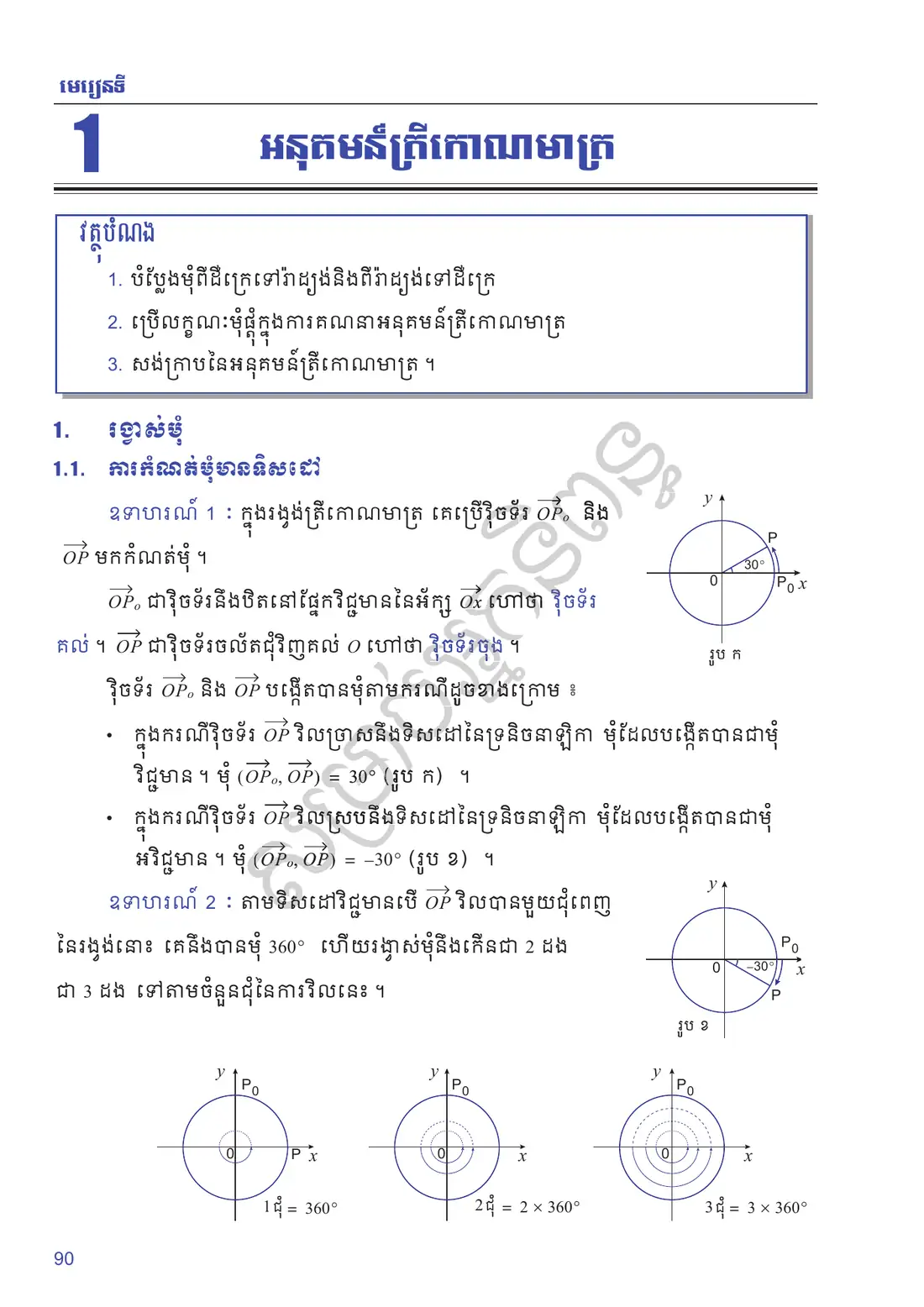
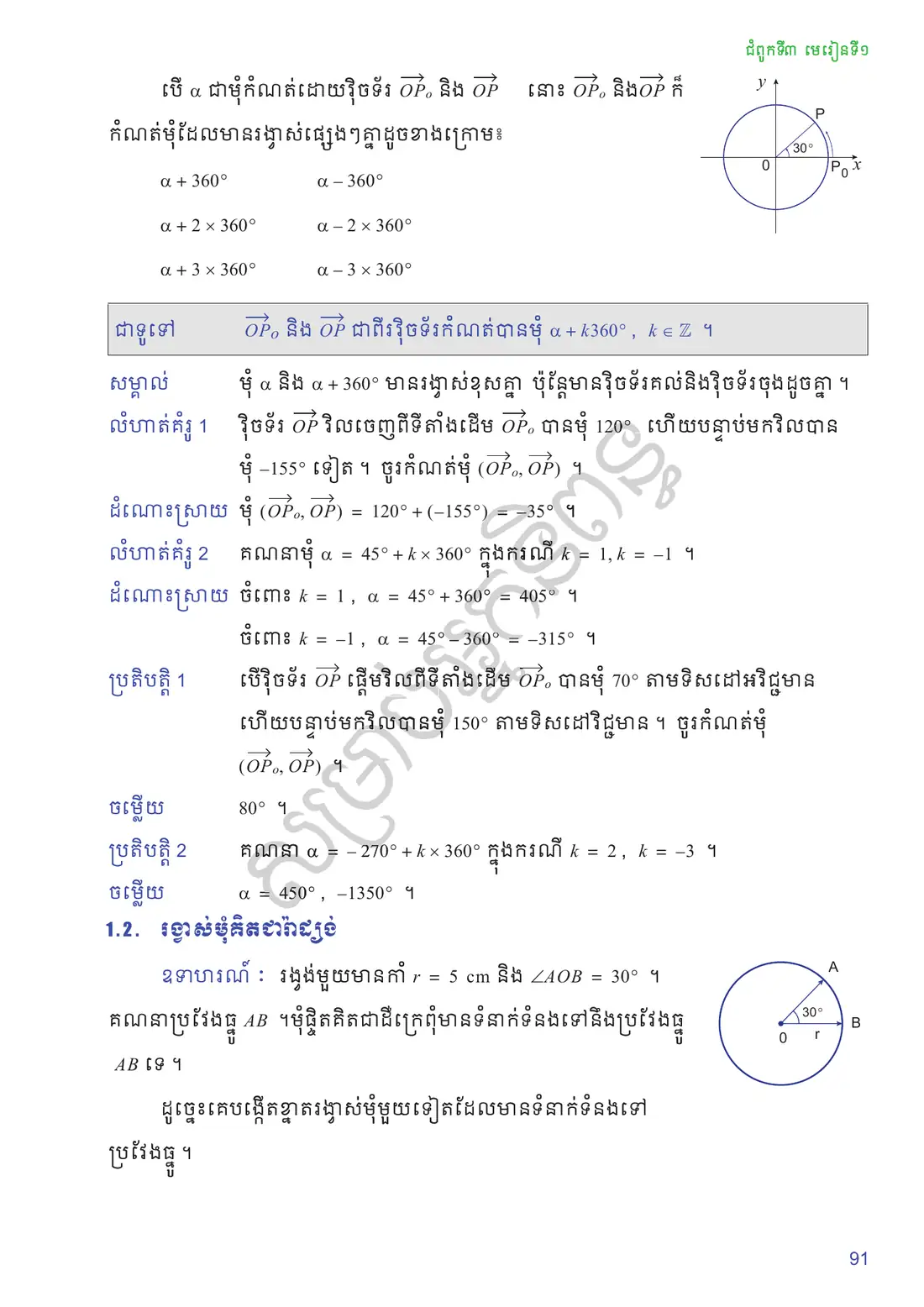
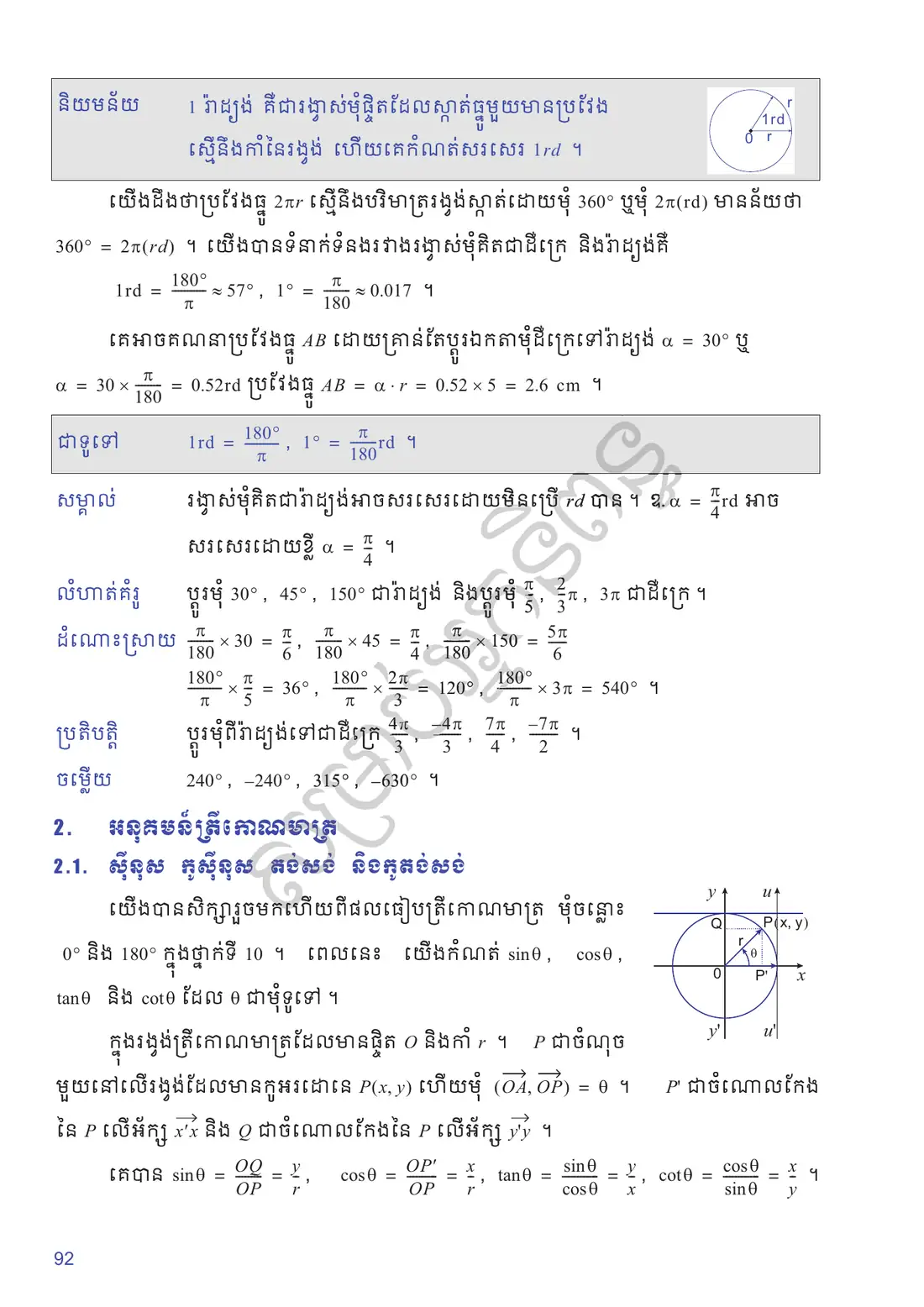
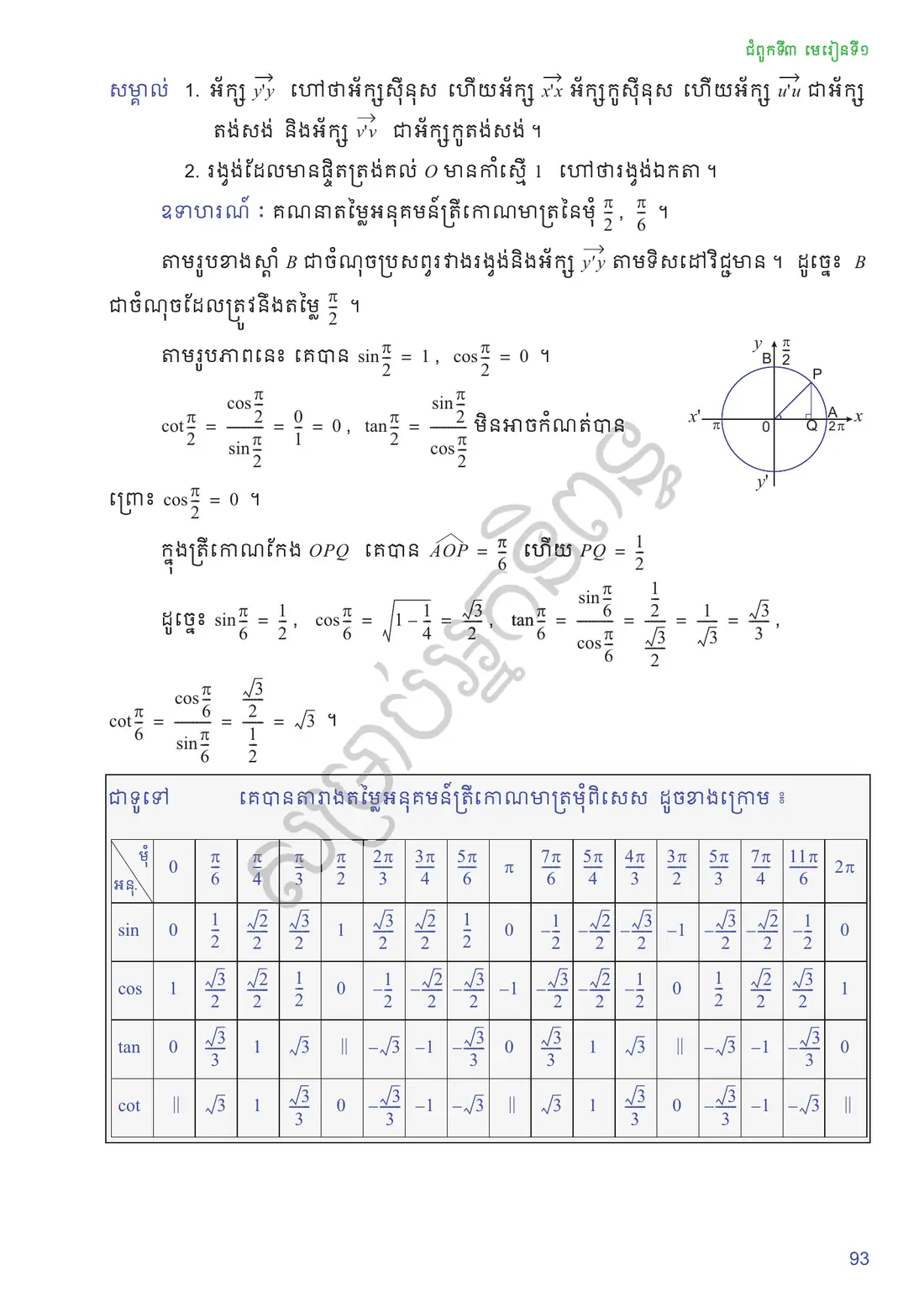
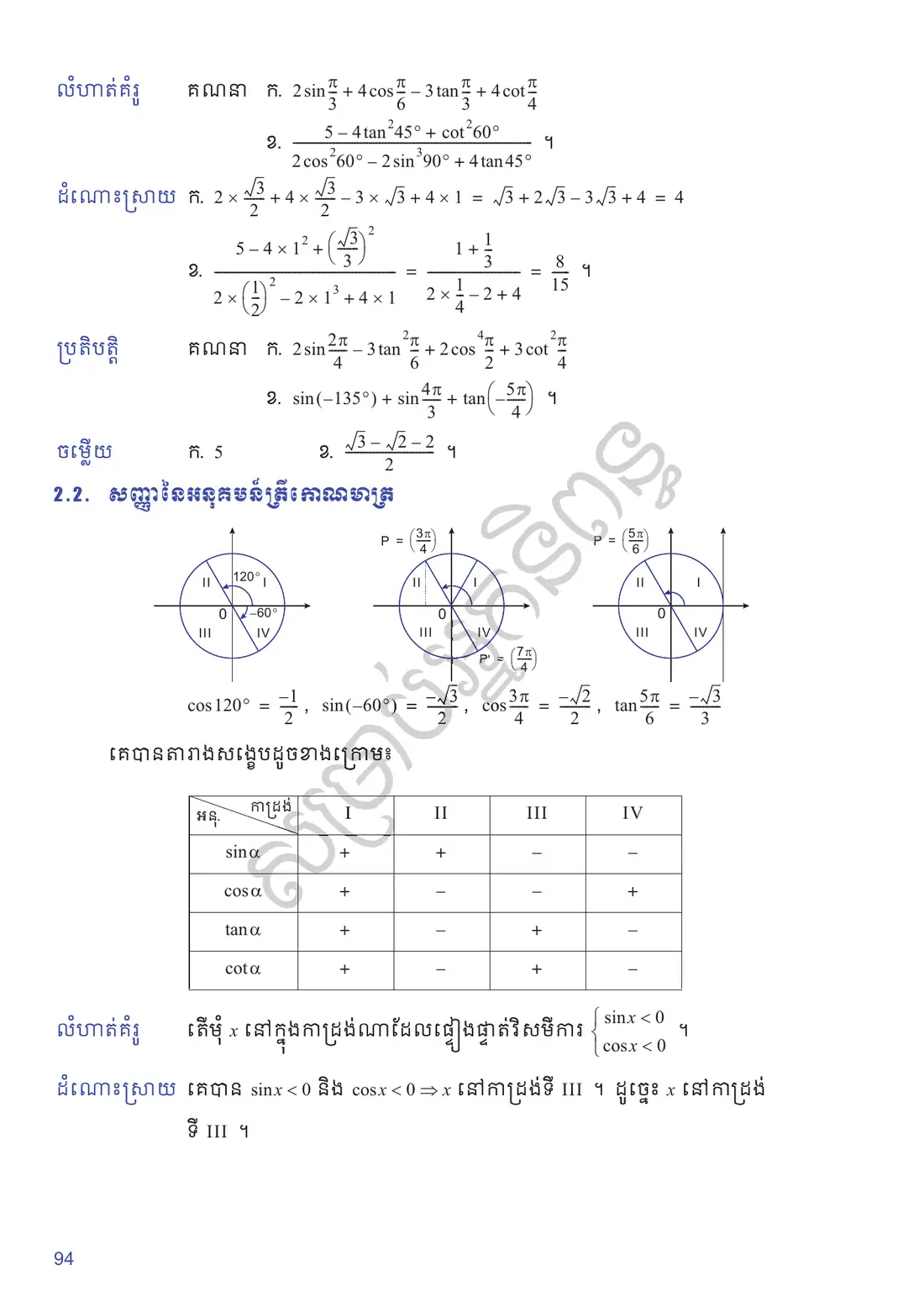
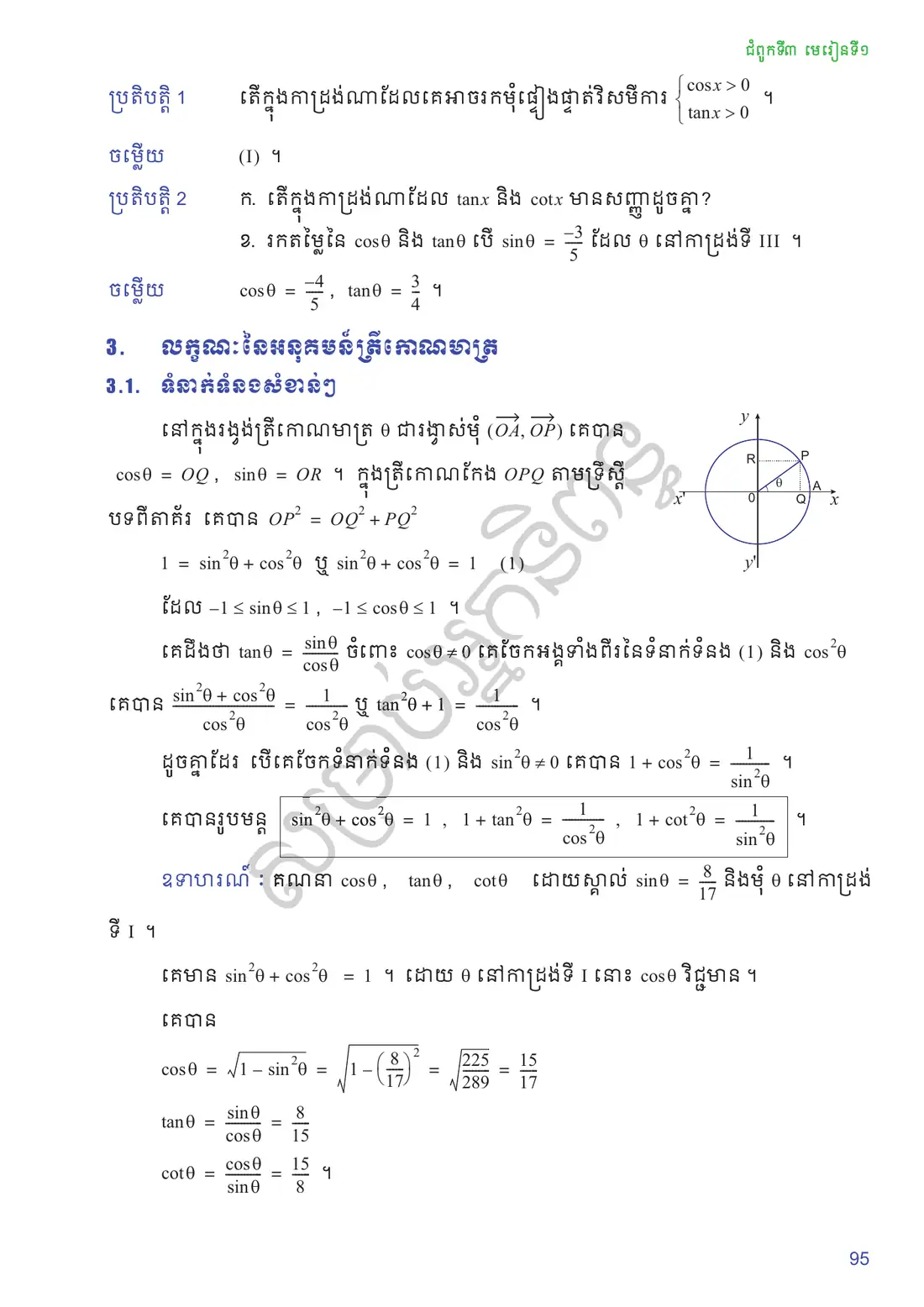
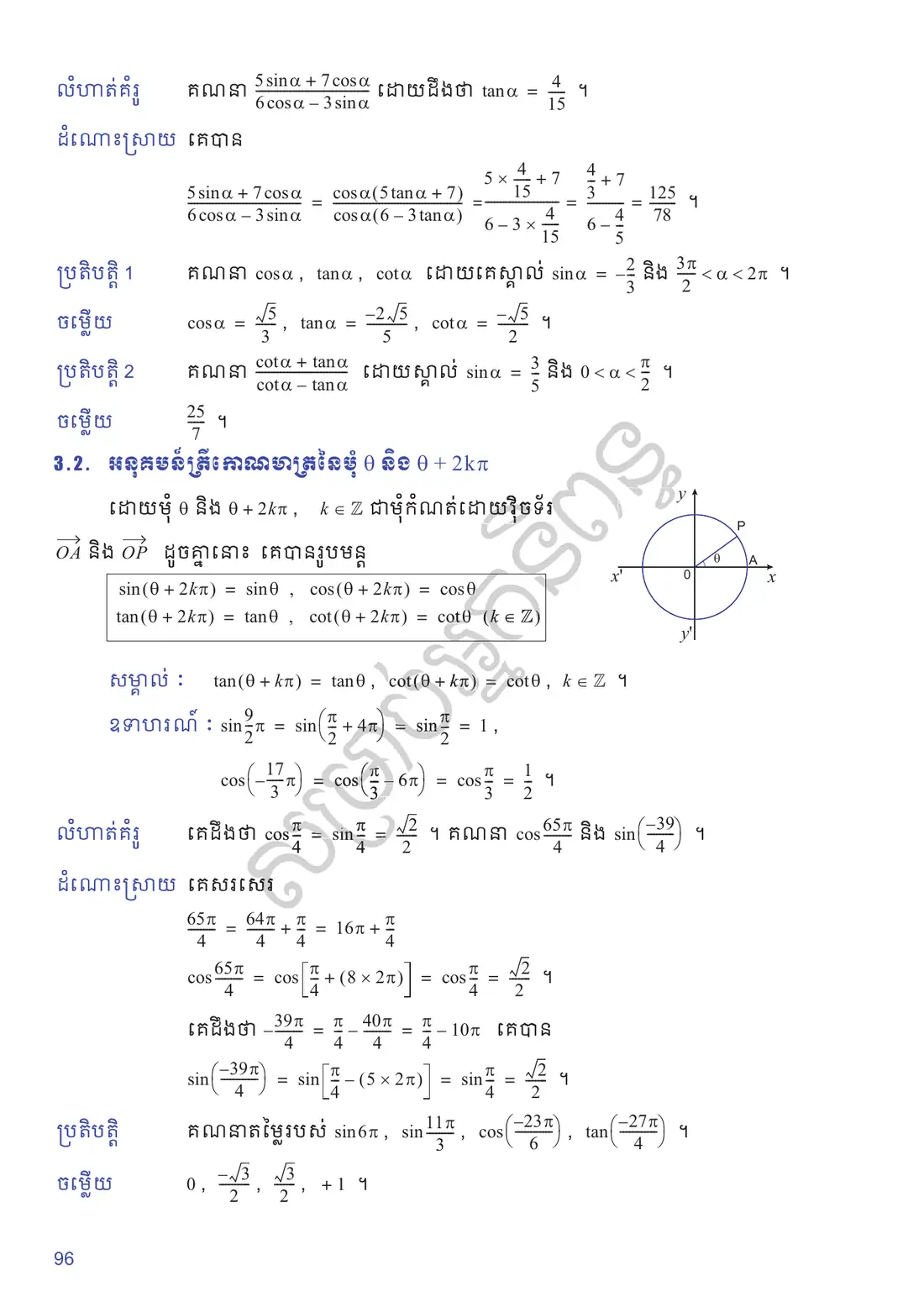
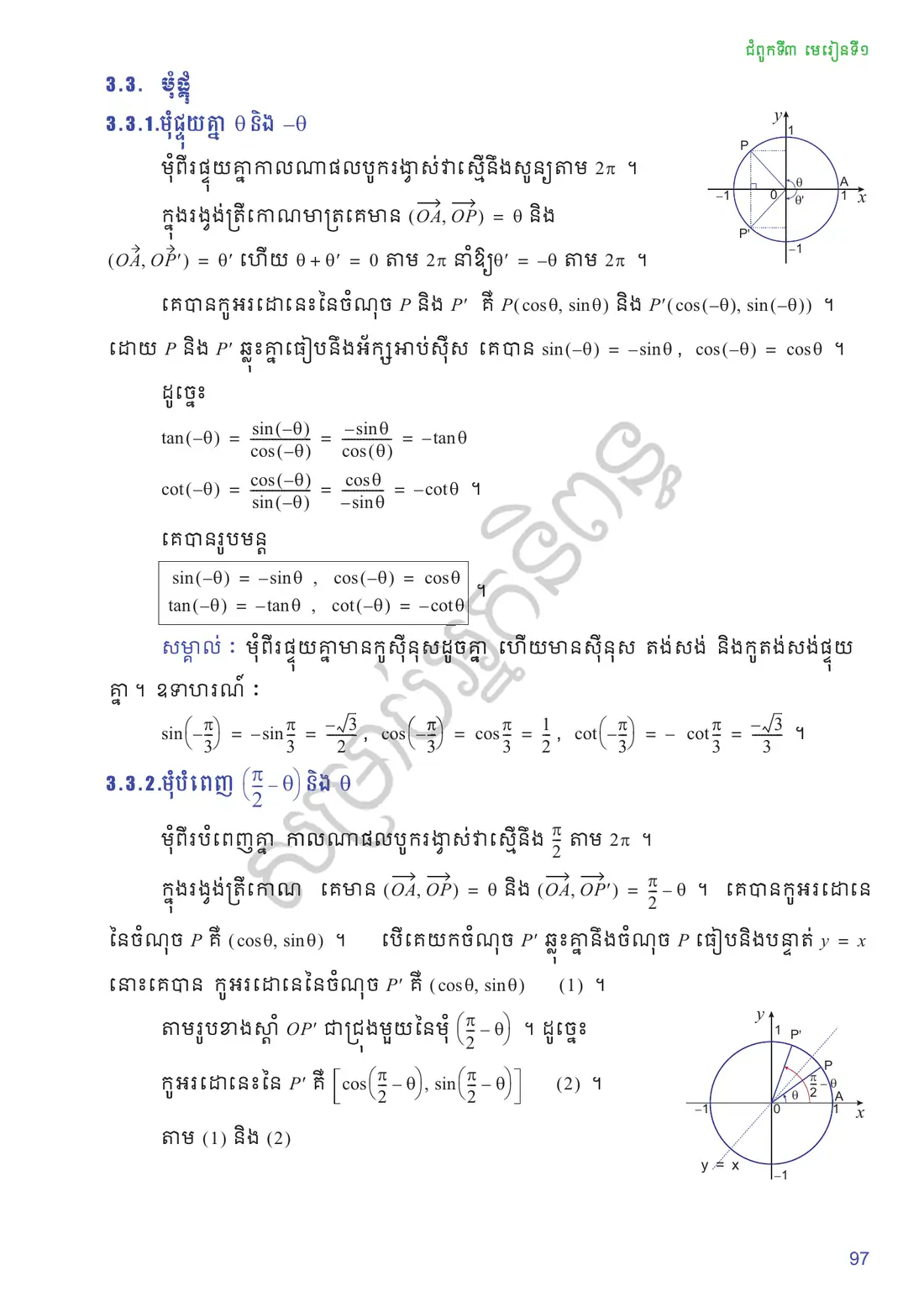
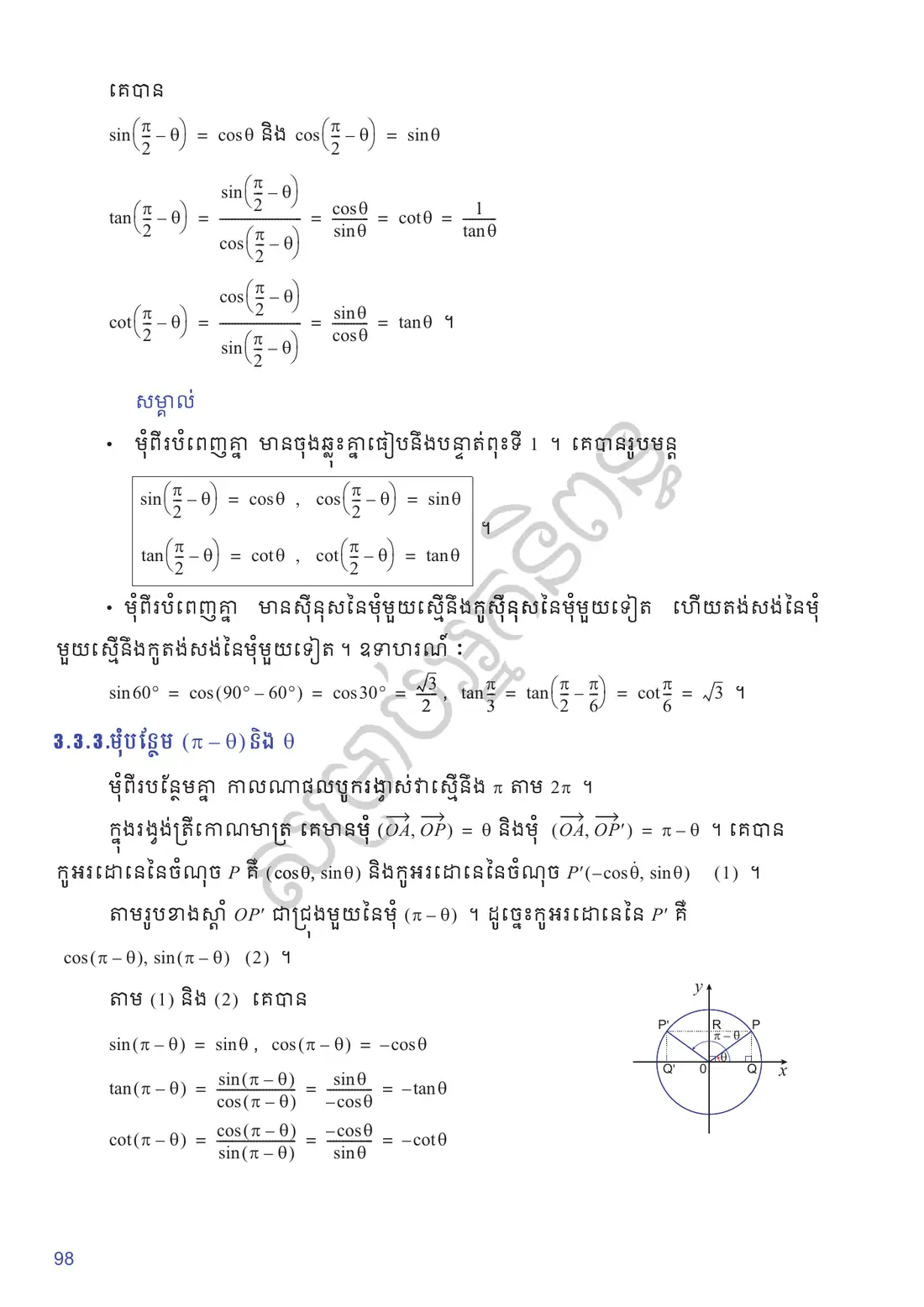
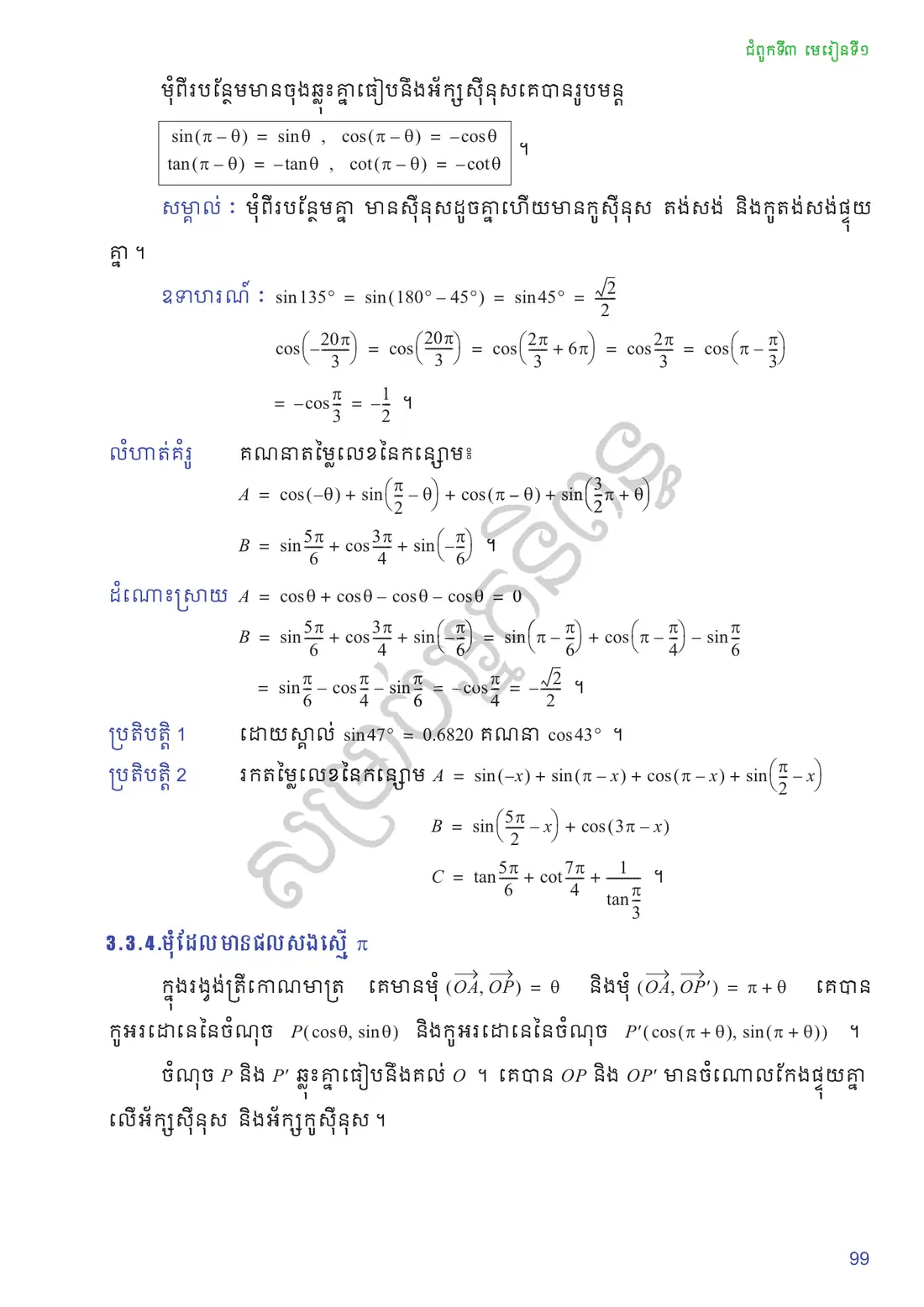
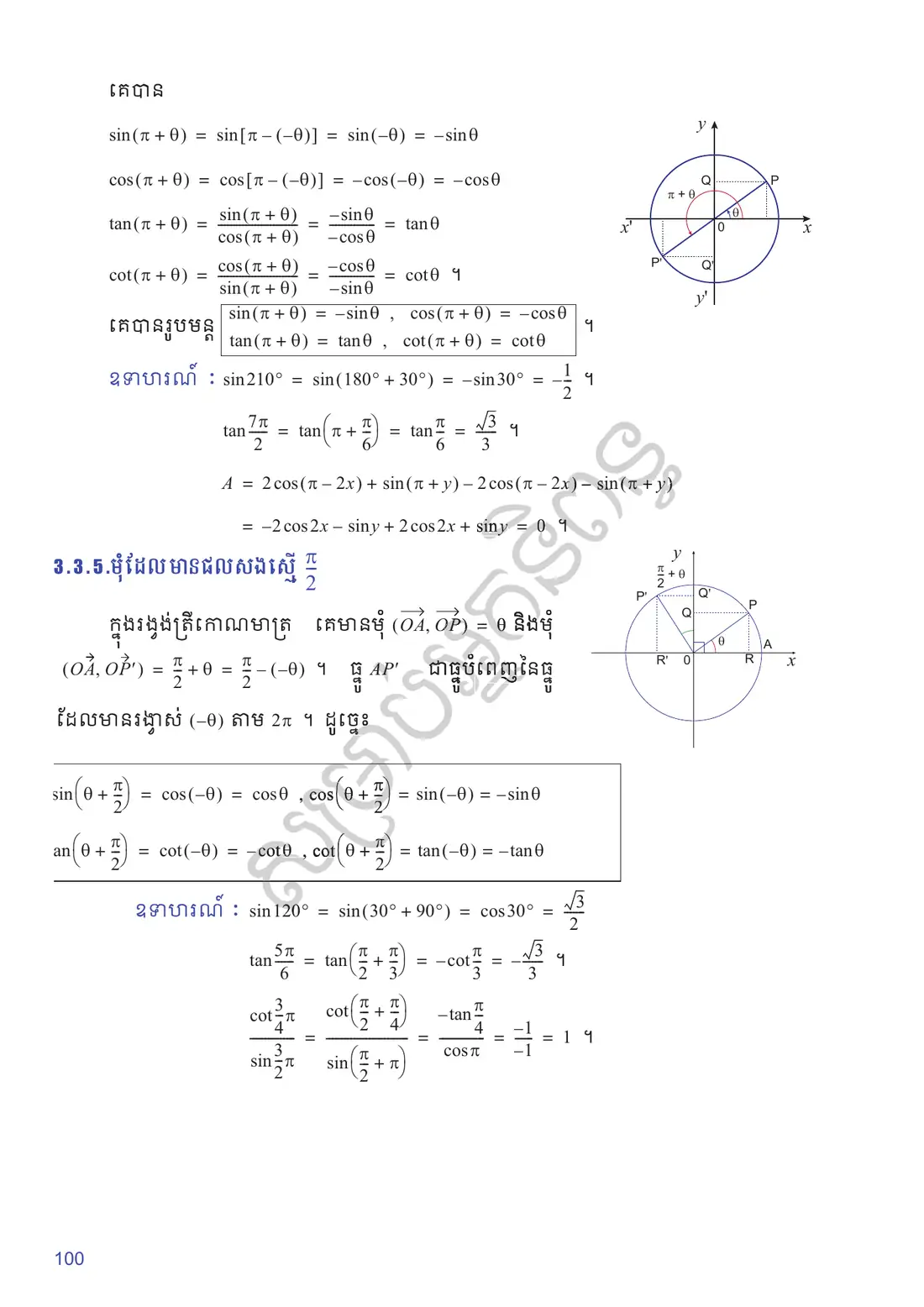
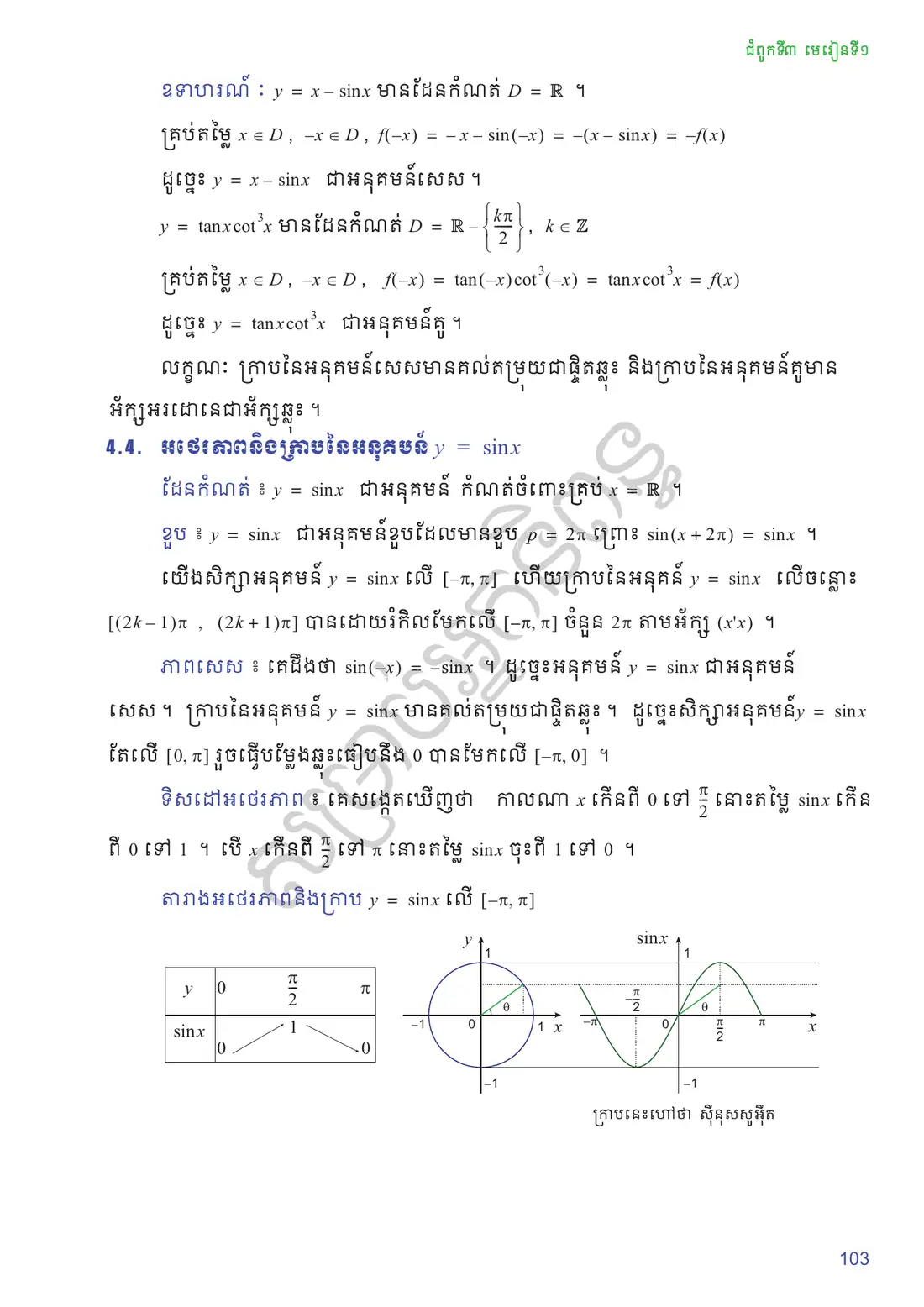
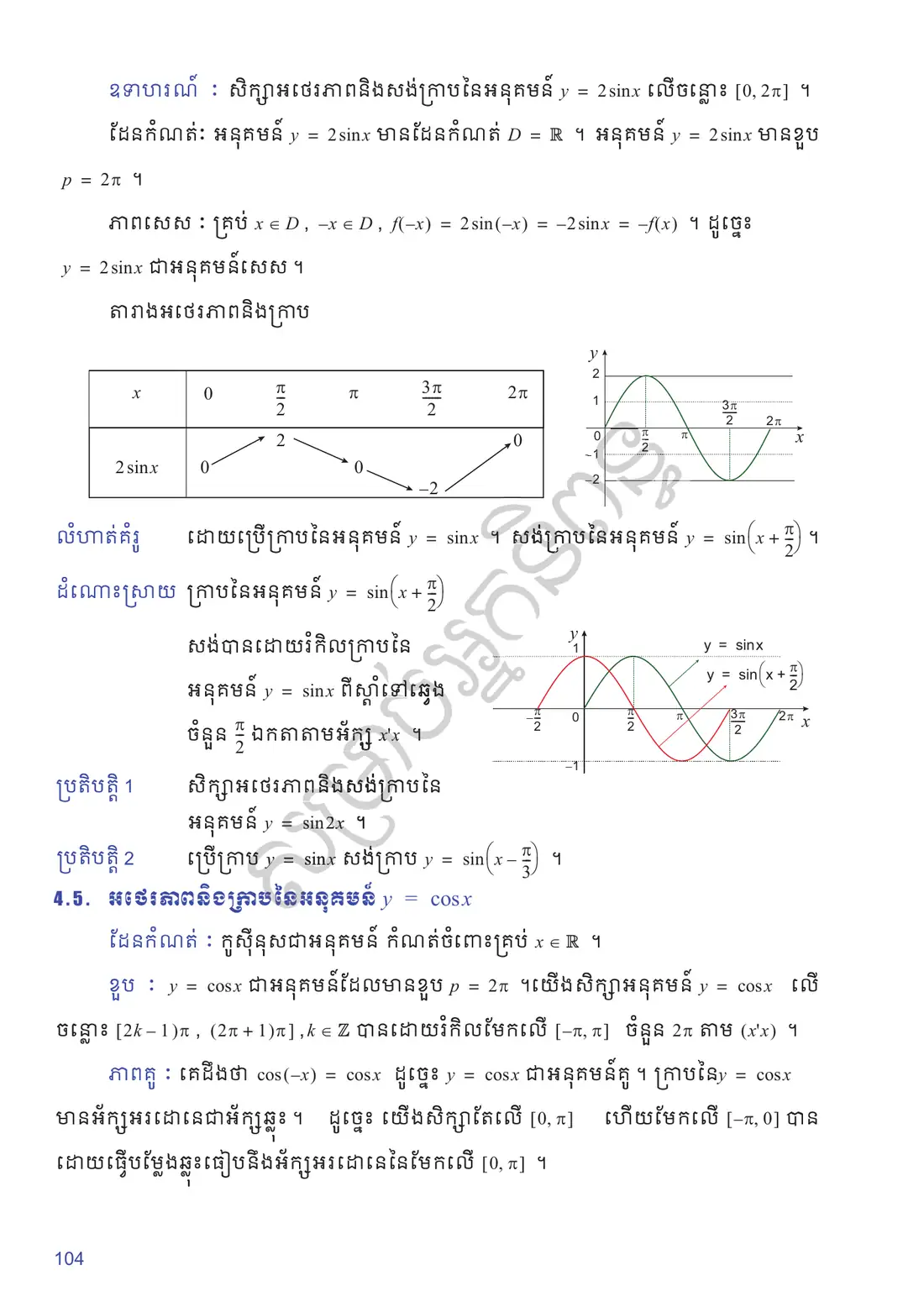
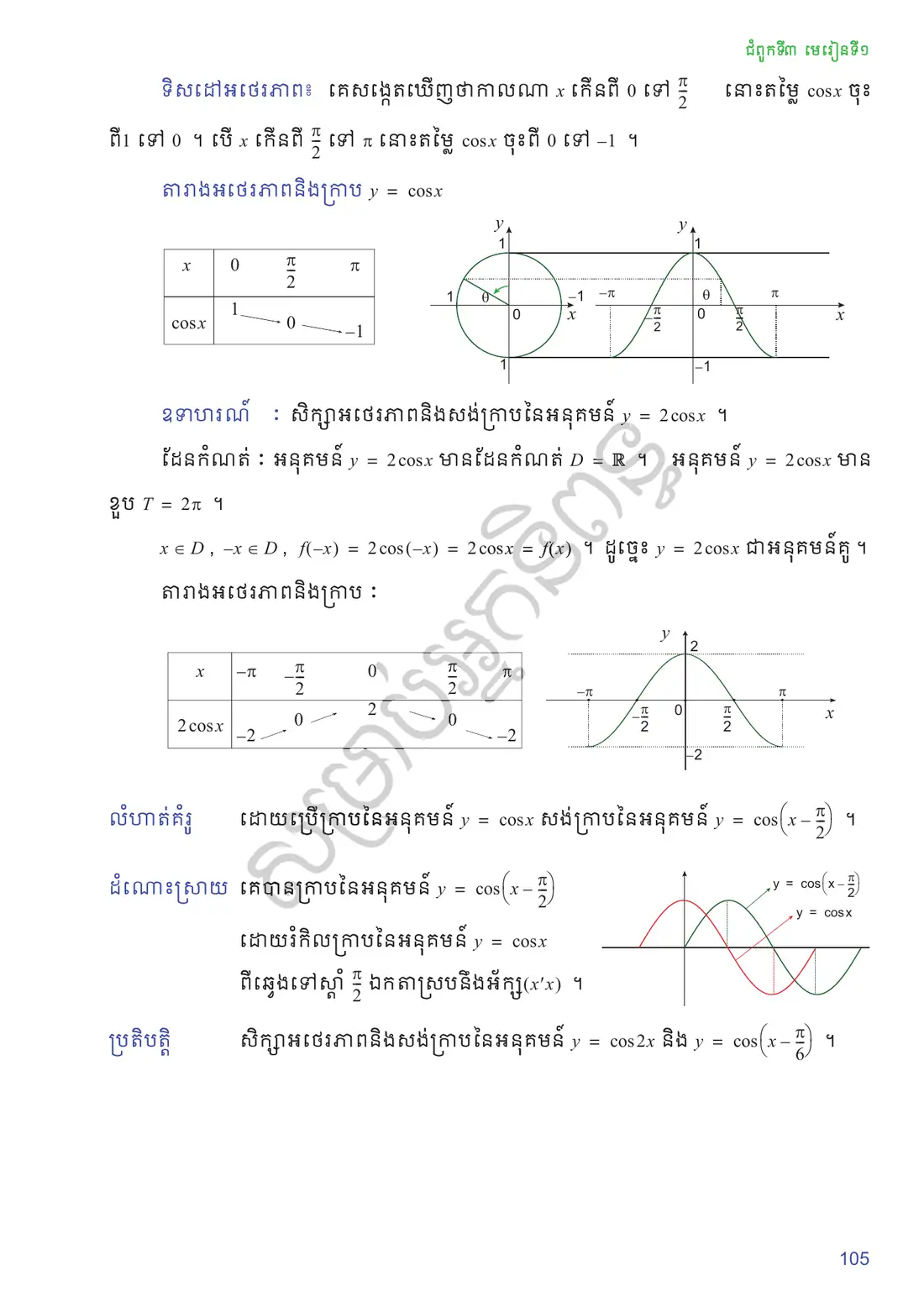
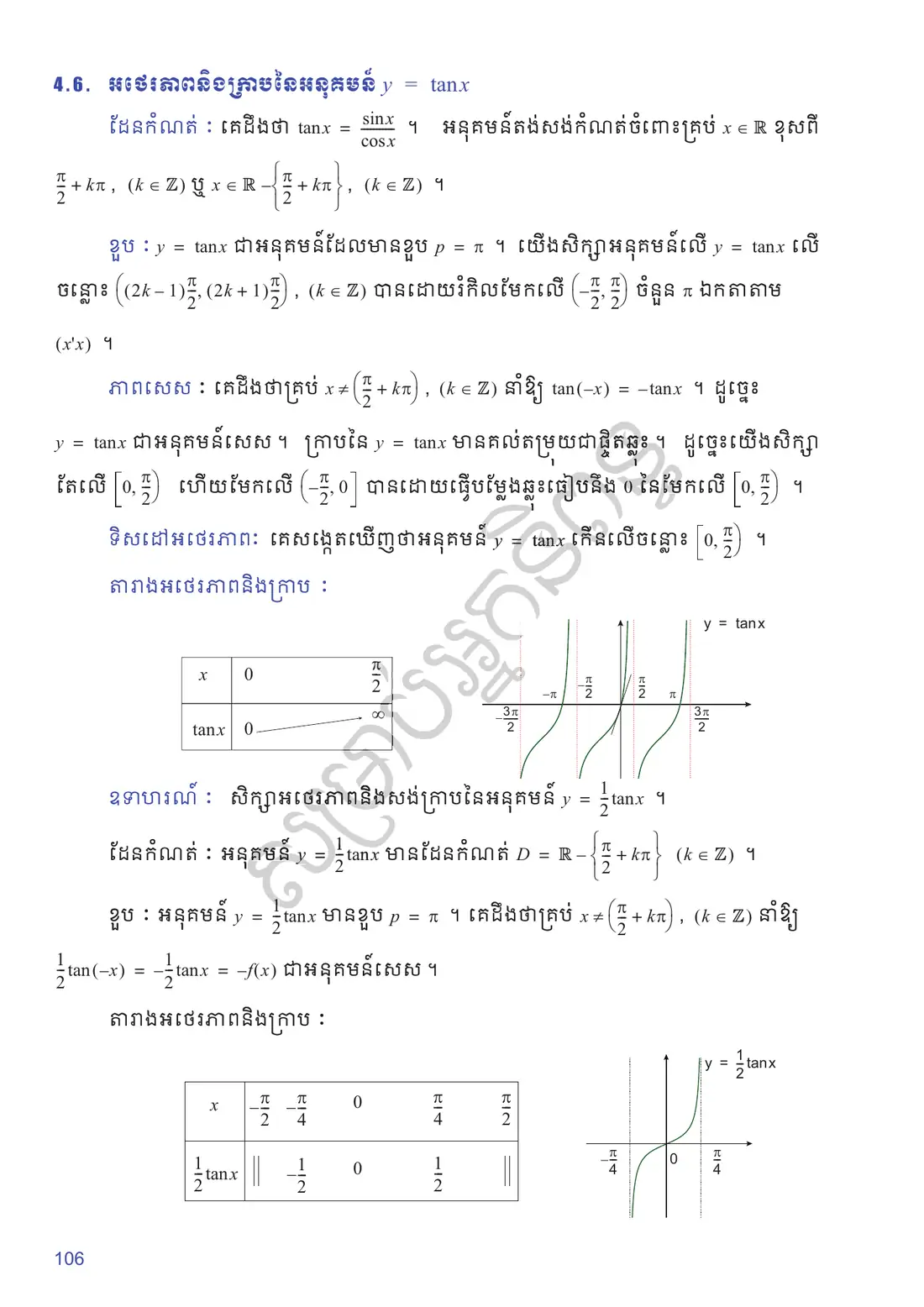
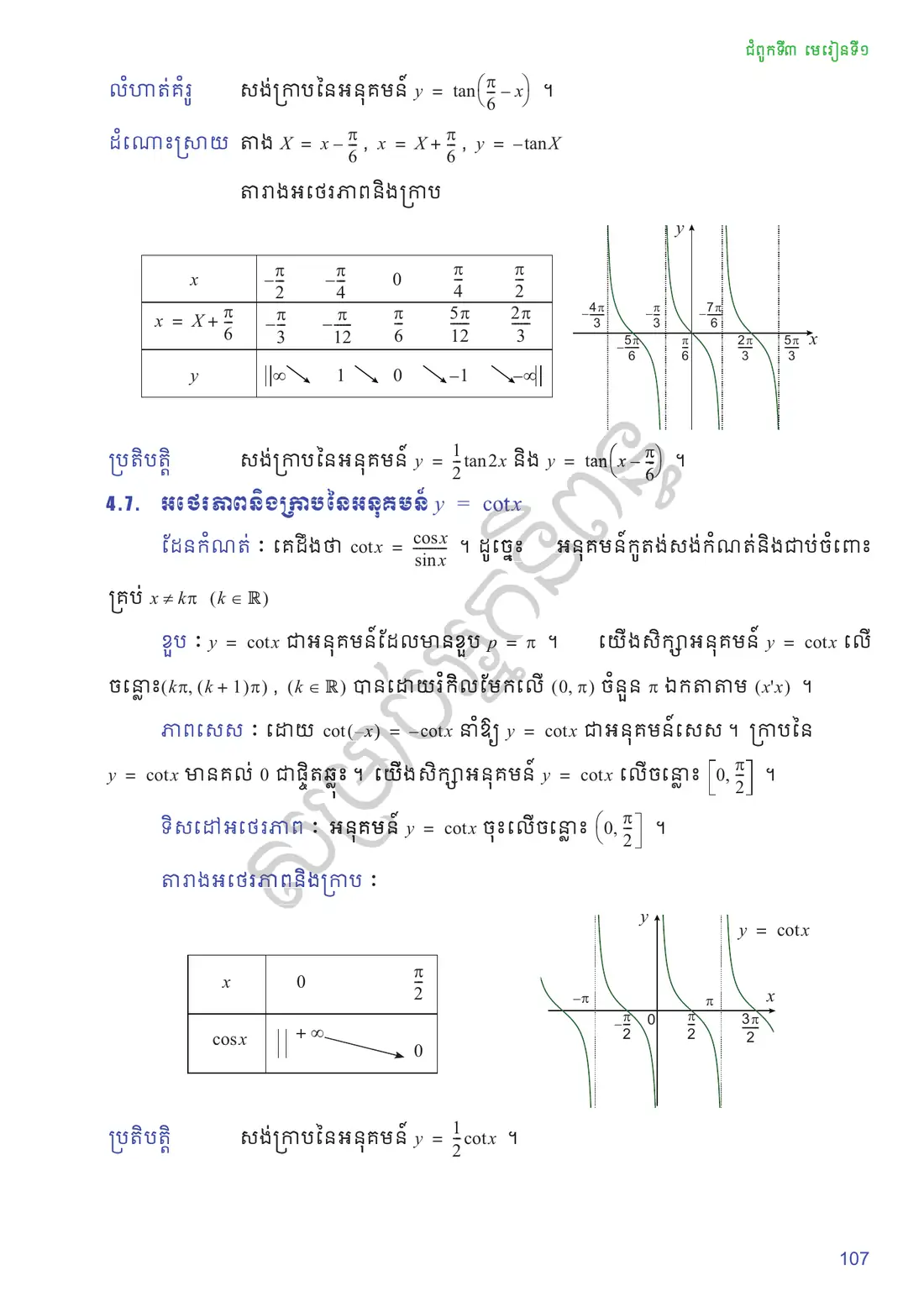
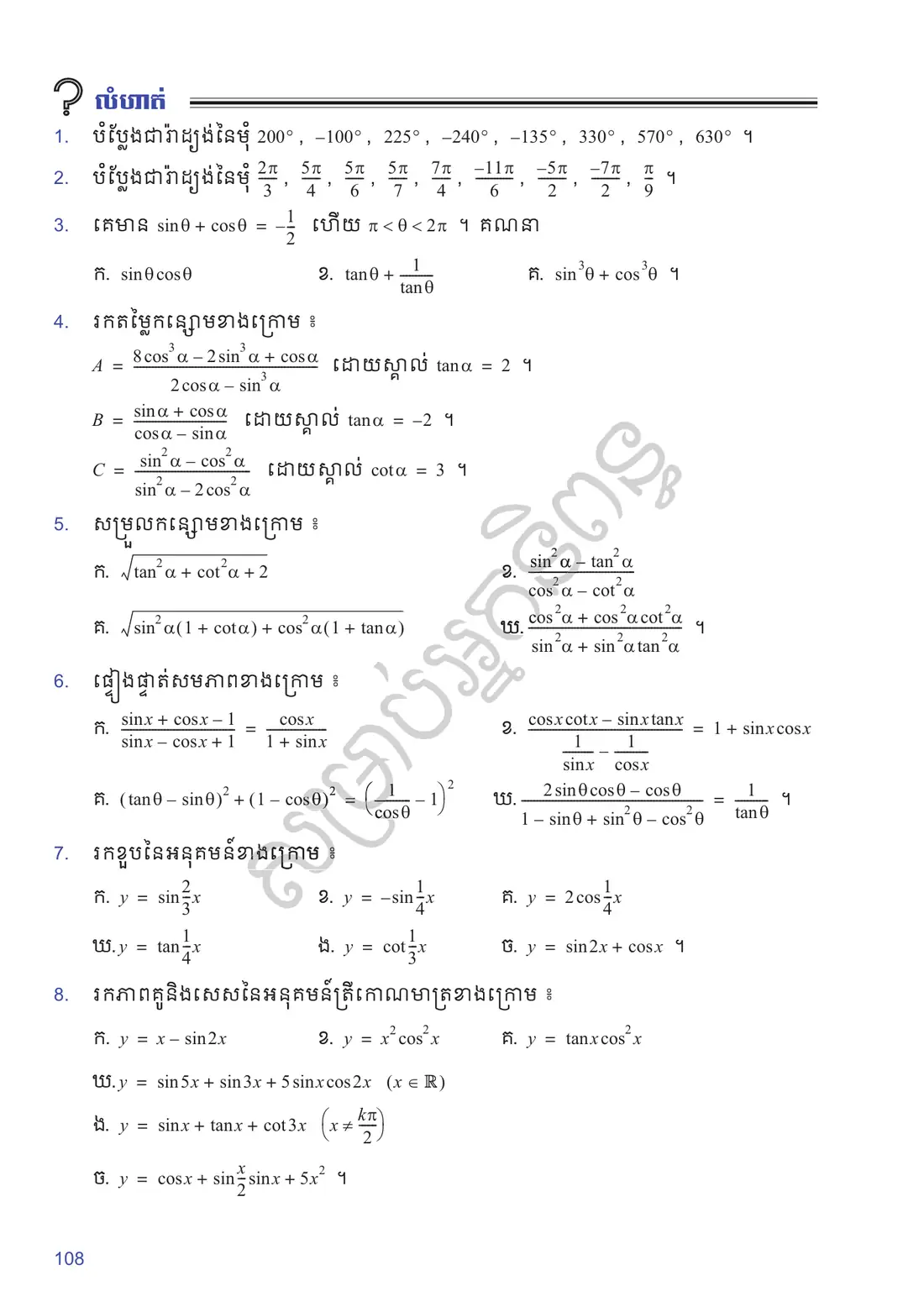
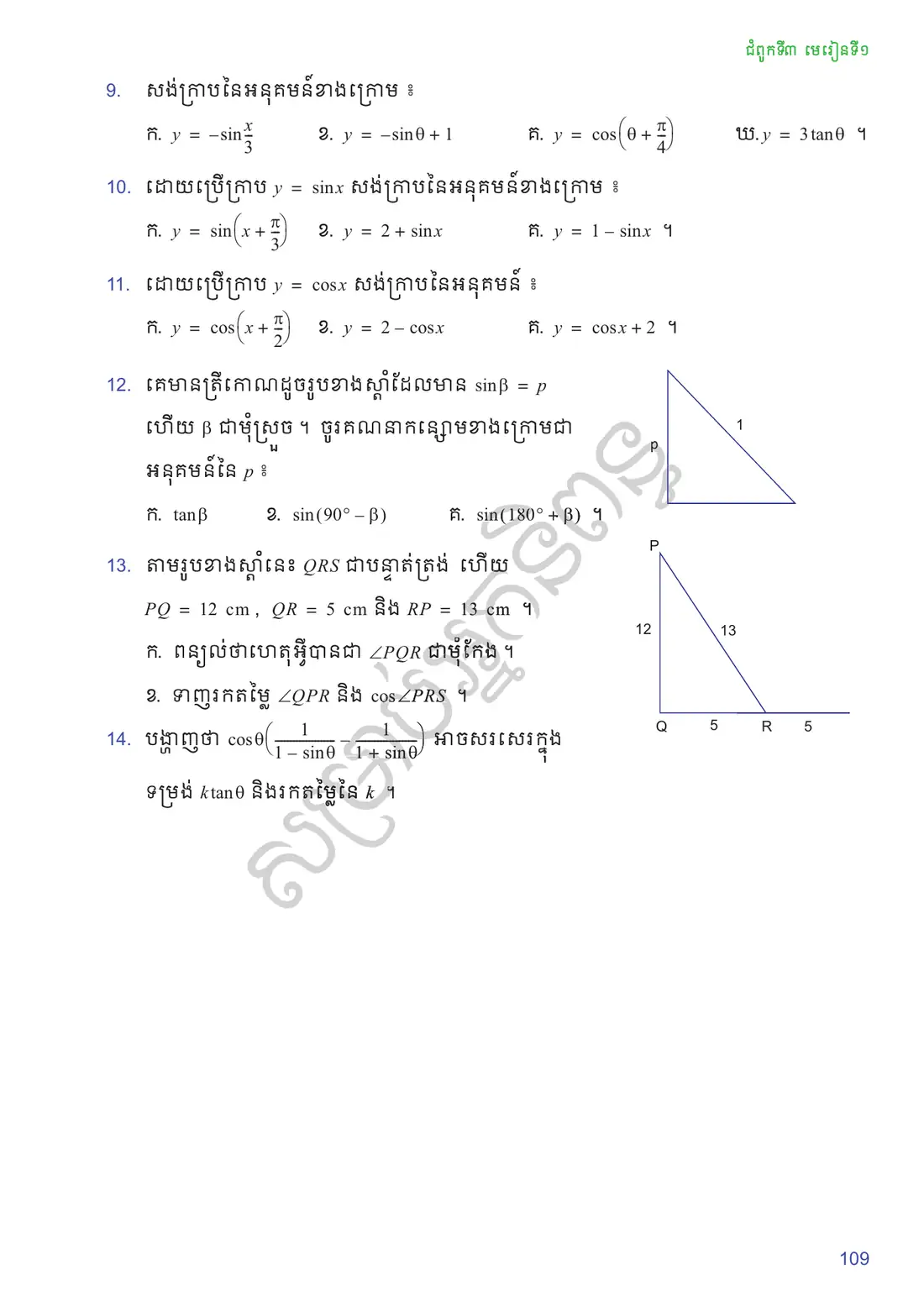
លំហាត់អនុវត្តន៍
បំប្លែងជារ៉ាដ្យង់នៃមុំ \(200^\circ\), \(-100^\circ\), \(225^\circ\), \(-240^\circ\), \(-135^\circ\), \(330^\circ\), \(570^\circ\), \(630^\circ\) ។
បំប្លែងជាដឺក្រេនៃមុំ \(\dfrac{2\pi}{3}\), \(\dfrac{5\pi}{4}\), \(\dfrac{5\pi}{6}\), \(\dfrac{5\pi}{7}\), \(\dfrac{7\pi}{4}\), \(-\dfrac{11\pi}{6}\), \(-\dfrac{5\pi}{2}\), \(-\dfrac{7\pi}{2}\), \(\dfrac{\pi}{9}\) ។
គេមាន \(\sin\theta + \cos\theta = -\dfrac{1}{2}\) ហើយ \(\pi < \theta < 2\pi\) ។ គណនា
\(\sin\theta\cos\theta\)
\(\tan\theta + \dfrac{1}{\tan\theta}\)
\(\sin^3\theta + \cos^3\theta\) ។
រកតម្លៃកន្សោមខាងក្រោម ៖
\(A = \dfrac{8\cos^3\alpha - 2\sin^3\alpha + \cos\alpha}{2\cos\alpha - \sin^3\alpha}\) ដោយស្គាល់ \(\tan\alpha = 2\) ។
\(B = \dfrac{\sin\alpha + \cos\alpha}{\cos\alpha - \sin\alpha}\) ដោយស្គាល់ \(\tan\alpha = -2\) ។
\(C = \dfrac{\sin^2\alpha - \cos^2\alpha}{\sin^2\alpha - 2\cos^2\alpha}\) ដោយស្គាល់ \(\cot\alpha = 3\) ។
សម្រួលកន្សោមខាងក្រោម ៖
\(\sqrt{\tan^2\alpha + \cot^2\alpha + 2}\)
\(\dfrac{\sin^2\alpha - \tan^2\alpha}{\cos^2\alpha - \cot^2\alpha}\)
\(\sqrt{\sin^2\alpha(1 + \cot\alpha) + \cos^2\alpha(1 + \tan\alpha)}\)
\(\dfrac{\cos^2\alpha + \cos^2\alpha\cot^2\alpha}{\sin^2\alpha + \sin^2\alpha\tan^2\alpha}\) ។
ផ្ទៀងផ្ទាត់សមភាពខាងក្រោម ៖
\(\dfrac{\sin x + \cos x - 1}{\sin x - \cos x + 1} = \dfrac{\cos x}{1 + \sin x}\)
\(\dfrac{\cos x\cot x - \sin x\tan x}{\frac{1}{\sin x} - \frac{1}{\cos x}} = 1 + \sin x\cos x\)
\((\tan\theta - \sin\theta)^2 + (1 - \cos\theta)^2 = \left(\dfrac{1}{\cos\theta} - 1\right)^2\)
\(\dfrac{2\sin\theta\cos\theta - \cos\theta}{1 - \sin\theta + \sin^2\theta - \cos^2\theta} = \dfrac{1}{\tan\theta}\) ។
រកខួបនៃអនុគមន៍ខាងក្រោម ៖
\(y = \sin\dfrac{2}{3}x\)
\(y = -\sin\dfrac{1}{4}x\)
\(y = 2\cos\dfrac{1}{4}x\)
\(y = \tan\dfrac{1}{4}x\)
\(y = \cot\dfrac{1}{3}x\)
\(y = \sin 2x + \cos x\) ។
រកភាពគូនិងសេសនៃអនុគមន៍ត្រីកោណមាត្រខាងក្រោម ៖
\(y = x - \sin 2x\)
\(y = x^2\cos^2 x\)
\(y = \tan x\cos^2 x\)
\(y = \sin 5x + \sin 3x + 5\sin x\cos 2x\) \((x \in \mathbb{R})\)
\(y = \sin x + \tan x + \cot 3x\) \(\left(x \ne \dfrac{k\pi}{2}\right)\)
\(y = \cos x + \sin\dfrac{x}{2}\sin x + 5x^2\) ។
សង់ក្រាបនៃអនុគមន៍ខាងក្រោម ៖
\(y = -\sin\dfrac{x}{3}\)
\(y = -\sin\theta + 1\)
\(y = \cos\left(\theta + \dfrac{\pi}{4}\right)\)
\(y = 3\tan\theta\) ។
ដោយប្រើក្រាប \(y = \sin x\) សង់ក្រាបនៃអនុគមន៍ខាងក្រោម ៖
\(y = \sin\left(x + \dfrac{\pi}{3}\right)\)
\(y = 2 + \sin x\)
\(y = 1 - \sin x\) ។
ដោយប្រើក្រាប \(y = \cos x\) សង់ក្រាបនៃអនុគមន៍ ៖
\(y = \cos\left(x + \dfrac{\pi}{2}\right)\)
\(y = 2 - \cos x\)
\(y = \cos x + 2\) ។
គេមានត្រីកោណកែងដែលមានអ៊ីប៉ូតេនុស \(1\) និងជ្រុងឈរមុំ \(\beta\) ស្មើ \(p\) ពោលគឺ \(\sin\beta = p\) ហើយ \(\beta\) ជាមុំស្រួច ។ ចូរគណនាកន្សោមខាងក្រោមជាអនុគមន៍នៃ \(p\) ៖
\(\tan\beta\)
\(\sin(90^\circ - \beta)\)
\(\sin(180^\circ + \beta)\) ។
គេមាន \(QRS\) ជាបន្ទាត់ត្រង់ ហើយ \(PQ = 12\) cm, \(QR = 5\) cm និង \(RP = 13\) cm (\(RS = 5\) cm) ។
%22 stroke-opacity=%221%22 stroke-miterlimit=%2210%22 d=%22M 0.00 -0.00 L 85.04 -0.00 %22 transform=%22matrix(0.99, 0, 0, -0.99, 19.70, 118.49)%22/%3E%3Cg fill=%22rgb(0%25, 0%25, 0%25)%22 fill-opacity=%221%22%3E%3Cuse xlink:href=%22%23glyph-0-0%22 x=%2215.78%22 y=%22128.96%22/%3E%3C/g%3E%3Cg fill=%22rgb(0%25, 0%25, 0%25)%22 fill-opacity=%221%22%3E%3Cuse xlink:href=%22%23glyph-0-1%22 x=%2258.22%22 y=%22128.96%22/%3E%3C/g%3E%3Cg fill=%22rgb(0%25, 0%25, 0%25)%22 fill-opacity=%221%22%3E%3Cuse xlink:href=%22%23glyph-0-2%22 x=%22101.03%22 y=%22128.96%22/%3E%3C/g%3E%3Cpath fill=%22none%22 stroke-width=%220.79%22 stroke-linecap=%22butt%22 stroke-linejoin=%22miter%22 stroke=%22rgb(0%25, 0%25, 0%25)%22 stroke-opacity=%221%22 stroke-miterlimit=%2210%22 d=%22M 0.00 -0.00 L 0.00 102.04 L 42.52 -0.00 %22 transform=%22matrix(0.99, 0, 0, -0.99, 19.70, 118.49)%22/%3E%3Cg fill=%22rgb(0%25, 0%25, 0%25)%22 fill-opacity=%221%22%3E%3Cuse xlink:href=%22%23glyph-0-3%22 x=%2215.83%22 y=%2213.19%22/%3E%3C/g%3E%3Cg fill=%22rgb(0%25, 0%25, 0%25)%22 fill-opacity=%221%22%3E%3Cuse xlink:href=%22%23glyph-1-0%22 x=%226.28%22 y=%2270.89%22/%3E%3Cuse xlink:href=%22%23glyph-1-1%22 x=%2211.23%22 y=%2270.89%22/%3E%3C/g%3E%3Cg fill=%22rgb(0%25, 0%25, 0%25)%22 fill-opacity=%221%22%3E%3Cuse xlink:href=%22%23glyph-1-0%22 x=%2244.37%22 y=%2266.65%22/%3E%3Cuse xlink:href=%22%23glyph-1-2%22 x=%2249.32%22 y=%2266.65%22/%3E%3C/g%3E%3Cg fill=%22rgb(0%25, 0%25, 0%25)%22 fill-opacity=%221%22%3E%3Cuse xlink:href=%22%23glyph-1-3%22 x=%2238.38%22 y=%22128.38%22/%3E%3C/g%3E%3Cg fill=%22rgb(0%25, 0%25, 0%25)%22 fill-opacity=%221%22%3E%3Cuse xlink:href=%22%23glyph-1-3%22 x=%2280.71%22 y=%22130.07%22/%3E%3C/g%3E%3C/svg%3E%0A)
ពន្យល់ថាហេតុអ្វីបានជា \(\angle PQR\) ជាមុំកែង ។
ទាញរកតម្លៃ \(\angle QPR\) និង \(\cos\angle PRS\) ។
បង្ហាញថា \(\cos\theta\left(\dfrac{1}{1 - \sin\theta} - \dfrac{1}{1 + \sin\theta}\right)\) អាចសរសេរក្នុងទម្រង់ \(k\tan\theta\) និងរកតម្លៃនៃ \(k\) ។
សំណួរពហុជ្រើសរើស
ជ្រើសរើសចម្លើយត្រឹមត្រូវតែមួយ រួចចុច «ពិនិត្យ»។ ចម្លើយរបស់អ្នកត្រូវបានរក្សាទុកក្នុងកុំព្យូទ័រនេះ។
✎ សំណួរទី ១–១០
✎ សំណួរទី ១១–២០
តេស្តសមត្ថភាព ៖ មេរៀនទី ៩ អនុគមន៍ត្រីកោណមាត្រ (វិទ្យាសាស្ត្រ) — ២០ សំណួរ · ៣៥ នាទី